


Page 1775 - Williams Hematology ( PDFDrive )
P. 1775
1750           Part XI:  Malignant Lymphoid Diseases                                                                                                                                             Chapter 107:  Myeloma           1751


                                                                          High-dose chemoradiotherapy followed by transplantation of
                                                                      either autologous marrow or PBPCs has achieved high (40 percent) com-
                                                                      plete response (CR) rates, but the median duration of these responses
                                                                      has been only 2 to 3 years. The Intergroupe Francais du Myelome (IFM
                                                                      90), a national French study, first demonstrated the efficacy of auto-
                                                                      HSCT over conventional chemotherapy in 200 myeloma patients.
                                                                                                                       399
                                                                      Several randomized trials and case-controlled studies have been per-
                                                                      formed and the results have been variable. For example, the Medical
                                                                      Research Council (MRC) randomized study confirmed a 12-month
                                                                                                    408
                                                                      survival benefit for the transplanted arm.  In contrast, the U.S. Inter-
                                                                      group randomized trial was unable to confirm the benefits of transplan-
                                                                           409
                                                                      tation.  Despite the use of aggressive approaches like transplantation,
                                                                      few, if any, patients are cured. To improve upon the results of high-dose
                                                                      chemotherapy,  the  French  group  has  compared  single  versus  double
                  A                       B                           autografts and their data suggest that two sequential transplants may
                                                                      benefit a subset of patients with myeloma who did not achieve a com-
                                                                                                   410
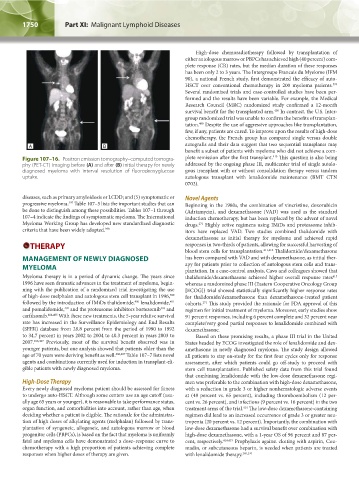
               Figure 107–16.  Positron emission tomography–computed tomogra-  plete remission after the first transplant.  This question is also being
               phy (PET-CT) imaging before (A) and after (B) initial therapy for newly   addressed by the ongoing phase III, multicenter trial of single autolo-
               diagnosed myeloma with interval resolution of fluorodeoxyglucose   gous transplant with or without consolidation therapy versus tandem
               uptake.                                                autologous transplant with lenalidomide maintenance (BMT CTN
                                                                      0702).

               diseases, such as primary amyloidosis or LCDD; and (5) symptomatic or   Novel Agents
               progressive myeloma.  Table  107–5 lists the important studies that can   Beginning in the 1980s, the combination of vincristine, doxorubicin
                               397
               be done to distinguish among these possibilities. Tables  107–1 through   (Adriamycin), and dexamethasone (VAD) was used as the standard
               107–4 indicate the findings of symptomatic myeloma. The International   induction chemotherapy, but has been replaced by the advent of novel
               Myeloma Working Group has developed new standardized diagnostic   drugs.  Highly active regimens using IMiDs and proteasome inhib-
                                                                           271
               criteria that have been widely adopted. 398            itors have replaced VAD. Two studies combined thalidomide with
                                                                      dexamethasone as initial therapy for myeloma and achieved rapid
                  THERAPY                                             responses in two-thirds of patients, allowing for successful harvesting of
                                                                      blood stem cells for transplantation. 411,412  Thalidomide/dexamethasone
               MANAGEMENT OF NEWLY DIAGNOSED                          has been compared with VAD and with dexamethasone, as initial ther-
               MYELOMA                                                apy for patients prior to collection of autologous stem cells and trans-
                                                                      plantation. In a case-control analysis, Cavo and colleagues showed that
               Myeloma therapy is in a period of dynamic change. The years since   thalidomide/dexamethasone achieved higher overall response rates
                                                                                                                       413
               1996 have seen dramatic advances in the treatment of myeloma, begin-  whereas a randomized phase III (Eastern Cooperative Oncology Group
               ning with the publication of a randomized trial investigating the use   [ECOG]) trial showed statistically significantly higher response rates
               of high-dose melphalan and autologous stem cell transplant in 1996,    for thalidomide/dexamethasone than dexamethasone-treated patient
                                                                 399
               followed by the introduction of IMiDs thalidomide,  lenalidomide,    cohorts.  This study provided the rationale for FDA approval of this
                                                                 401
                                                     400
                                                                            271
               and pomalidomide,  and the proteasome inhibitors bortezomib  and   regimen for initial treatment of myeloma. Moreover, early studies show
                                                              403
                             402
               carfilzomib. 404,405  With these new treatments, the 5-year relative survival   91 percent responses, including 6 percent complete and 32 percent near
               rate has increased in the Surveillance Epidemiology and End Results   complete/very good partial responses to lenalidomide combined with
               (SEER) database from 28.8 percent from the period of 1990 to 1992   dexamethasone.
               to 34.7 percent in years 2002 to 2004 to 40.3 percent in years 2003 to   Based on these promising results, a phase III trial in the United
               2007. 406,407  Previously, most of the survival benefit observed was in   States headed by ECOG investigated the role of lenalidomide and dex-
               younger patients, but one analysis showed that patients older than the   amethasone in newly diagnosed myeloma. The study design allowed
               age of 70 years were deriving benefit as well. 406,407  Table  107–7 lists novel   all patients to stay on-study for the first four cycles only for response
               agents and combinations currently used for induction in transplant-eli-  assessment, after which patients could go off-study to proceed with
               gible patients with newly diagnosed myeloma.           stem cell transplantation. Published safety data from this trial found
                                                                      that combining lenalidomide with the low-dose dexamethasone regi-
               High-Dose Therapy                                      men was preferable to the combination with high-dose dexamethasone,
               Every newly diagnosed myeloma patient should be assessed for fitness   with a reduction in grade 3 or higher nonhematologic adverse events
               to undergo auto-HSCT. Although some centers use an age cutoff (usu-  at  (48  percent  vs.  65  percent),  including  thromboembolism  (12  per-
               ally age 65 years or younger), it is reasonable to take performance status,   cent vs. 26 percent), and infections (9 percent vs. 16 percent) in the two
               organ function, and comorbidities into account, rather than age, when   treatment arms of the trial.  The low-dose dexamethasone-containing
                                                                                         414
               deciding whether a patient is eligible. The rationale for the administra-  regimen did lead to an increased occurrence of grade 3 or greater neu-
               tion of high doses of alkylating agents (melphalan) followed by trans-  tropenia (20 percent vs. 12 percent). Importantly, the combination with
               plantation of syngeneic, allogeneic, and autologous marrow or blood   low-dose dexamethasone had a survival benefit over combination with
               progenitor cells (PBPCs), is based on the fact that myeloma is uniformly   high-dose dexamethasone, with a 1-year OS of 96 percent and 87 per-
               fatal and myeloma cells have demonstrated a dose–response curve to   cent, respectively. 414,415  Prophylaxis against clotting with aspirin, Cou-
               chemotherapy with a high proportion of patients achieving complete   madin, or subcutaneous heparin, is needed when patients are treated
               responses when higher doses of therapy are given.      with lenalidomide therapy. 269,270


          Kaushansky_chapter 107_p1733-1772.indd   1750                                                                 9/21/15   12:35 PM

