


Page 1774 - Williams Hematology ( PDFDrive )
P. 1774
1748  Part XI:  Malignant Lymphoid Diseases                                         Chapter 107:  Myeloma            1749


                                   B                                      C

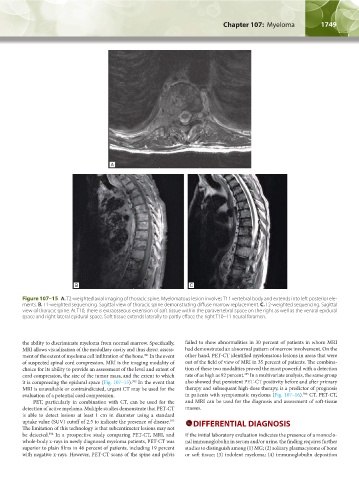
                  Figure 107–15  A. T2-weighted axial imaging of thoracic spine. Myelomatous lesion involves T11 vertebral body and extends into left posterior ele-
                  ments. B. T1-weighted sequencing. Sagittal view of thoracic spine demonstrating diffuse marrow replacement. C. T2-weighted sequencing. Sagittal
                  view of thoracic spine. At T10, there is extraosseous extension of soft tissue within the paravertebral space on the right as well as the ventral epidural
                  space and right lateral epidural space. Soft tissue extends laterally to partly efface the right T10–11 neural foramen.


                  the ability to discriminate myeloma from normal marrow. Specifically,   failed to show abnormalities in 30 percent of patients in whom MRI
                  MRI allows visualization of the medullary cavity and thus direct assess-  had demonstrated an abnormal pattern of marrow involvement. On the
                                                           391
                  ment of the extent of myeloma cell infiltration of the bone.  In the event   other hand, PET-CT identified myelomatous lesions in areas that were
                  of suspected spinal cord compression, MRI is the imaging modality of   out of the field of view of MRI in 35 percent of patients. The combina-
                  choice for its ability to provide an assessment of the level and extent of   tion of these two modalities proved the most powerful with a detection
                                                                                            395
                  cord compression, the size of the tumor mass, and the extent to which   rate of as high as 92 percent.  In a multivariate analysis, the same group
                  it is compressing the epidural space (Fig. 107–15).  In the event that   also showed that persistent PET-CT positivity before and after primary
                                                       392
                  MRI is unavailable or contraindicated, urgent CT may be used for the   therapy and subsequent high-dose therapy, is a predictor of prognosis
                                                                                                                396
                  evaluation of a potential cord compression.           in patients with symptomatic myeloma (Fig. 107–16).  CT, PET-CT,
                     PET, particularly in combination with CT, can be used for the   and MRI can be used for the diagnosis and assessment of soft-tissue
                  detection of active myeloma. Multiple studies demonstrate that PET-CT   masses.
                  is able to detect lesions at least 1 cm in diameter using a standard
                  uptake value (SUV) cutoff of 2.5 to indicate the presence of disease.    DIFFERENTIAL DIAGNOSIS
                                                                   393
                  The limitation of this technology is that subcentimeter lesions may not
                  be  detected.   In  a  prospective  study  comparing  PET-CT,  MRI,  and   If the initial laboratory evaluation indicates the presence of a monoclo-
                           394
                  whole-body x-rays in newly diagnosed myeloma patients, PET-CT was   nal immunoglobulin in serum and/or urine, the finding requires further
                  superior to plain films in 46 percent of patients, including 19 percent   studies to distinguish among (1) MG; (2) solitary plasmacytoma of bone
                  with negative x-rays. However, PET-CT scans of the spine and pelvis   or soft tissue; (3) indolent myeloma; (4) immunoglobulin deposition


          Kaushansky_chapter 107_p1733-1772.indd   1749                                                                 9/21/15   12:35 PM

