


Page 1882 - Williams Hematology ( PDFDrive )
P. 1882
1856  Part XII:  Hemostasis and Thrombosis   Chapter 112:  Platelet Morphology, Biochemistry, and Function           1857


                                                Membrane
                                               phospholipids
                                             Arachidonic acid (AA)                         Arachidonic acid (AA)
                                         COX          12-LOX                                5-LOX
                                                     12-HPETE      LTA              LTA       5-HPETE
                                      PGG 2                           4  Glutathione-S-  4
                                                              12-LOX      transferase
                                       PGH 2
                               TX synthase            12-HETE    LXA 4  LTC 4       LTB 4
                                       TXA 2    Platelet
                                                                                              WBC
                                       TXB 2
                                                          PGE 2


                                                              PGE synthase
                                                          (from neighboring cells)
                                        PGI 2
                                            Prostacyclin  PGH 2
                                             synthase
                                                             PGG 2
                                                           COX1  COX2
                                                                                Endothelial Cells
                                                         Arachidonic acid (AA)

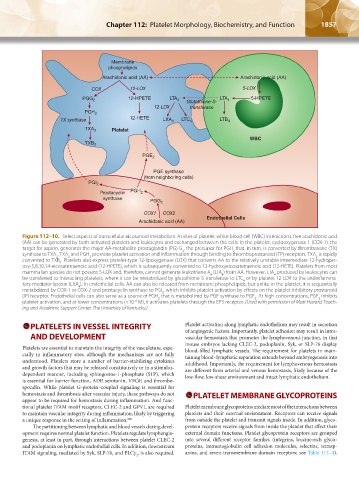
                  Figure 112–10.  Select aspects of transcellular eicosanoid metabolism. At sites of platelet-white blood cell (WBC) interactions, free arachidonic acid
                  (AA) can be generated by both activated platelets and leukocytes and exchanged between the cells. In the platelet, cyclooxygenase 1 (COX-1), the
                  target for aspirin, generates the major AA-metabolite prostaglandin (PG) G , the precursor for PGH  that, in turn, is converted by thromboxane (TX)
                                                                       2
                                                                                        2
                  synthase to TXA . TXA  and PGH  promote platelet activation and inflammation through binding to thromboprostanoid (TP) receptors. TXA  is rapidly
                                                                                                                    2
                             2
                                        2
                                 2
                  converted to TXB . Platelets also express platelet-type 12-lipoxygenase (LOX) that converts AA to the relatively unstable intermediate 12-hydroper-
                              2
                  oxy-5,8,10,14-eicosatetraenoic acid (12-HPETE), which is subsequently converted to 12-hydroxyeicosatetraenoic acid (12-HETE). Platelets from most
                  mammalian species do not possess 5-LOX and, therefore, cannot generate leukotriene A  (LTA ) from AA. However, LTA  produced by leukocytes can
                                                                                 4
                                                                                     4
                                                                                                      4
                  be transferred to interacting platelets, where it can be metabolized by glutathione-S-transferase to LTC  or by platelet 12-LOX to the antiinflamma-
                                                                                            4
                  tory mediator lipoxin (LXA ). In endothelial cells, AA can also be released from membrane phospholipids, but unlike in the platelet, it is sequentially
                                     4
                  metabolized by COX-1 or COX-2 and prostacyclin synthase to PGI , which inhibits platelet activation by effects on the platelet inhibitory prostanoid
                                                                 2
                  (IP) receptor. Endothelial cells can also serve as a source of PGH  that is metabolized by PGE synthase to PGE . At high concentrations, PGE  inhibits
                                                               2
                                                                                                                     2
                                                                                                2
                  platelet activation, and at lower concentrations (<10  M), it activates platelets through the EP3 receptor. (Used with permission of Matt Hazard, Teach-
                                                       –6
                  ing and Academic Support Center, The University of Kentucky.)
                       PLATELETS IN VESSEL INTEGRITY                    Platelet activation along lymphatic endothelium may result in secretion
                                                                        of angiogenic factors. Importantly, platelet adhesion may result in intra-
                     AND DEVELOPMENT                                    vascular hemostasis that promotes the lymphovenous junction, in that
                                                                        mouse embryos lacking CLEC-2, podoplanin, Syk, or SLP-76 display
                  Platelets are essential to maintain the integrity of the vasculature, espe-  blood-filled lymphatic vessels. The requirement for platelets in main-
                  cially  in inflammatory  sites,  although  the  mechanisms  are  not  fully   taining blood–lymphatic separation extends beyond embryogenesis into
                  understood. Platelets store a number of barrier-stabilizing cytokines   adulthood. Importantly, the requirement for lymphovenous hemostasis
                  and growth factors that may be released constitutively or in a stimulus-   are different from arterial and venous hemostasis, likely because of the
                  dependent manner, including sphingosine-1-phosphate (S1P), which   low-flow, low-shear environment and intact lymphatic endothelium.
                  is essential for barrier function, ADP, serotonin, VEGF, and thrombo-
                  spondin.  While  platelet  G-protein–coupled  signaling  is  essential for
                  hemostasis and thrombosis after vascular injury, these pathways do not   PLATELET MEMBRANE GLYCOPROTEINS
                  appear to be required for hemostasis during inflammation. And func-
                  tional platelet ITAM motif receptors, CLEC-2 and GPVI, are required   Platelet membrane glycoproteins mediate most of the interactions between
                  to maintain vascular integrity during inflammation, likely by triggering   platelets and their external environment. Receptors can receive signals
                  a unique response in the setting of inflammation. 800  from outside the platelet and transmit signals inside. In addition, glyco-
                     The partitioning between lymphatic and blood vessels during devel-  protein receptors receive signals from inside the platelet that affect their
                  opment requires normal platelet function. Platelets regulate lymphangio-  external domain functions. Platelet glycoprotein receptors are grouped
                  genesis, at least in part, through interactions between platelet CLEC-2   into several different receptor families (integrins, leucine-rich glyco-
                  and podoplanin on lymphatic endothelial cells. In addition, downstream   proteins, immunoglobulin cell adhesion molecules, selectins, tetrasp-
                  ITAM signaling, mediated by Syk, SLP-76, and PLCγ , is also required.   anins, and seven-transmembrane domain receptors; see Table 112–4).
                                                        2
          Kaushansky_chapter 112_p1829-1914.indd   1857                                                                 17/09/15   3:29 pm

