


Page 1960 - Williams Hematology ( PDFDrive )
P. 1960
1934  Part XII:  Hemostasis and Thrombosis  Chapter 113:  Molecular Biology and Biochemistry of the Coagulation Factors  1935


                  Crosslinks stabilize a clot by incorporation of the plasmin inhibi-  1  234 5  6 78  910        1112
                  tor  α -antiplasmin  which makes  it resistant to  fibrinolytic  attack  by   Gene                 28 kb
                      2
                  plasmin. 304
                     Several other processes during clotting are factor XIII-dependent,
                                                       305
                  among which red blood cell incorporation in clots,  complement fac-
                                          306
                                                                   307
                  tor 3 (C3) crosslinking to fibrin,  and clot retraction by platelets.    mRNA     2.2 kb
                  Factor XIII also plays a role in the functioning of multiple adhesive and
                                                                   308
                  contractile proteins and in angiotensin type I receptor crosslinking.
                  Fetal specific crosslinking of Fas by factor XIII dampens apoptosis,
                                                                   309
                  suggesting that factor XIII may play a role in cell survival prenatally.    Exon  1  2  3  4  5  6  7  8  9  1011  12
                  Related to its expression by monocytes/macrophages, factor XIII levels   Protein  ProS1S2S3S4S5S6S7  S8S9S10 Carb
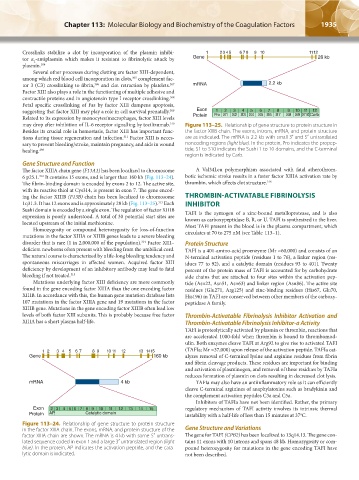
                  may drop after inhibition of IL-6 receptor signalling by tocilizumab.    Figure 113–25.  Relationship of gene structure to protein structure in
                                                                   310
                  Besides its crucial role in hemostasis, factor XIII has important func-  the factor XIIIB chain. The exons, introns, mRNA, and protein structure
                                                    311
                  tions during tissue regeneration and infection.  Factor XIII is neces-  are as indicated. The mRNA is 2.2 kb with small 3′ and 5′ untranslated
                  sary to prevent bleeding/stroke, maintain pregnancy, and aids in wound   noncoding regions (light blue). In the protein, Pro indicates the propep-
                  healing. 298                                          tide, S1 to S10 indicates the Sushi 1 to 10 domains, and the C-terminal
                                                                        region is indicated by Carb.
                  Gene Structure and Function
                  The factor XIIIA chain gene (F13A1) has been localized to chromosome   A Val34Leu polymorphism associated with fatal atherothrom-
                  6 p25.1.  It contains 15 exons, and is larger than 160 kb (Fig. 113–24).   botic ischemic stroke results in a faster factor XIIIA activation rate by
                       312
                  The fibrin-binding domain is encoded by exons 2 to 12. The active site,   thrombin, which affects clot structure. 316
                  with its reactive thiol at Cys314, is present in exon 7. The gene encod-
                  ing the factor XIIIB (F13B) chain has been localized to chromosome   THROMBIN-ACTIVATABLE FIBRINOLYSIS
                  1q31.3. It has 12 exons and is approximately 28 kb (Fig. 113–25).  Each   INHIBITOR
                                                               313
                  Sushi domain is encoded by a single exon. The regulation of factor XIIIB   TAFI is the zymogen of a zinc-bound metalloprotease, and is also
                  expression is poorly understood. A total of 30 potential start sites are   known as carboxypeptidase B, R, or U. TAFI is synthesized in the liver.
                  located upstream of the initial methionine.           Most TAFI present in the blood is in the plasma compartment, which
                     Homozygosity or compound heterozygosity for loss-of-function   circulates at 70 to 275 nM (see Table  113–1).
                  mutations in the factor XIIIA or XIIIB genes leads to a severe bleeding
                                                          314
                  disorder that is rare (1 in 2,000,000 of the population).  Factor XIII–  Protein Structure
                  deficient newborns often present with bleeding from the umbilical cord.   TAFI is a 401-amino-acid proenzyme (Mr ≈60,000) and consists of an
                  The natural course is characterized by a life-long bleeding tendency and   N-terminal activation peptide (residues 1 to 76), a linker region (res-
                  spontaneous miscarriages in affected women. Acquired factor XIII   idues 77 to 92), and a catalytic domain (residues 93 to 401). Twenty
                  deficiency by development of an inhibitory antibody may lead to fatal   percent of the protein mass of TAFI is accounted for by carbohydrate
                  bleeding if not treated. 315                          side chains that are attached to four sites within the activation pep-
                     Mutations underlying factor XIII deficiency are more commonly   tide (Asn22, Asn51, Asn63) and linker region (Asn86). The active site
                  found in the gene encoding factor XIIIA than the one encoding factor   residues (Glu271, Arg125) and zinc-binding residues (His67, Glu70,
                  XIIIB. In accordance with this, the human gene mutation database lists   His196) in TAFI are conserved between other members of the carboxy-
                  107 mutations in the factor XIIIA gene and 19 mutations in the factor   peptidase A family.
                  XIIIB gene. Mutations in the gene encoding factor XIIIB often lead low
                  levels of both factor XIII subunits. This is probably because free factor   Thrombin-Activatable  Fibrinolysis  Inhibitor  Activation  and
                  XIIIA has a short plasma half-life.                   Thrombin-Activatable Fibrinolysis Inhibitor-a Activity
                                                                        TAFI is proteolytically activated by plasmin or thrombin, reactions that
                                                                        are accelerated 1000-fold when thrombin is bound to thrombomod-
                                                                        ulin. Both enzymes cleave TAFI at Arg92 to give rise to activated TAFI
                        12   34  5  6 7  8 9  1011  12   131415         (TAFIa; Mr ≈37,000) upon release of the activation peptide. TAFIa cat-
                    Gene                                      160 kb    alyzes removal of C-terminal lysine and arginine residues from fibrin
                                                                        and fibrin cleavage products. These residues are important for binding
                                                                        and activation of plasminogen, and removal of these residues by TAFIa
                                                                        reduces formation of plasmin on clots resulting in decreased clot lysis.
                    mRNA                           4 kb                     TAFIa may also have an antiinflammatory role as it can efficiently
                                                                        cleave C-terminal arginines of anaphylatoxins such as bradykinin and
                                                                        the complement activation peptides C3a and C5a.
                                                                            Inhibitors of TAFIa have not been identified. Rather, the primary
                     Exon  2 3  4 56 78 9  10  11  12  13  14  15       regulatory mechanism of TAFI activity involves its intrinsic thermal
                    Protein  AP        Catalytic domain                 instability with a half-life of less than 15 minutes at 37 C.
                                                                                                               o
                  Figure 113–24.  Relationship of gene structure to protein structure
                  in the factor XIIIA chain. The exons, mRNA, and protein structure of the   Gene Structure and Variations
                  factor XIIIA chain are shown. The mRNA is 4 kb with some 5′ untrans-  The gene for TAFI (CPB2) has been localized to 13q14.13. The gene con-
                  lated sequence coded in exon 1 and a large 3′ untranslated region (light   tains 11 exons with 10 introns and spans 48 kb. Homozygosity or com-
                  blue). In the protein, AP indicates the activation peptide, and the cata-  pound heterozygosity for mutations in the gene encoding TAFI have
                  lytic domain is indicated.                            not been described.


          Kaushansky_chapter 113_p1915-1948.indd   1935                                                                 9/21/15   2:40 PM

