


Page 2124 - Williams Hematology ( PDFDrive )
P. 2124
2098  Part XII:  Hemostasis and Thrombosis                              Chapter 122:  The Vascular Purpuras          2099


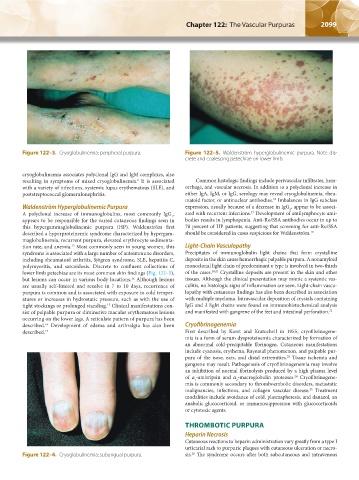
                  Figure 122–3.  Cryoglobulinemia: peripheral purpura.  Figure 122–5.  Waldenström hyperglobulinemic purpura. Note dis-
                                                                        crete and coalescing petechiae on lower limb.

                  cryoglobulinemia associates polyclonal IgG and IgM complexes, also
                  resulting  in  symptoms  of mixed  cryoglobulinemia.   It is  associated   Common histologic findings include perivascular infiltrates, hem-
                                                        6
                  with a variety of infections, systemic lupus erythematous (SLE), and   orrhage, and vascular necrosis. In addition to a polyclonal increase in
                  poststreptococcal glomerulonephritis.                 either IgA, IgM, or IgG, serology may reveal cryoglobulinemia, rheu-
                                                                        matoid factor, or antinuclear antibodies.  Imbalances in IgG subclass
                                                                                                      18
                  Waldenström Hyperglobulinemic Purpura                 expression, usually because of a decrease in IgG , appear to be associ-
                                                                                                           2
                  A polyclonal increase of immunoglobulins, most commonly IgG ,   ated with recurrent infections.  Development of antilymphocyte anti-
                                                                                              17
                                                                    1
                  appears to be responsible for the varied cutaneous findings seen in   bodies results in lymphopenia. Anti-Ro/SSA antibodies occur in up to
                  this hypergammaglobulinemic purpura (HP). Waldenström first   78 percent of HP patients, suggesting that screening for anti-Ro/SSA
                  described a hyperproteinemic syndrome characterized by hypergam-  should be considered in cases suspicious for Waldenström. 19
                  maglobulinemia, recurrent purpura, elevated erythrocyte sedimenta-
                  tion rate, and anemia.  Most commonly seen in young women, this   Light-Chain Vasculopathy
                                  13
                  syndrome is associated with a large number of autoimmune disorders,   Precipitates of immunoglobulin light chains that form crystalline
                  including rheumatoid arthritis, Sjögren syndrome, SLE, hepatitis C,   deposits in the skin cause hemorrhagic palpable purpura. A nonamyloid
                  polymyositis, and sarcoidosis. Discrete to confluent collections of   monoclonal light chain of predominant κ type is involved in two-thirds
                  lower limb petechiae are its most common skin findings (Fig. 122–5),   of the cases. 20,21  Crystalline deposits are present in the skin and other
                  but lesions can occur in various body locations.  Although lesions   tissues. Although the clinical presentation may mimic a systemic vas-
                                                      14
                  are usually self-limited and resolve in 7 to 10 days, recurrence of   culitis, no histologic signs of inflammation are seen. Light-chain vascu-
                  purpura is common and is associated with exposure to cold temper-  lopathy with cutaneous findings has also been described in association
                  atures or increases in hydrostatic pressure, such as with the use of   with multiple myeloma. Intravascular deposition of crystals containing
                  tight stockings or prolonged standing.  Clinical manifestations con-  IgG and λ light chains were found on immunohistochemical analysis
                                              15
                  sist of palpable purpura or diminutive macular erythematous lesions   and manifested with gangrene of the feet and intestinal perforation. 22
                  occurring on the lower legs. A reticulate pattern of purpura has been
                  described.   Development  of  edema  and  arthralgia  has  also  been   Cryofibrinogenemia
                         16
                  described. 17                                         First described by Korst and Kratochvil in 1955, cryofibrinogene-
                                                                        mia is a form of serum dysproteinemia characterized by formation of
                                                                        an  abnormal  cold-precipitable  fibrinogen.  Cutaneous  manifestations
                                                                        include cyanosis, erythema, Raynaud phenomenon, and palpable pur-
                                                                        pura of the nose, ears, and distal extremities.  Tissue ischemia and
                                                                                                           23
                                                                        gangrene may result. Pathogenesis of cryofibrinogenemia may involve
                                                                        an inhibition of normal fibrinolysis produced by a high plasma level
                                                                        of  α -antitripsin and  α -macroglobulin proteases.  Cryofibrinogene-
                                                                                                             24
                                                                            1
                                                                                         2
                                                                        mia is commonly secondary to thromboembolic disorders, metastatic
                                                                        malignancies, infections, and collagen vascular disease.  Treatment
                                                                                                                  25
                                                                        modalities include avoidance of cold, plasmapheresis, and danazol, an
                                                                        anabolic glucocorticoid, or immunosuppression with glucocorticoids
                                                                        or cytotoxic agents.
                                                                        THROMBOTIC PURPURA
                                                                        Heparin Necrosis
                                                                        Cutaneous reactions to heparin administration vary greatly from a type I
                                                                        urticarial rash to purpuric plaques with cutaneous ulceration or necro-
                                                                           26
                  Figure 122–4.  Cryoglobulinemia: subungual purpura.   sis.  The syndrome occurs after both subcutaneous and intravenous


          Kaushansky_chapter 122_p2097-2112.indd   2099                                                                 9/18/15   10:30 AM

