


Page 2127 - Williams Hematology ( PDFDrive )
P. 2127
2102           Part XII:  Hemostasis and Thrombosis                                                                                                                                 Chapter 122:  The Vascular Purpuras          2103


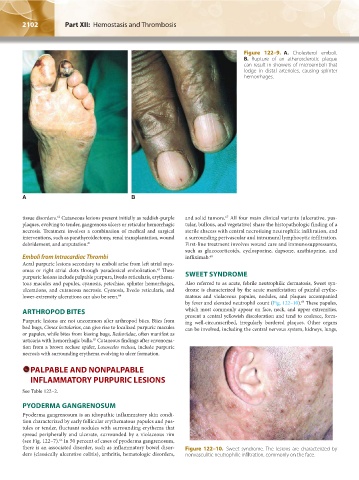
                                                                                          Figure  122–9.  A. Cholesterol emboli.
                                                                                          B.  Rupture  of  an atherosclerotic  plaque
                                                                                          can result in showers of microemboli that
                                                                                          lodge in distal arterioles, causing splinter
                                                                                          hemorrhages.


               A                                    B


               tissue disorders.  Cutaneous lesions present initially as reddish-purple   and solid tumors.  All four main clinical variants (ulcerative, pus-
                                                                                   67
                           62
               plaques, evolving to tender, gangrenous ulcers or reticular hemorrhagic   tular, bullous, and vegetative) share the histopathologic finding of a
               necrosis. Treatment involves a combination of medical and surgical   sterile abscess with central necrotizing neutrophilic infiltration, and
               interventions, such as parathyroidectomy, renal transplantation, wound   a surrounding perivascular and intramural lymphocytic infiltration.
               debridement, and amputation. 61                        First-line treatment involves wound care and immunosuppressants,
                                                                      such as glucocorticoids, cyclosporine, dapsone, azathioprine, and
               Emboli from Intracardiac Thrombi                       infliximab. 68
               Acral purpuric lesions secondary to emboli arise from left atrial myx-
               omas or right atrial clots through paradoxical embolization.  These
                                                             63
               purpuric lesions include palpable purpura, livedo reticularis, erythema-  SWEET SYNDROME
               tous macules and papules, cyanosis, petechiae, splinter hemorrhages,   Also referred to as acute, febrile neutrophilic dermatosis, Sweet syn-
               ulcerations, and cutaneous necrosis. Cyanosis, livedo reticularis, and   drome is characterized by the acute manifestation of painful erythe-
               lower-extremity ulcerations can also be seen. 64       matous and violaceous papules, nodules, and plaques accompanied
                                                                                                             69
                                                                      by fever and elevated neutrophil count (Fig. 122–10).  These papules,
               ARTHROPOD BITES                                        which most commonly appear on face, neck, and upper extremities,
                                                                      present a central yellowish discoloration and tend to coalesce, form-
               Purpuric lesions are not uncommon after arthropod bites. Bites from   ing well-circumscribed, irregularly bordered plaques. Other organs
               bed bugs, Cimex lectularius, can give rise to localized purpuric macules   can be involved, including the central nervous system, kidneys, lungs,
               or papules, while bites from kissing bugs, Reduviidae, often manifest as
                                       65
               urticaria with hemorrhagic bulla.  Cutaneous findings after envenoma-
               tion from a brown recluse spider, Loxosceles reclusa, include purpuric
               necrosis with surrounding erythema evolving to ulcer formation.

                    PALPABLE AND NONPALPABLE
                  INFLAMMATORY PURPURIC LESIONS

               See Table  122–2.
               PYODERMA GANGRENOSUM
               Pyoderma gangrenosum is an idiopathic inflammatory skin condi-
               tion characterized by early follicular erythematous papules and pus-
               tules or tender, fluctuant nodules with surrounding erythema that
               spread peripherally and ulcerate, surrounded by a violaceous rim
               (see Fig. 122–7).  In 50 percent of cases of pyoderma gangrenosum,
                            66
               there is an associated disorder, such as inflammatory bowel disor-  Figure 122–10.  Sweet syndrome. The lesions are characterized by
               ders (classically ulcerative colitis), arthritis, hematologic disorders,   nonvasculitic neutrophilic infiltration, commonly on the face.


          Kaushansky_chapter 122_p2097-2112.indd   2102                                                                 9/18/15   10:30 AM

