


Page 2126 - Williams Hematology ( PDFDrive )
P. 2126
2100  Part XII:  Hemostasis and Thrombosis                              Chapter 122:  The Vascular Purpuras          2101


                      A                                                B


                                               C
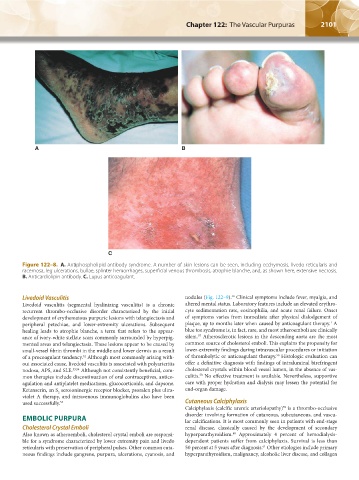
                  Figure 122–8.  A. Antiphospholipid antibody syndrome. A number of skin lesions can be seen, including ecchymosis, livedo reticularis and
                  racemosa, leg ulcerations, bullae, splinter hemorrhages, superficial venous thrombosis, atrophie blanche, and, as shown here, extensive necrosis.
                  B. Anticardiolipin antibody. C. Lupus anticoagulant.


                                                                                        56
                  Livedoid Vasculitis                                   nodules (Fig. 122–9).  Clinical symptoms include fever, myalgia, and
                  Livedoid vasculitis (segmental hyalinizing vasculitis) is a chronic   altered mental status. Laboratory features include an elevated erythro-
                  recurrent thrombo-occlusive disorder characterized by the initial   cyte sedimentation rate, eosinophilia, and acute renal failure. Onset
                  development of erythematous purpuric lesions with telangiectasis and   of symptoms varies from immediate after physical dislodgement of
                                                                                                                         1
                  peripheral petechiae, and lower-extremity ulcerations. Subsequent   plaque, up to months later when caused by anticoagulant therapy.  A
                  healing  leads  to  atrophie  blanche,  a  term  that  refers  to  the  appear-  blue toe syndrome is, in fact, rare, and most atheroemboli are clinically
                                                                             57
                  ance of ivory-white stellate scars commonly surrounded by hyperpig-  silent.  Atherosclerotic lesions in the descending aorta are the most
                  mented areas and telangiectasia. These lesions appear to be caused by   common source of cholesterol emboli. This explains the propensity for
                  small-vessel fibrin thrombi in the middle and lower dermis as a result   lower-extremity findings during intravascular procedures or initiation
                                                                                                       56
                  of a procoagulant tendency.  Although most commonly arising with-  of thrombolytic or anticoagulant therapy.  Histologic evaluation can
                                      52
                  out associated cause, livedoid vasculitis is associated with polyarteritis   offer a definitive diagnosis with findings of intraluminal birefringent
                  nodosa, APS, and SLE. 53,54  Although not consistently beneficial, com-  cholesterol crystals within blood vessel lumen, in the absence of vas-
                                                                             58
                  mon therapies include discontinuation of oral contraceptives, antico-  culitis.  No effective treatment is available. Nevertheless, supportive
                  agulation and antiplatelet medications, glucocorticoids, and dapsone.   care with proper hydration and dialysis may lessen the potential for
                  Ketanserin, an S  serotoninergic receptor blocker, psoralen plus ultra-  end-organ damage.
                              2
                  violet A therapy, and intravenous immunoglobulins also have been
                  used successfully. 55                                 Cutaneous Calciphylaxis
                                                                        Calciphylaxis (calcific uremic arteriolopathy)  is a thrombo-occlusive
                                                                                                         59
                  EMBOLIC PURPURA                                       disorder involving formation of cutaneous, subcutaneous, and vascu-
                                                                        lar calcifications. It is most commonly seen in patients with end-stage
                  Cholesterol Crystal Emboli                            renal disease, classically caused by the development of secondary
                  Also known as atheroemboli, cholesterol crystal emboli are responsi-  hyperparathyroidism.   Approximately  4  percent  of  hemodialysis-
                                                                                        60
                  ble for a syndrome characterized by lower extremity pain and livedo   dependent  patients  suffer  from  calciphylaxis.  Survival  is  less  than
                  reticularis with preservation of peripheral pulses. Other common cuta-  50 percent at 5 years after diagnosis.  Other etiologies include primary
                                                                                                  61
                  neous findings include gangrene, purpura, ulcerations, cyanosis, and   hyperparathyroidism, malignancy, alcoholic liver disease, and collagen


          Kaushansky_chapter 122_p2097-2112.indd   2101                                                                 9/18/15   10:30 AM

