


Page 2129 - Williams Hematology ( PDFDrive )
P. 2129
2104           Part XII:  Hemostasis and Thrombosis                                                                                                                                 Chapter 122:  The Vascular Purpuras          2105


               Persistent purpura, severe abdominal symptoms, and diminished
               plasma coagulation factor XIII activity are predictive of renal involve-
               ment, requiring initiation of glucocorticoids. 85


               INFECTIONS
               Careful  analysis of  skin  lesions  of  infectious  etiology  can provide
               important hints toward identifying the responsible pathogen. Purpura
               can arise through a variety of pathophysiologic mechanisms associ-
               ated with infection: (1) vascular effects of toxins, (2) septic emboli,
               (3) direct invasion of vessels with subsequent vascular occlusion, and
               (4) immune complex formation.  Although the morphology of such
                                       86
               purpuric lesions may be nonspecific, many pathogens lead to charac-
               teristic findings.
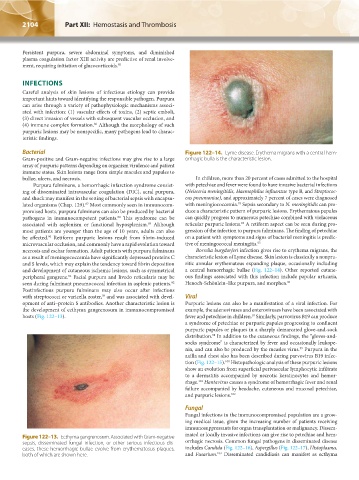
               Bacterial                                              Figure 122–14.  Lyme disease. Erythema migrans with a central hem-
               Gram-positive and Gram-negative infections may give rise to a large   orrhagic bulla is the characteristic lesion.
               array of purpuric patterns depending on organism virulence and patient
               immune status. Skin lesions range from simple macules and papules to
               bullae, ulcers, and necrosis.                              In children, more than 20 percent of cases admitted to the hospital
                   Purpura fulminans, a hemorrhagic infarction syndrome consist-  with petechiae and fever were found to have invasive bacterial infections
               ing of disseminated intravascular coagulation (DIC), acral purpura,   (Neisseria meningitidis, Haemophilus influenzae type B, and Streptococ-
               and shock may manifest in the setting of bacterial sepsis with encapsu-  cus pneumoniae), and approximately 7 percent of cases were diagnosed
                                                                                        93
               lated organisms (Chap. 129).  Most commonly seen in immunocom-  with meningiococcemia.  Sepsis secondary to N. meningitidis can pro-
                                     87
               promised hosts, purpura fulminans can also be produced by bacterial   duce a characteristic pattern of purpuric lesions. Erythematous papules
               pathogens  in  immunocompetent  patients.   This  syndrome  can  be   can quickly progress to numerous petechiae combined with violaceous
                                               88
               associated with asplenism or functional hyposplenism.  Although   reticular purpuric lesions.  A retiform aspect can be seen during pro-
                                                                                         94
                                                          89
               most patients are younger than the age of 10 years, adults can also   gression of the infection to purpura fulminans. The finding of petechiae
               be affected.  Retiform purpuric lesions result from fibrin-induced   on a patient with symptoms and signs of bacterial meningitis is predic-
                        90
               microvascular occlusion, and commonly have a rapid evolution toward   tive of meningococcal meningitis. 95
               necrosis and eschar formation. Adult patients with purpura fulminans   Borrelia burgdorferi infection gives rise to erythema migrans, the
               as a result of meningococcemia have significantly depressed proteins C   characteristic lesion of Lyme disease. Skin lesion is classically a nonpru-
               and S levels, which may explain the tendency toward fibrin deposition   ritic annular erythematous expanding plaque, occasionally including
               and development of cutaneous ischemic lesions, such as symmetrical   a central hemorrhagic bullae (Fig. 122–14). Other reported cutane-
               peripheral gangrene.  Facial purpura and livedo reticularis may be   ous findings associated with this infection include papular urticaria,
                               91
               seen during fulminant pneumococcal infection in asplenic patients.    Henoch-Schönlein–like purpura, and morphea. 96
                                                                 92
               Postinfectious purpura fulminans may also occur after infections
               with streptococci or varicella zoster,  and was associated with devel-  Viral
                                          39
               opment of anti–protein S antibodies. Another characteristic lesion is   Purpuric lesions can also be a manifestation of a viral infection. For
               the development of ecthyma gangrenosum in immunocompromised   example, the adenoviruses and enteroviruses have been associated with
               hosts (Fig. 122–13).                                   fever and petechiae in children.  Similarly, parvovirus B19 can produce
                                                                                            97
                                                                      a syndrome of petechiae or purpuric papules progressing to confluent
                                                                      purpuric papules or plaques in a sharply demarcated glove-and-sock
                                                                      distribution.  In addition to the cutaneous findings, the “gloves-and-
                                                                               98
                                                                      socks syndrome” is characterized by fever and occasionally leukope-
                                                                      nia, and can also be produced by the measles virus.  Purpura in the
                                                                                                            99
                                                                      axilla and chest also has been described during parvovirus B19 infec-
                                                                      tion (Fig. 122–15).  Histopathologic analysis of these purpuric lesions
                                                                                   100
                                                                      show an evolution from superficial perivascular lymphocytic infiltrate
                                                                      to a  dermatitis accompanied by necrotic keratinocytes and hemor-
                                                                      rhage.  Hantavirus causes a syndrome of hemorrhagic fever and renal
                                                                          101
                                                                      failure accompanied by headache, cutaneous and mucosal petechiae,
                                                                      and purpuric lesions. 102
                                                                      Fungal
                                                                      Fungal infections in the immunocompromised population are a grow-
                                                                      ing medical issue, given the increasing number of patients receiving
                                                                      immunosuppressants for organ transplantation or malignancy. Dissem-
                                                                      inated or locally invasive infections can give rise to petechiae and hem-
               Figure 122–13.  Ecthyma gangrenosum. Associated with Gram-negative
               sepsis, disseminated fungal infection, or other serious infectious dis-  orrhagic necrosis. Common fungal pathogens in disseminated disease
               eases, these hemorrhagic bullae evolve from erythematosus plaques,   includes Candida (Fig. 122–16), Aspergillus (Fig. 122–17), Histoplasma,
                                                                                 103
               both of which are shown here.                          and  Fusarium.  Disseminated candidiasis can manifest as ecthyma


          Kaushansky_chapter 122_p2097-2112.indd   2104                                                                 9/18/15   10:30 AM

