


Page 2133 - Williams Hematology ( PDFDrive )
P. 2133
2108           Part XII:  Hemostasis and Thrombosis                                                                                                                                 Chapter 122:  The Vascular Purpuras          2109


                    A                                                B
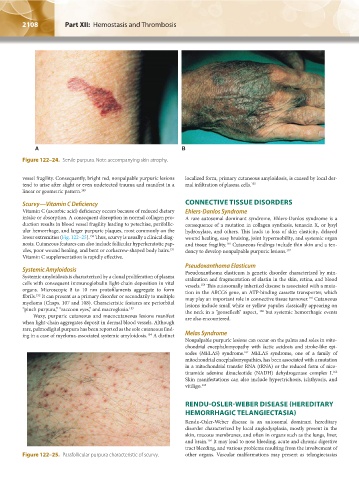
               Figure 122–24.  Senile purpura. Note accompanying skin atrophy.


               vessel fragility. Consequently, bright red, nonpalpable purpuric lesions   localized form, primary cutaneous amyloidosis, is caused by local der-
               tend to arise after slight or even undetected trauma and manifest in a   mal infiltration of plasma cells. 155
               linear or geometric pattern. 149
               Scurvy—Vitamin C Deficiency                            CONNECTIVE TISSUE DISORDERS
               Vitamin C (ascorbic acid) deficiency occurs because of reduced dietary   Ehlers-Danlos Syndrome
               intake or absorption. A consequent disruption in normal collagen pro-  A rare autosomal dominant syndrome, Ehlers-Danlos syndrome is a
               duction results in blood vessel fragility leading to petechiae, perifollic-  consequence of a mutation in collagen synthesis, tenascin X, or lysyl
               ular hemorrhage, and larger purpuric plaques, most commonly on the   hydroxylase, and others. This leads to loss of skin elasticity, delayed
               lower extremities (Fig. 122–25).  Thus, scurvy is usually a clinical diag-  wound healing, easy bruising, joint hypermobility, and systemic organ
                                      150
               nosis. Cutaneous features can also include follicular hyperkeratotic pap-  and tissue fragility.  Cutaneous findings include thin skin and a ten-
                                                                                    156
               ules, poor wound healing, and bent or corkscrew-shaped body hairs.    dency to develop nonpalpable purpuric lesions. 157
                                                                 151
               Vitamin C supplementation is rapidly effective.
                                                                      Pseudoxanthoma Elasticum
               Systemic Amyloidosis                                   Pseudoxanthoma elasticum is genetic disorder characterized by min-
               Systemic amyloidosis is characterized by a clonal proliferation of plasma   eralization and fragmentation of elastin in the skin, retina, and blood
               cells with consequent immunoglobulin light-chain deposition in vital   vessels.  This autosomally inherited disease is associated with a muta-
                                                                           158
               organs. Microscopic 8 to 10 nm protofilaments aggregate to form   tion in the ABCC6 gene, an ATP-binding cassette transporter, which
               fibrils.  It can present as a primary disorder or secondarily to multiple   may play an important role in connective tissue turnover.  Cutaneous
                    152
                                                                                                               159
               myeloma (Chaps. 107 and 108). Characteristic features are periorbital   lesions include small white or yellow papules classically appearing on
               “pinch purpura,” “raccoon eyes,” and macroglosia. 153  the neck in a “gooseflesh” aspect,   but systemic hemorrhagic events
                                                                                               160
                   Waxy, purpuric cutaneous and mucocutaneous lesions manifest   are also encountered.
               when light-chain aggregates deposit in dermal blood vessels. Although
               rare, palmodigital purpura has been reported as the sole cutaneous find-
               ing in a case of myeloma-associated systemic amyloidosis.  A distinct   Melas Syndrome
                                                         154
                                                                      Nonpalpable purpuric lesions can occur on the palms and soles in mito-
                                                                      chondrial  encephalomyopathy with  lactic  acidosis and  stroke-like epi-
                                                                      sodes (MELAS) syndrome.  MELAS syndrome, one of a family of
                                                                                          161
                                                                      mitochondrial encephalomyopathies, has been associated with a mutation
                                                                      in a mitochondrial transfer RNA (tRNA) or the reduced form of nico-
                                                                      tinamide  adenine  dinucleotide  (NADH)  dehydrogenase  complex  I.
                                                                                                                        162
                                                                      Skin manifestations can also include hypertrichosis, ichthyosis, and
                                                                      vitiligo. 163
                                                                      RENDU-OSLER-WEBER DISEASE (HEREDITARY
                                                                      HEMORRHAGIC TELANGIECTASIA)
                                                                      Rendu-Osler-Weber disease is an autosomal dominant hereditary
                                                                      disorder characterized by local angiodysplasia, mostly present in the
                                                                      skin, mucous membranes, and often in organs such as the lungs, liver,
                                                                      and brain.  It may lead to nose bleeding, acute and chronic digestive
                                                                             164
                                                                      tract bleeding, and various problems resulting from the involvement of
               Figure 122–25.  Parafollicular purpura characteristic of scurvy.  other organs. Vascular malformations may present as telangiectasias


          Kaushansky_chapter 122_p2097-2112.indd   2108                                                                 9/18/15   10:30 AM

