


Page 2132 - Williams Hematology ( PDFDrive )
P. 2132
2106  Part XII:  Hemostasis and Thrombosis                              Chapter 122:  The Vascular Purpuras          2107


                                                                            Focal ecchymosis and other purpuric lesions can manifest as a
                                                                        result of trauma. Characteristic patterns of purpuric lesions are com-
                                                                        monly used in forensic science. Traumatic asphyxia, for instance, is
                                                                        characterized by cervicofacial cyanosis and swelling, petechiae, and
                                                                                              139
                                                                        subconjunctival hemorrhage.  Factitious purpura, often related to
                                                                        deliberate suction purpura, should be considered in the differential for
                                                                        purpura.  Other physical causes of purpura consist of physical rem-
                                                                               140
                                                                        edies, such as spooning (Quat Sha) or coin rubbing (Cao Gio). Exer-
                                                                        cise-induced purpura results in purpuric, erythematous, or urticarial
                                                                        lesions distributed on the lower legs. 141

                                                                        THROMBOCYTOPENIAS
                                                                        Disseminated Intravascular Coagulation
                                                                        DIC is defined as widespread, amplified and uncontrolled intravascular
                                                                        coagulation with a range of causes including sepsis, trauma, and malig-
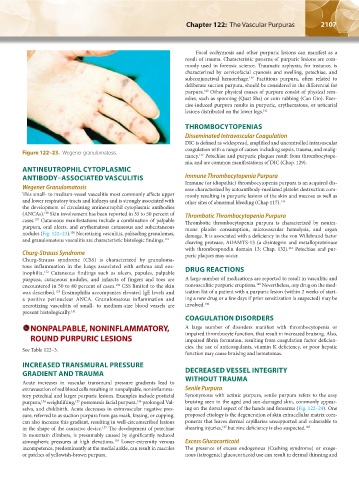
                  Figure 122–23.  Wegener granulomatosis.
                                                                        nancy.  Petechiae and purpuric plaques result from thrombocytope-
                                                                             142
                                                                        nia, and are common manifestations of DIC (Chap. 129).
                  ANTINEUTROPHIL CYTOPLASMIC
                  ANTIBODY–ASSOCIATED VASCULITIS                        Immune Thrombocytopenia Purpura
                                                                        Immune (or idiopathic) thrombocytopenia purpura is an acquired dis-
                  Wegener Granulomatosis                                ease characterized by autoantibody-mediated platelet destruction com-
                  This small- to medium-vessel vasculitis most commonly affects upper   monly resulting in purpuric lesions of the skin and mucosa as well as
                  and lower respiratory tracts and kidneys and is strongly associated with   other sites of abnormal bleeding (Chap 117). 143
                  the development of circulating antineutrophil cytoplasmic antibodies
                  (ANCAs).  Skin involvement has been reported in 35 to 50 percent of   Thrombotic Thrombocytopenia Purpura
                         128
                  cases.  Cutaneous manifestations include a combination of palpable   Thrombotic thrombocytopenia purpura is characterized by nonim-
                      129
                  purpura, oral ulcers, and erythematous cutaneous and subcutaneous   mune  platelet  consumption,  microvascular  hemolysis,  and  organ
                  nodules (Fig. 122–23).  Necrotizing vasculitis, palisading granulomas,   damage. It is associated with a deficiency in the von Willebrand factor
                                  130
                  and granulomatous vasculitis are characteristic histologic findings. 131  cleaving  protease,  ADAMTS-13  (a  disintegrin  and  metalloproteinase
                                                                        with thrombospondin domain 13; Chap. 132).  Petechiae and pur-
                                                                                                           144
                  Churg-Strauss Syndrome                                puric plaques may occur.
                  Churg-Strauss syndrome (CSS) is characterized by granuloma-
                  tous inflammation in the lungs associated with asthma and eos-
                  inophilia.  Cutaneous findings such as ulcers, papules, palpable   DRUG REACTIONS
                         132
                  purpura, cutaneous nodules, and infarcts of fingers and toes are   A large number of medications are reported to result in vasculitic and
                                                                                                145
                  encountered in 50 to 80 percent of cases.  CSS limited to the skin   nonvasculitic purpuric eruptions.  Nevertheless, any drug on the med-
                                                 130
                  was described.  Eosinophilia accompanies elevated IgE levels and   ication list of a patient with a purpuric lesion (within 2 weeks of start-
                             133
                  a  positive  perinuclear  ANCA.  Granulomatous  inflammation  and   ing a new drug or a few days if prior sensitization is suspected) may be
                  necrotizing vasculitis of small- to medium-size blood vessels are   involved. 146
                  present histologically. 131
                                                                        COAGULATION DISORDERS
                       NONPALPABLE, NONINFLAMMATORY,                    A large number of disorders manifest with thrombocytopenia or
                     ROUND PURPURIC LESIONS                             impaired thrombocyte function, that result in increased bruising. Also,
                                                                        impaired fibrin formation, resulting from coagulation factor deficien-
                                                                        cies, the use of anticoagulants, vitamin K deficiency, or poor hepatic
                  See Table  122–3.
                                                                        function may cause bruising and hematomas.
                  INCREASED TRANSMURAL PRESSURE
                  GRADIENT AND TRAUMA                                   DECREASED VESSEL INTEGRITY
                  Acute increases in vascular transmural pressure gradients lead to   WITHOUT TRAUMA
                  extravasation of red blood cells resulting in nonpalpable, noninflamma-  Senile Purpura
                  tory petechial and larger purpuric lesions. Examples include postictal   Synonymous with actinic purpura, senile purpura refers to the easy
                  purpura,  weightlifting,  postemesis facial purpura,  prolonged Val-  bruising seen in the aged and sun-damaged skin, commonly appear-
                                                        136
                        134
                                    135
                  salva, and childbirth. Acute decreases in extravascular negative pres-  ing on the dorsal aspect of the hands and forearms (Fig. 122–24). One
                  sure, referred to as suction purpura from gas mask, kissing, or cupping,   proposed etiology is the degeneration of skin extracellular matrix com-
                  can also increase this gradient, resulting in well-circumscribed lesions   ponents that leaves dermal capillaries unsupported and vulnerable to
                                                                                     147
                  in the shape of the causative device.  The development of petechiae   shearing injuries,  but zinc deficiency is also suspected. 148
                                             137
                  in mountain climbers, is presumably caused by significantly reduced
                  atmospheric pressures at high elevations.  Lower-extremity venous   Excess Glucocorticoid
                                                 138
                  incompetence, predominantly at the medial ankle, can result in macules   The presence  of excess endogenous (Cushing  syndrome)  or exoge-
                  or patches of yellowish-brown purpura.                nous (iatrogenic) glucocorticoid use can result in dermal thinning and


          Kaushansky_chapter 122_p2097-2112.indd   2107                                                                 9/18/15   10:30 AM

