


Page 2139 - Williams Hematology ( PDFDrive )
P. 2139
2114           Part XII:  Hemostasis and Thrombosis                                                                                                                       Chapter 123:  Hemophilia A and Hemophilia B            2115


               activated the next zymogen until thrombin ultimately was produced.   hemophilic males are normal, whereas all the daughters are obligatory
               In this scheme, factors VIII and IX were considered to be proenzymes.   carriers of the factor VIII defect. Sons of carriers have a 50 percent
               Later, however, factor VIII, when activated by thrombin, was shown   chance of being affected, whereas daughters of carriers have a 50 percent
               not to be a proenzyme but rather an essential cofactor for factor IXa.   chance of being carriers themselves.
               The waterfall hypothesis has been modified so that the primary role of   The factor VIII gene is very large, approximately 186 kb, with
               the tissue factor–factor VII complex in the initiation of coagulation is   approximately 9 kb of exons. The gene contains 26 exons and 25 introns.
                                                                                                                        16
               emphasized (Chap. 113). 12                             Based on the sequence of the factor VIII gene in normal individuals and
                                                                      patients with hemophilia A, numerous specific mutations have been
               ETIOLOGY AND PATHOGENESIS                              described 16,17 ; as of 2015, more than 2000 specific variants in the factor
                                                                                                                  17
               Hemophilia A is a heterogeneous disorder resulting from defects in the   VIII gene resulting in classic hemophilia have been described.
                                                                          Hemophilia A can result from multiple alterations in the factor VIII
               factor VIII gene that leads to absent or reduced circulating levels of func-  gene. These include gene rearrangements; missense mutations, in which
               tional factor VIII. The reduced activity can result from a decreased amount   a single base substitution leads to an amino acid change in the molecule;
               of factor VIII protein, the presence of a functionally abnormal protein,   nonsense mutations, which result in a stop codon; abnormal splicing
               or a combination of both. For factor VIII to be an effective cofactor for   of the gene; deletions of all or portions of the gene; and insertions of
               factor IXa, it must first be activated by thrombin, a reaction that results   genetic elements.  The genetic defects leading to hemophilia have been
                                                                                  18
               in the formation of a heterotrimer composed of the A , A , A , C , and     reviewed. 17
                                                      1
                                                              1
                                                            3
                                                         2
               C  domains of factor VIII in a complex with calcium (Chap. 113).    One of the most common mutations, accounting for 40 to
                                                                 13
                 2
               Activated factor VIII (factor VIIIa) and activated factor IX (factor IXa)   50 percent of severe hemophilia A patients, is a unique “combined
               associate on the surface of activated platelets, forming a functional factor   gene inversion and crossing over” that disrupts the factor VIII gene. 19,20
               X-activating complex (“tenase” or “Xase”).  In the presence of factor VIIIa,   Figures 123–2 and 123–3 schematically depict the factor VIII gene and
                                            14
               the rate of factor X activation by factor IXa is dramatically enhanced. That   the mechanism of the “inversion–crossing over.”  Within intron 22 are
                                                                                                         21
               hemophilia A and hemophilia B have similar clinical manifestations is not   two other genes: (1) F8A(a ), which is transcribed in the 5′ direction,
                                                                                          1
               surprising, because both factor VIIIa and factor IXa are required to form   and (2) F8B, which is transcribed in the 3′ direction of the factor VIII
               the Xase complex. The lack of either activated protein leads to a similar   gene. The hatched boxes in Figure  123–3 show two other extragenic
               lack of platelet surface Xase activity with subsequent decreased thrombin   homologous sequences (a ,a ) 5′ to the F8A gene that lies within intron
                                                                                        2
                                                                                          3
               generation. In patients with hemophilia, clot formation is delayed because   22 (a ). The presence of extragenic F8A sequences 5′ to the F8A gene
                                                                          1
               of the decreased thrombin generation. The clot that is formed is friable,   within intron 22 is central to the inversion and translocation of part of
               easily dislodged, and highly susceptible to fibrinolysis, all of which lead to   the factor VIII gene from exon 1 to exon 22. The mechanism is homol-
               excessive bleeding and poor wound healing. 15          ogous recombination between the F8A sequence that lies within intron
                                                                      22 and one of the homologous extragenic sequences of the F8A gene
               GENETICS                                               5′ to the factor VIII gene. During meiosis, crossing over of homolo-
               Hemophilia A results when mutations occur in the factor VIII gene   gous sequences occurs between the F8A gene lying within intron 22 and
               located on the long arm of the X-chromosome (X-q28). The disease   one of the extragenic homologous F8A sequences 5′ to intron 22. Thus,
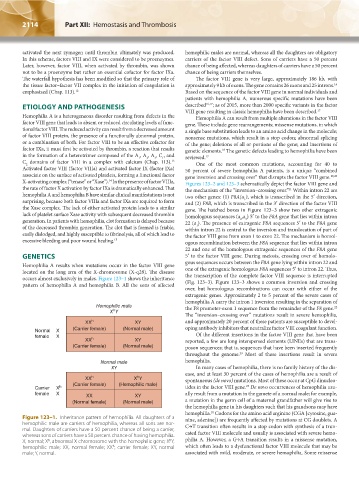
               occurs almost exclusively in males. Figure 123–1 shows the inheritance   the transcription of the complete factor VIII sequence is interrupted
               pattern of hemophilia A and hemophilia B. All the sons of affected   (Fig. 123–3). Figure   123–3 shows a common inversion and crossing
                                                                      over, but homologous recombinations can occur with either of the
                                                                      extragenic genes. Approximately 2 to 5 percent of the severe cases of
                                                                      hemophilia A carry the intron 1 inversion resulting in the separation of
                                        Hemophilic male               the F8 promoter-exon 1 sequence from the remainder of the F8 gene.
                                                                                                                        22
                                              h
                                             X Y
                                                                      The “inversion–crossing over” mutations result in severe hemophilia,
                                    XX h             XY               and approximately 20 percent of these patients are susceptible to devel-
                    Normal  X   (Carrier female)  (Normal male)       oping antibody inhibitors that neutralize factor VIII coagulant function.
                    female  X          h                                  Of the different insertions in the factor VIII gene that have been
                                    XX               XY               reported, a few are long interspersed elements (LINEs) that are trans-
                                (Carrier female)  (Normal male)       poson sequences; that is, sequences that have been inserted frequently
                                                                      throughout the genome.  Most of these insertions result in severe
                                                                                        23
                                          Normal male                 hemophilia.
                                             XY                           In many cases of hemophilia, there is no family history of the dis-
                                                                      ease, and at least 30 percent of the cases of hemophilia are a result of
                                                      h
                                    XX h             X Y              spontaneous (de novo) mutations. Most of these occur at CpG dinucleo-
                                (Carrier female)  (Hemophilic male)
                                                                                          23
                    Carrier  X h                                      tides in the factor VIII gene.  De novo occurrences of hemophilia usu-
                    female  X        XX              XY               ally result from a mutation in the gamete of a normal male; for example,
                                (Normal female)  (Normal male)        a mutation in the germ cell of a maternal grandfather will give rise to
                                                                      the hemophilia gene in his daughters such that his grandsons may have
                                                                               18
                                                                      hemophilia.  Codons for the amino acid arginine (CGA [cytosine, gua-
               Figure 123–1.  Inheritance pattern of hemophilia. All daughters of a   nine, adenine]) are frequently affected by mutations at CG doublets. A
               hemophilic male are carriers of hemophilia, whereas all sons are nor-  C→T transition often results in a stop codon with synthesis of a trun-
               mal. Daughters of carriers have a 50 percent chance of being a carrier,
               whereas sons of carriers have a 50 percent chance of having hemophilia.   cated factor VIII molecule and usually is associated with severe hemo-
               X, normal; X , abnormal X chromosome with the hemophilic gene; X Y,   philia A. However, a G→A transition results in a missense mutation,
                                                                 h
                        h
               hemophilic  male;  XX,  normal  female;  XX ,  carrier  female;  XY,  normal   which often leads to a dysfunctional factor VIII molecule that may be
                                              h
               male; Y, normal.                                       associated with mild, moderate, or severe hemophilia. Some missense
          Kaushansky_chapter 123_p2113-2132.indd   2114                                                                 9/21/15   4:35 PM

