


Page 2143 - Williams Hematology ( PDFDrive )
P. 2143
2118           Part XII:  Hemostasis and Thrombosis                                                                                                                       Chapter 123:  Hemophilia A and Hemophilia B            2119


                        1            2


                 A                             B                                  C                  D
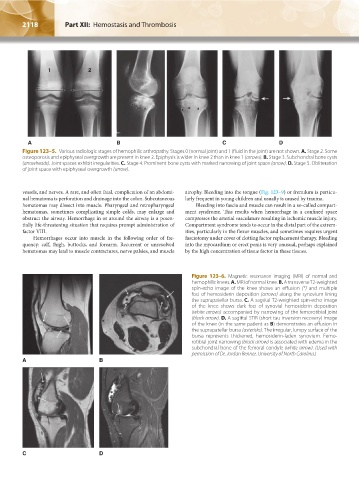
               Figure 123–5.  Various radiologic stages of hemophilic arthropathy. Stages 0 (normal joint) and 1 (fluid in the joint) are not shown. A. Stage 2. Some
               osteoporosis and epiphyseal overgrowth are present in knee 2. Epiphysis is wider in knee 2 than in knee 1 (arrows). B. Stage 3. Subchondral bone cysts
               (arrowheads). Joint spaces exhibit irregularities. C. Stage 4. Prominent bone cysts with marked narrowing of joint space (arrow). D. Stage 5. Obliteration
               of joint space with epiphyseal overgrowth (arrow).


               vessels, and nerves. A rare, and often fatal, complication of an abdomi-  atrophy. Bleeding into the tongue (Fig. 123–9) or frenulum is particu-
               nal hematoma is perforation and drainage into the colon. Subcutaneous   larly frequent in young children and usually is caused by trauma.
               hematomas may dissect into muscle. Pharyngeal and retropharyngeal   Bleeding into fascia and muscle can result in a so-called compart-
               hematomas, sometimes complicating simple colds, may enlarge and   ment syndrome. This results when hemorrhage in a confined space
               obstruct the airway. Hemorrhage in or around the airway is a poten-  compresses the arterial vasculature resulting in ischemic muscle injury.
               tially life-threatening situation that requires prompt administration of   Compartment syndrome tends to occur in the distal part of the extrem-
               factor VIII.                                           ities, particularly in the flexor muscles, and sometimes requires urgent
                   Hemorrhages occur into muscle in the following order of fre-  fasciotomy under cover of clotting factor replacement therapy. Bleeding
               quency: calf, thigh, buttocks, and forearm. Recurrent or unresolved   into the myocardium or erect penis is very unusual, perhaps explained
               hematomas may lead to muscle contractures, nerve palsies, and muscle   by the high concentration of tissue factor in these tissues.


                                                                        Figure 123–6.  Magnetic resonance imaging (MRI) of normal and
                                                                        hemophilic knees. A. MRI of normal knee. B. A transverse T2-weighted
                                                                        spin-echo  image  of  the  knee  shows  an effusion  (*)  and multiple
                                                                        foci of hemosiderin deposition (arrows) along the synovium lining
                                                                        the suprapatellar bursa. C. A sagittal T2-weighted spin-echo image
                                                                        of the knee shows dark foci of synovial hemosiderin deposition
                                                                        (white arrows) accompanied by narrowing of the femorotibial joint
                                                                        (black arrow). D. A sagittal STIR (short tau inversion recovery) image
                                                                        of the knee (in the same patient as B) demonstrates an effusion in
                                                                        the suprapatellar bursa (asterisks). The irregular, lumpy surface of the
                                                                        bursa  represents  thickened, hemosiderin-laden  synovium.  Femo-
                                                                        rotibial joint narrowing (black arrow) is associated with edema in the
                                                                        subchondral bone of the femoral condyle (white arrow). (Used with
                                                                        permission of Dr. Jordan Renner, University of North Carolina.)
               A                         B


               C                         D


          Kaushansky_chapter 123_p2113-2132.indd   2118                                                                 9/21/15   4:36 PM

