


Page 2146 - Williams Hematology ( PDFDrive )
P. 2146
2120  Part XII:  Hemostasis and Thrombosis                    Chapter 123:  Hemophilia A and Hemophilia B            2121


                     Functional factor VIII coagulant activity is measured by one-stage   of the numerous nonprescription analgesics and herbals that contain
                  clotting assays based on the aPTT. Chromogenic assays for factor VIII   aspirin or other antiplatelet agents. Addictive narcotic agents should be
                  activity also are used widely, but do not always agree with one-stage   used with great caution and only when clearly indicated, because drug
                       39
                  assays.  Although infrequently measured in practice, factor VIII anti-  dependency can be a major problem for patients with hemophilia. In
                  gen is measured by immunologic assays, which detect normal and most   general, intramuscular injections should be avoided unless the patient
                  abnormal factor VIII molecules. If the factor VIII antigen level is nor-  receives adequate replacement therapy. In the absence of prophylactic
                  mal but the clotting activity is reduced, the patient has a dysfunctional   therapy, patients with hemophilia A must be treated as early as pos-
                  factor VIII molecule. Such patients have antigen-positive hemophilia,   sible to avoid bleeding complications. Surgical procedures in hemo-
                                                            40
                  also referred to as cross-reacting material (CRM)-positive.  Patients in   philic patients should be scheduled early in the week to avoid “weekend
                  whom both the factor VIII antigen level and activity are nearly unde-  crises.” Ample supplies of factor VIII should be available in the blood
                  tectable are said to be CRM-negative.                 bank or pharmacy to ensure rapid access to treatment when needed. All
                                                                        hemophilic patients should have access to home treatment and periodic
                  DIFFERENTIAL DIAGNOSIS                                examinations at a comprehensive hemophilia treatment center. Prophy-
                  VWD sometimes is confused with hemophilia A. The basic defect in   lactic therapy is recommended in all severely affected patients, and it
                                                                        should be initiated before the onset of recurrent hemarthroses (primary
                  VWD is reduced activity of von Willebrand factor (VWF), which acts   prophylaxis) or as directed. Secondary prophylaxis for an established
                  as a carrier of factor VIII in vivo (Chap. 126). Thus, in VWD, factor VIII   “target” joint may be necessary. 45
                  levels are reduced, although considerable variability exists. Although
                  factor VIII is synthesized normally in patients with VWD, the half-life
                  of factor VIII is markedly shortened because the VWF “carrier” mole-  Factor VIII Replacement Therapy
                  cule is decreased or absent. Other abnormalities in VWD that distin-  Hemorrhagic episodes in patients with hemophilia A can be managed
                  guish VWD from hemophilia A are decreased VWF antigen level, and   by replacing factor VIII. Several products are available for use in raising
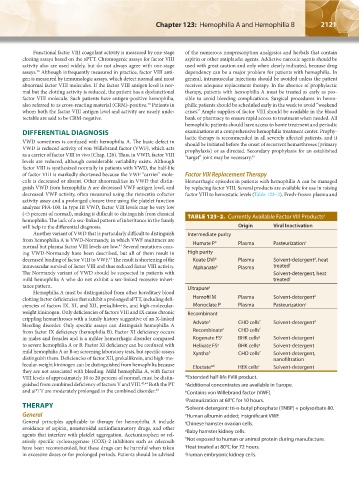
                  decreased VWF activity, often measured using the ristocetin cofactor   factor VIII to hemostatic levels (Table 123–2). Fresh-frozen plasma and
                  activity assay and a prolonged closure time using the platelet function
                  analyzer PFA-100. In type III VWD, factor VIII levels may be very low
                  (<5 percent of normal), making it difficult to distinguish from classical   TABLE 123–2.  Currently Available Factor VIII Products a
                  hemophilia. The lack of a sex-linked pattern of inheritance in the family
                  will help in the differential diagnosis.                                Origin      Viral Inactivation
                     Another variant of VWD that is particularly difficult to distinguish   Intermediate purity
                  from hemophilia A is VWD-Normandy, in which VWF multimers are   b                              c
                  normal but plasma factor VIII levels are low.  Several mutations caus-    Humate P  Plasma  Pasteurization
                                                  41
                  ing  VWD-Normandy  have  been  described,  but  all  of  them  result  in   High purity
                  decreased binding of factor VIII to VWF.  The result is shortening of the     Koate DVI b  Plasma  Solvent-detergent , heat
                                               42
                                                                                                                    d
                  intravascular survival of factor VIII and thus reduced factor VIII activity.     Alphanate b  Plasma  treated i
                  The Normandy variant of VWD should be suspected in patients with                    Solvent-detergent, heat
                  mild hemophilia A who do not exhibit a sex-linked recessive inheri-                 treated i
                  tance pattern.                                         Ultrapure e
                     Hemophilia A must be distinguished from other hereditary blood
                  clotting factor deficiencies that exhibit a prolonged aPTT, including defi-    Hemofil M  Plasma  Solvent-detergent d
                  ciencies of factors IX, XI, and XII, prekallikrein, and high-molecular-     Monoclate P  Plasma  Pasteurization c
                  weight kininogen. Only deficiencies of factors VIII and IX cause chronic   Recombinant
                  crippling hemarthroses with a family history suggestive of an X-linked   h     f                  d
                  bleeding disorder. Only specific assays can distinguish hemophilia A     Advate  CHO cells  Solvent-detergent
                  from factor IX deficiency (hemophilia B). Factor XI deficiency occurs     Recombinate e  CHO cells f
                  in males and females and is a milder hemorrhagic disorder compared     Kogenate FS e  BHK cells g  Solvent-detergent
                  to severe hemophilia A or B. Factor XI deficiency can be confused with     Helixate FS e  BHK cells g  Solvent-detergent
                  mild hemophilia A or B on screening laboratory tests, but specific assays     Xyntha h  CHO cells f  Solvent-detergent,
                  distinguish them. Deficiencies of factor XII, prekallikrein, and high-mo-           nanofiltration
                  lecular-weight kininogen can be distinguished from hemophilia because     Eloctate* h  HEK cells J  Solvent-detergent
                  they are not associated with bleeding. Mild hemophilia A, with factor
                  VIII levels of approximately 10 to 20 percent of normal, must be distin-  *Extended half-life FVIII product.
                  guished from combined deficiency of factors V and VIII. 43,44  Both the PT   a Additional concentrates are available in Europe.
                  and aPTT are moderately prolonged in the combined disorder. 44  b Contains von Willebrand factor (VWF).

                                                                        c Pasteurization at 60°C for 10 hours.
                  THERAPY                                               d Solvent-detergent: tri-n-butyl phosphate (TNBP) + polysorbate 80.
                  General                                               e Human albumin added; insignificant VWF.
                  General principles  applicable to therapy for hemophilia A include   f Chinese hamster ovarian cells.
                  avoidance of aspirin, nonsteroidal antiinflammatory drugs, and other   g Baby hamster kidney cells.
                  agents that interfere with platelet aggregation. Acetaminophen or rel-
                  atively specific cyclooxygenase (COX)-2 inhibitors such as celecoxib   h Not exposed to human or animal protein during manufacture.
                  have been recommended, but these drugs can be harmful when taken   i Heat treated at 80°C for 72 hours.
                  in excessive doses or for prolonged periods. Patients should be advised   J Human embryonic kidney cells.


          Kaushansky_chapter 123_p2113-2132.indd   2121                                                                 9/21/15   4:36 PM

