


Page 2266 - Williams Hematology ( PDFDrive )
P. 2266
2240  Part XII:  Hemostasis and Thrombosis                   Chapter 131:  The Antiphospholipid Syndrome             2241


                  for prothrombin should be performed when the prothrombin time is   OTHER MANIFESTATIONS
                  prolonged. Other causes of bleeding in APS include acquired throm-  Acute adrenal failure secondary to bilateral infarction of the adrenal
                  bocytopathies,  thrombocytopenia  (see  “Thrombocytopenia,”  above),   glands has been reported as the first manifestation of primary APS.
                                                                                                                          254
                  acquired inhibitors against specific coagulation factors, such as factor   Adrenal hemorrhage has been reported.  aPL antibodies have been
                                                                                                      255
                  VIII, and the acquired von Willebrand syndrome (AVWS).
                                                                        associated with marrow necrosis. 256
                  RETINAL ABNORMALITIES
                  The diagnosis of aPL antibody retinopathy should be suspected in   LABORATORY FEATURES
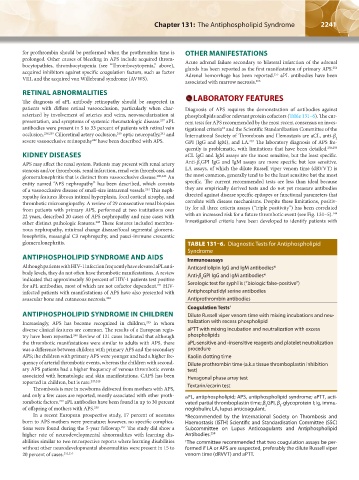
                  patients with diffuse retinal vasoocclusion, particularly when char-  Diagnosis of APS requires the demonstration of antibodies against
                  acterized by involvement of arteries and veins, neovascularization at   phospholipids and/or relevant protein cofactors (Table 131–6). The cur-
                  presentation, and symptoms of systemic rheumatologic disease.  aPL   rent tests for APS recommended by the most recent consensus on inves-
                                                                237
                  antibodies were present in 5 to 33 percent of patients with retinal vein   tigational criteria  and the Scientific Standardization Committee of the
                                                                                     18
                  occlusion. 238,239  Cilioretinal artery occlusion,  optic neuropathy,  and   International Society of Thrombosis and Hemostasis are aCL, anti-β
                                                                241
                                                  240
                  severe vasoocclusive retinopathy  have been described with APS.  GPI (IgG and IgM), and LA.  The laboratory diagnosis of APS fre- 2
                                         242
                                                                                              257
                                                                        quently is problematic, with limitations that have been detailed. 258,259
                  KIDNEY DISEASES                                       aCL IgG and IgM assays are the most sensitive, but the least specific.
                  APS may affect the renal system. Patients may present with renal artery   Anti-β GPI IgG and IgM assays are more specific but less sensitive.
                                                                             2
                  stenosis and/or thrombosis, renal infarction, renal vein thrombosis, and   LA assays, of which the dilute Russell viper venom time (dRVVT) is
                  glomerulonephritis that is distinct from vasoocclusive disease. 200,243  An   the most common, generally tend to be the least sensitive but the most
                  entity named “APS nephropathy” has been described, which consists   specific. The current recommended tests are less than ideal because
                                                           244
                  of a vasoocclusive disease of small-size intrarenal vessels.  This neph-  they are empirically derived tests and do not yet measure antibodies
                  ropathy features fibrous intimal hyperplasia, focal cortical atrophy, and   directed against disease specific epitopes or functional parameters that
                  thrombotic microangiopathy. A review of 29 consecutive renal biopsies   correlate with disease mechanisms. Despite these limitations, positiv-
                  from patients with primary APS, performed at two institutions over   ity for all three criteria assays (“triple positivity”) has been correlated
                                                                                                                          144
                  22 years, described 20 cases of APS nephropathy and nine cases with   with an increased risk for a future thrombotic event (see Fig. 131–5).
                                          243
                  other distinct pathologic features.  These features included membra-  Investigational criteria have been developed to identify patients with
                  nous nephropathy, minimal change disease/focal segmental glomeru-
                  lonephritis, mesangial C3 nephropathy, and pauci-immune crescentic
                  glomerulonephritis.                                    TABLE 131–6.  Diagnostic Tests for Antiphospholipid
                                                                         Syndrome
                  ANTIPHOSPHOLIPID SYNDROME AND AIDS                     Immunoassays
                  Although patients with HIV-1 infection frequently have elevated aPL anti-  Anticardiolipin IgG and IgM antibodies*
                  body levels, they do not often have thrombotic manifestations. A review   Anti-β GPI IgG and IgM antibodies*
                  indicated that approximately 50 percent of HIV-1 patients test positive   2
                  for aPL antibodies, most of which are not cofactor dependent.  HIV-   Serologic test for syphilis (“biologic false-positive”)
                                                               221
                  infected patients with manifestations of APS have also presented with   Antiphosphatidyl serine antibodies
                  avascular bone and cutaneous necrosis. 222             Antiprothrombin antibodies
                                                                         Coagulation Tests †
                  ANTIPHOSPHOLIPID SYNDROME IN CHILDREN                  Dilute Russell viper venom time with mixing incubations and neu-
                  Increasingly, APS  has  become  recognized  in  children,   in  whom   tralization with excess phospholipid
                                                           245
                  diverse clinical features are common. The results of a European regis-  aPTT with mixing incubation and neutralization with excess
                                   246
                  try have been reported.  Review of 121 cases indicated that although   phospholipids
                  the thrombotic manifestations were similar to adults with APS, there   aPL-sensitive and -insensitive reagents and platelet neutralization
                  was a difference between children with primary APS and the secondary   procedure
                  APS; the children with primary APS were younger and had a higher fre-  Kaolin clotting time
                  quency of arterial thrombotic events, whereas the children with second-  Dilute prothrombin time (a.k.a tissue thromboplastin inhibition
                  ary APS patients had a higher frequency of venous thrombotic events   test)
                  associated with hematologic and skin manifestations. CAPS has been   Hexagonal phase array test
                  reported in children, but is rare. 247,248
                     Thrombosis is rare in newborns delivered from mothers with APS,   Textarin/ecarin test
                  and only a few cases are reported, mostly associated with other proth-  aPL, antiphospholipid; APS, antiphospholipid syndrome; aPTT, acti-
                  rombotic factors.  aPL antibodies have been found in up to 30 percent   vated partial thromboplastin time; β GPI, β -glycoprotein I; Ig, immu-
                              249
                  of offspring of mothers with APS. 250                 noglobulin; LA, lupus anticoagulant. 2  2
                     In a recent European prospective study, 17 percent of neonates   *Recommended  by  the  International  Society  on  Thrombosis  and
                  born to APS mothers were premature; however, no specific complica-  Haemostasis (ISTH) Scientific and Standardisation Committee (SSC)
                                                   251
                  tions were found during the 5-year followup.  The study did show a   Subcommittee  on  Lupus  Anticoagulants  and  Antiphospholipid
                  higher rate of neurodevelopmental abnormalities with learning dis-  Antibodies. 258
                  abilities similar to two retrospective reports where learning disabilities   † The committee recommended that two coagulation assays be per-
                  without other neurodevelopmental abnormalities were present in 15 to   formed if LA or APS are suspected, preferably the dilute Russell viper
                  20 percent of cases. 252,253                          venom time (dRVVT) and aPTT.


          Kaushansky_chapter 131_p2233-2252.indd   2241                                                                 9/18/15   5:10 PM

