


Page 326 - Williams Hematology ( PDFDrive )
P. 326
300  Part IV:  Molecular and Cellular Hematology                              Chapter 20:  Innate Immunity            301


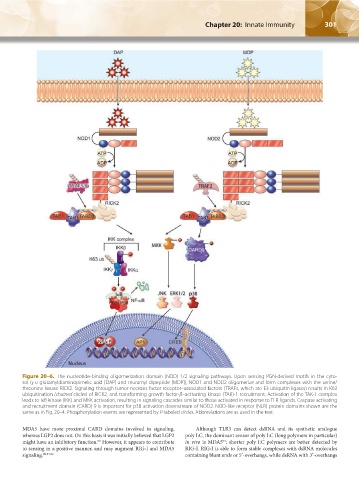
                  Figure 20–6.  The nucleotide-binding oligomerization domain (NOD) 1/2 signaling pathways. Upon sensing PGN-derived motifs in the cyto-
                  sol (γ-d-glutamyldiaminopimelic acid [DAP] and muramyl dipeptide [MDP]), NOD1 and NOD2 oligomerize and form complexes with the serine/
                  threonine kinase RICK2. Signaling through tumor necrosis factor receptor–associated factors (TRAFs, which are E3 ubiquitin ligases) results in K63
                  ubiquitination (chained circles) of RICK2, and transforming growth factor-β–activating kinase (TAK)-1 recruitment. Activation of the TAK-1 complex
                  leads to IκB kinase (IKK) and MKK activation, resulting in signaling cascades similar to those activated in response to TLR ligands. Caspase activating
                  and recruitment domain (CARD) 9 is important for p38 activation downstream of NOD2. NOD-like receptor (NLR) protein domains shown are the
                  same as in Fig. 20–4. Phosphorylation events are represented by P-labeled circles. Abbreviations are as used in the text.

                  MDA5 have more proximal CARD domains involved in signaling,   Although  TLR3  can  detect  dsRNA  and  its  synthetic  analogue
                  whereas LGP2 does not. On this basis it was initially believed that LGP2   poly I:C, the dominant sensor of poly I:C (long polymers in particular)
                                           90
                                                                                     93
                  might have an inhibitory function.  However, it appears to contribute   in vivo is MDA5 ; shorter poly I:C polymers are better detected by
                  to sensing in a positive manner, and may augment RIG-I and MDA5    RIG-I. RIG-I is able to form stable complexes with dsRNA molecules
                  signaling. 89,91,92                                   containing blunt ends or 5′-overhangs, while dsRNA with 3′-overhangs


          Kaushansky_chapter 20_p0293-0306.indd   301                                                                   9/17/15   5:52 PM

