


Page 327 - Williams Hematology ( PDFDrive )
P. 327
302            Part IV:  Molecular and Cellular Hematology                                                                                                                                 Chapter 20:  Innate Immunity            303


                                           88
               are unwound by its helicase activity.  RIG-I additionally recognizes   activate IRF3.  MAVS, in its active form, is capable of triggering three
                                                                                100
               single-stranded RNA (ssRNA) molecules, distinguishing them from   different signaling pathways. One pathway mimics the TNF signaling
               host RNA by detecting 5′-triphosphate structures such as are found in   pathway, and includes the adaptor protein TRADD, Fas-associated death
               ssRNA from the influenza virus. 94,95  RIG-I must be activated by T-cell   domain protein (FADD), RIP1, caspase-8 and caspase-10, and leads to
               receptor interacting molecule 25 (TRIM25), a host resistance factor that   IKK complex and NF-κB activation. A second pathway recruits TRAF6
               ubiquitinates RIG-I (K63 linkages).                    and MEKK1, leading to activation of the MAP kinases and AP1. These
                   Upon virus recognition the RLHs initiate signaling, leading to type   two pathways are responsible for inflammatory cytokine production. The
               I IFN and inflammatory cytokine production dependent, respectively,   third pathway entails activation of TBK1 and IKKε, and leads to the acti-
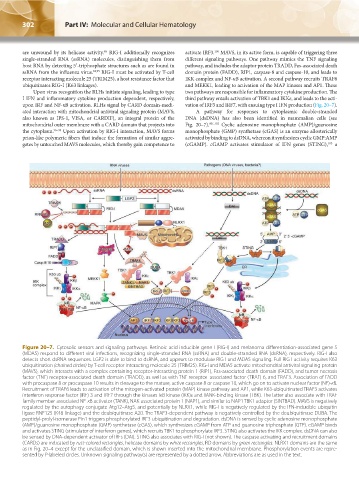
               upon IRF and NF-κB activation. RLHs signal by CARD domain-medi-  vation of IRF3 and IRF7, with ensuing type I IFN production (Fig. 20–7).
               ated interaction with mitochondrial antiviral signaling protein (MAVS;   A pathway for responses to cytoplasmic double-stranded
               also known as IPS-1, VISA, or CARDIF), an integral protein of the   DNA (dsDNA) has also been identified in mammalian cells (see
               mitochondrial outer membrane with a CARD domain that projects into   Fig. 20–7). 101,102  Cyclic adenosine monophosphate (AMP)/guanosine
               the cytoplasm. 96–99  Upon activation by RIG-I interaction, MAVS forms   monophosphate (GMP) synthetase (cGAS) is an enzyme allosterically
               prion-like polymeric fibers that induce the formation of similar aggre-  activated by binding to dsDNA, whereon it synthesizes cyclic GMP:AMP
               gates by untouched MAVS molecules, which thereby gain competence to   (cGAMP). cGAMP activates stimulator of IFN genes (STING),  a
                                                                                                                      103


               Figure 20–7.  Cytosolic sensors and signaling pathways. Retinoic acid inducible gene I (RIG-I) and melanoma differentiation-associated gene 5
               (MDA5) respond to different viral infections, recognizing single-stranded RNA (ssRNA) and double-stranded RNA (dsRNA), respectively. RIG-I also
               detects short dsRNA sequences. LGP2 is able to bind to dsRNA, and appears to modulate RIG-I and MDA5 signaling. Full RIG-I activity requires K63
               ubiquitination (chained circles) by T-cell receptor interacting molecule 25 (TRIM25). RIG-I and MDA5 activate mitochondrial antiviral signaling protein
               (MAVS), which interacts with a complex containing receptor-interacting protein 1 (RIP1), Fas-associated death domain (FADD), and tumor necrosis
               factor (TNF) receptor-associated death domain (TRADD), as well as with TNF receptor–associated factor (TRAF) 6, and TRAF3. Association of FADD
               with procaspase 8 or procaspase 10 results in cleavage to the mature, active caspase 8 or caspase 10, which go on to activate nuclear factor (NF)-κB.
               Recruitment of TRAF6 leads to activation of the mitogen-activated protein (MAP) kinase pathway and AP1, while K63-ubiquitinated TRAF3 activates
               interferon response factor (IRF) 3 and IRF7 through the kinases IκB kinase (IKK)ε and TANK-binding kinase (TBK). The latter also associate with TRAF
               family member-associated NF-κB activator (TANK), NAK-associated protein 1 (NAP1), and similar to NAP1 TBK1 adaptor (SINTBAD). MAVS is negatively
               regulated by the autophagy conjugate Atg12–Atg5, and potentially by NLRX1, while RIG-I is negatively regulated by the IFN-inducible ubiquitin
               ligase RNF125 (K48 linkage) and the deubiquitinase A20. The TRAF3-dependent pathway is negatively controlled by the deubiquitinase DUBA. The
               peptidyl-prolyl-isomerase Pin1 triggers phosphorylated IRF3 ubiquitination and degradation. dsDNA is sensed by cyclic adenosine monophosphate
               (AMP)/guanosine monophosphate (GMP) synthetase (cGAS), which synthesizes cGAMP from ATP and guanosine triphosphate (GTP). cGAMP binds
               and activates STING (stimulator of interferon genes), which recruits TBK1 to phosphorylate IRF3. STING also activates the IKK complex. dsDNA can also
               be sensed by DNA-dependent activator of IRFs (DAI). STING also associates with RIG-I (not shown). The caspase activating and recruitment domains
               (CARDs) are indicated by rust-colored rectangles, helicase domains by white rectangles, RD domains by green rectangles. NLRX1 domains are the same
               as in Fig. 20–4 except for the unclassified domain, which is shown inserted into the mitochondrial membrane. Phosphorylation events are repre-
               sented by P-labeled circles. Unknown signaling pathway(s) are represented by a dotted arrow. Abbreviations are as used in the text.


          Kaushansky_chapter 20_p0293-0306.indd   302                                                                   9/17/15   5:52 PM

