


Page 498 - Williams Hematology ( PDFDrive )
P. 498
472  Part VI:  The Erythrocyte                   Chapter 31:  Structure and Composition of the Erythrocyte            473


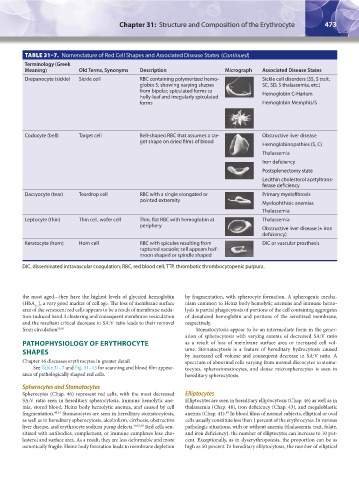
                   TABLE 31–7.  Nomenclature of Red Cell Shapes and Associated Disease States   (Continued)
                   Terminology (Greek
                   Meaning)          Old Terms, Synonyms  Description                 Micrograph  Associated Disease States
                   Drepanocyte (sickle)  Sickle cell     RBC containing polymerized hemo-         Sickle cell disorders (SS, S trait,
                                                         globin S; showing varying shapes         SC, SD, S thalassemia, etc.)
                                                         from bipolar, spiculated forms to        Hemoglobin C-Harlem
                                                         holly-leaf and irregularly spiculated
                                                         forms                                    Hemoglobin Memphis/S


                   Codocyte (bell)   Target cell         Bell-shaped RBC that assumes a tar-      Obstructive liver disease
                                                         get shape on dried films of blood
                                                                                                  Hemoglobinopathies (S, C)
                                                                                                  Thalassemia
                                                                                                  Iron deficiency
                                                                                                  Postsplenectomy state
                                                                                                  Lecithin cholesterol acetyltrans-
                                                                                                  ferase deficiency
                   Dacryocyte (tear)  Teardrop cell      RBC with a single elongated or           Primary myelofibrosis
                                                         pointed extremity
                                                                                                  Myelophthisic anemias
                                                                                                  Thalassemia
                   Leptocyte (thin)  Thin cell, wafer cell  Thin, flat RBC with hemoglobin at     Thalassemia
                                                         periphery
                                                                                                  Obstructive liver disease (± iron
                                                                                                  deficiency)
                   Keratocyte (horn)  Horn cell          RBC with spicules resulting from         DIC or vascular prosthesis
                                                         ruptured vacuole; cell appears half-
                                                         moon shaped or spindle shaped
                  DIC, disseminated intravascular coagulation; RBC, red blood cell; TTP, thrombotic thrombocytopenic purpura.


                  the most aged—they have the highest levels of glycated hemoglobin   by fragmentation, with spherocyte formation. A spherogenic mecha-
                  (HbA ), a very good marker of cell age. The loss of membrane surface   nism common to Heinz body hemolytic anemias and immune hemo-
                      1C
                  area of the senescent red cells appears to be a result of membrane oxida-  lysis is partial phagocytosis of portions of the cell containing aggregates
                  tion-induced band 3 clustering and consequent membrane vesiculation   of denatured hemoglobin and portions of the sensitized membrane,
                  and the resultant critical decrease in SA:V ratio leads to their removal   respectively.
                  from circulation 59,60                                    Stomatocytosis appear to be an intermediate form in the gener-
                                                                        ation of spherocytosis with varying extents of decreased SA:V ratio
                  PATHOPHYSIOLOGY OF ERYTHROCYTE                        as  a result of loss  of membrane  surface area or  increased  cell  vol-
                  SHAPES                                                ume. Stomatocytosis is a feature of hereditary hydrocytosis caused
                                                                        by increased cell volume and consequent decrease in SA:V ratio. A
                  Chapter 46 discusses erythrocytes in greater detail.  spectrum of abnormal cells varying from normal discocytes to stoma-
                     See Table 31–7 and Fig. 31–13 for scanning and blood film appear-  tocytes, spherostomatocytes, and dense microspherocytes is seen in
                  ance of pathologically shaped red cells.              hereditary spherocytosis.
                  Spherocytes and Stomatocytes
                  Spherocytes (Chap. 46) represent red cells, with the most decreased   Elliptocytes
                  SA:V ratio seen in hereditary spherocytosis, immune hemolytic ane-  Elliptocytes are seen in hereditary elliptocytosis (Chap. 46) as well as in
                  mia, stored blood, Heinz body hemolytic anemia, and caused by cell   thalassemia (Chap. 48), iron deficiency (Chap. 43), and megaloblastic
                  fragmentation. 49,61  Stomatocytes are seen in hereditary stomatocytosis,   anemia (Chap. 41).  In blood films of normal subjects, elliptical or oval
                                                                                      49
                  as well as in hereditary spherocytosis, alcoholism, cirrhosis, obstructive   cells usually constitute less than 1 percent of the erythrocytes. In various
                  liver disease, and erythrocyte sodium pump defects. 49,62,63  Red cells sen-  pathologic situations, with or without anemia (thalassemia trait, folate,
                  sitized with antibodies, complement, or immune complexes lose cho-  and iron deficiency), the number of elliptocytes can increase to 10 per-
                  lesterol and surface area. As a result, they are less deformable and more   cent. Exceptionally, as in dyserythropoiesis, the proportion can be as
                  osmotically fragile. Heinz body formation leads to membrane depletion   high as 50 percent. In hereditary elliptocytosis, the number of elliptical


          Kaushansky_chapter 31_p0459-0478.indd   473                                                                   9/18/15   10:59 PM

