


Page 496 - Williams Hematology ( PDFDrive )
P. 496
470  Part VI:  The Erythrocyte                   Chapter 31:  Structure and Composition of the Erythrocyte            471


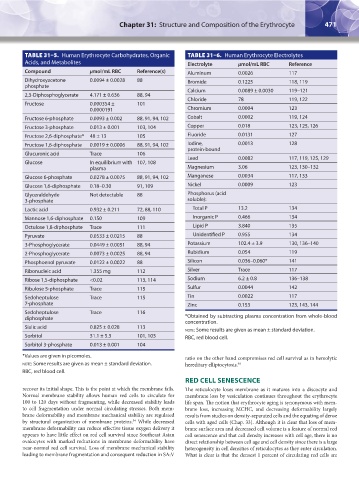
                   TABLE 31–5.  Human Erythrocyte Carbohydrates, Organic   TABLE 31–6.  Human Erythrocyte Electrolytes
                   Acids, and Metabolites                                Electrolyte      μmol/mL RBC      Reference
                   Compound             μmol/mL RBC     Reference(s)     Aluminum         0.0026           117
                   Dihydroxyacetone     0.0094 ± 0.0028  88              Bromide          0.1225           118, 119
                   phosphate
                                                                         Calcium          0.0089 ± 0.0030  119–121
                   2,3-Diphosphoglycerate  4.171 ± 0.636  88, 94
                                                                         Chloride         78               119, 122
                   Fructose             0.000354 ±      101
                                        0.0000191                        Chromium         0.0004           123
                   Fructose 6-phosphate  0.0093 ± 0.002  88, 91, 94, 102  Cobalt          0.0002           119, 124
                   Fructose 3-phosphate  0.013 ± 0.001  103, 104         Copper           0.018            123, 125, 126
                   Fructose 2,6-diphosphate*  48 ± 13   105              Fluoride         0.0131           127
                   Fructose 1,6-diphosphate  0.0019 ± 0.0006  88, 91, 94, 102  Iodine,    0.0013           128
                                                                         protein-bound
                   Glucuronic acid      Trace           106
                                                                         Lead             0.0082           117, 119, 125, 129
                   Glucose              In equilibrium with  107, 108
                                        plasma                           Magnesium        3.06             123, 130–132
                   Glucose 6-phosphate  0.0278 ± 0.0075  88, 91, 94, 102  Manganese       0.0034           117, 133
                   Glucose 1,6-diphosphate  0.18–0.30   91, 109          Nickel           0.0009           123
                   Glyceraldehyde       Not detectable  88               Phosphorus (acid
                   3-phosphate                                           soluble):
                   Lactic acid          0.932 ± 0.211   72, 88, 110        Total P        13.2             134
                   Mannose 1,6-diphosphate  0.150       109                Inorganic P    0.466            134
                   Octulose 1,8-diphosphate  Trace      111                Lipid P        3.840            135
                   Pyruvate             0.0533 ± 0.0215  88                Unidentified P  0.955           134
                   3-Phosphoglycerate   0.0449 ± 0.0051  88, 94          Potassium        102.4 ± 3.9      130, 136–140
                   2-Phosphoglycerate   0.0073 ± 0.0025  88, 94          Rubidium         0.054            119
                   Phosphoenol pyruvate  0.0122 ± 0.0022  88             Silicon          0.036–0.060*     141
                   Ribonucleic acid     1.355 mg        112              Silver           Trace            117
                   Ribose 1,5-diphosphate  <0.02        113, 114         Sodium           6.2 ± 0.8        136–138
                   Ribulose 5-phosphate  Trace          115              Sulfur           0.0044           142
                   Sedoheptulose        Trace           115              Tin              0.0022           117
                   7-phosphate                                           Zinc             0.153            123, 143, 144
                   Sedoheptulose        Trace           116
                   diphosphate                                          *Obtained by subtracting plasma concentration from whole-blood
                                                                        concentration.
                   Sialic acid          0.825 ± 0.028   113
                                                                        note: Some results are given as mean ± standard deviation.
                   Sorbitol             31.1 ± 5.3      101, 103        RBC, red blood cell.
                   Sorbitol 3-phosphate  0.013 ± 0.001  104
                  *Values are given in picomoles.                       ratio on the other hand compromises red cell survival as in hemolytic
                  note: Some results are given as mean ± standard deviation.   hereditary elliptocytosis. 49
                  RBC, red blood cell.
                                                                        RED CELL SENESCENCE
                  recover its initial shape. This is the point at which the membrane fails.   The reticulocyte loses membrane as it matures into a discocyte and
                  Normal  membrane  stability allows  human red cells  to circulate  for   membrane loss by vesiculation continues throughout the erythrocyte
                  100 to 120 days without fragmenting, while decreased stability leads   life span. The notion that erythrocyte aging is synonymous with mem-
                  to cell fragmentation under normal circulating stresses. Both mem-  brane loss, increasing MCHC, and decreasing deformability largely
                  brane deformability and membrane mechanical stability are regulated   results from studies on density-separated cells and the equating of dense
                                                       54
                  by structural organization of membrane proteins.  While decreased   cells with aged cells (Chap. 33). Although it is clear that loss of mem-
                  membrane deformability can reduce effective tissue oxygen delivery it   brane surface area and decreased cell volume is a feature of normal red
                  appears to have little effect on red cell survival since Southeast Asian   cell senescence and that cell density increases with cell age, there is no
                  ovalocytes with marked reductions in membrane deformability have   direct relationship between cell age and cell density since there is a large
                  near-normal red cell survival. Loss of membrane mechanical stability   heterogeneity in cell densities of reticulocytes as they enter circulation.
                  leading to membrane fragmentation and consequent reduction in SA:V   What is clear is that the densest 1 percent of circulating red cells are


          Kaushansky_chapter 31_p0459-0478.indd   471                                                                   9/18/15   10:59 PM

