


Page 495 - Williams Hematology ( PDFDrive )
P. 495
470            Part VI:  The Erythrocyte                                                                                                                      Chapter 31:  Structure and Composition of the Erythrocyte            471


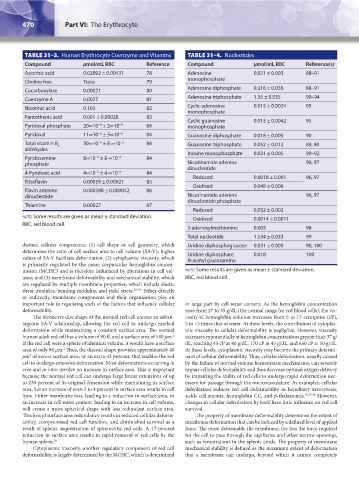
                TABLE 31–3.  Human Erythrocyte Coenzyme and Vitamins   TABLE 31–4.  Nucleotides
                Compound            μmol/mL RBC          Reference     Compound              μmol/mL RBC       Reference(s)
                Ascorbic acid       0.02892 ± 0.00431    78            Adenosine             0.021 ± 0.003     88–91
                Choline free        Trace                79            monophosphate
                Cocarboxylase       0.00021              80            Adenosine diphosphate  0.216 ± 0.036    88–91
                Coenzyme A          0.0027               81            Adenosine triphosphate  1.35 ± 0.035    90–94
                Nicotinic acid      0.105                82            Cyclic adenosine      0.015 ± 0.0024    95
                                                                       monophosphate
                Pantothenic acid    0.001 ± 0.00028      83
                                                                       Cyclic guanosine      0.013 ± 0.0042    95
                Pyridoxal phosphate  20∞10  ± 2∞10 −6    84            monophosphate
                                         −6
                                         −6
                Pyridoxal           11∞10  ± 3∞10 −6     84            Guanosine diphosphate  0.018 ± 0.005    90
                Total vitamin B     30∞10  ± 8 ∞10 −6    84            Guanosine triphosphate  0.052 ± 0.012   89, 90
                                         −6
                           6
                aldehydes
                                                                       Inosine monophosphate  0.031 ± 0.005    90–92
                Pyridoxamine        8∞10  ± 8 ∞10 −6     84
                                        −6
                phosphate                                              Nicotinamide adenine                    96, 97
                                                                       dinucleotide
                4-Pyridoxic acid    4∞10  ± 4 ∞10 −6     84
                                        −6
                                                                         Reduced             0.0018 ± 0.001    96, 97
                Riboflavin          0.00059 ± 0.00021    85
                                                                         Oxidized            0.049 ± 0.006
                Flavin adenine      0.000398 ± 0.000042  86
                dinucleotide                                           Nicotinamide adenine                    96, 97
                                                                       dinucleotide phosphate
                Thiamine            0.00027              87
                                                                         Reduced             0.032 ± 0.002
               note: Some results are given as mean ± standard deviation.     Oxidized       0.0014 ± 0.0011
               RBC, red blood cell.
                                                                       S-adenosylmethionine  0.005             98
                                                                       Total nucleotide      1.534 ± 0.033     99
               distinct cellular components: (1) cell shape or cell geometry, which   Uridine diphosphoglucose  0.031 ± 0.005  90, 100
               determines the ratio of cell surface area to cell volume (SA:V); higher
               values of SA:V facilitate deformation; (2) cytoplasmic viscosity, which   Uridine diphosphate   0.018  100
                                                                       N-acetyl glucosamine
               is primarily regulated by the mean corpuscular hemoglobin concen-
               tration (MCHC) and is therefore influenced by alterations in cell vol-  note: Some results are given as mean ± standard deviation.
               ume; and (3) membrane deformability and mechanical stability, which   RBC, red blood cell.
               are regulated by multiple membrane properties, which include elastic
               shear modulus, bending modulus, and yield stress. 52–55  Either directly
               or indirectly, membrane components and their organization play an
               important role in regulating each of the factors that influence cellular   in large part by cell water content. As the hemoglobin concentration
               deformability.                                         rises from 27 to 35 g/dL (the normal range for red blood cells), the vis-
                   The biconcave disc shape of the normal red cell creates an advan-  cosity of hemoglobin solution increases from 5 to 15 centipoise (cP),
               tageous  SA:V  relationship,  allowing  the  red cell  to  undergo  marked   5 to 15 times that of water. At these levels, the contribution of cytoplas-
               deformation while maintaining a constant surface area. The normal   mic viscosity to cellular deformability is negligible. However, viscosity
               human adult red cell has a volume of 90 fL and a surface area of 140 μm.    increases exponentially at hemoglobin concentrations greater than 37 g/
                                                                  2
               If the red cell were a sphere of identical volume, it would have a surface   dL, reaching 45 cP at 40 g/dL, 170 cP at 45 g/dL, and 650 cP at 50 g/dL.
               area of only 98 μm.  Thus, the discoid shape provides approximately 40   At these levels, cytoplasmic viscosity may become the primary determi-
                             2
               μm  of excess surface area, or an extra 43 percent, that enables the red   nant of cellular deformability. Thus, cellular dehydration, usually caused
                  2
               cell to undergo extensive deformation. Most deformations occurring in   by the failure of normal volume homeostasis mechanisms, can severely
               vivo and in vitro involve no increase in surface area. This is important   impair cellular deformability and thus decrease optimal oxygen delivery
               because the normal red cell can undergo large linear extensions of up   by impairing the ability of red cells to undergo rapid deformation nec-
               to 230 percent of its original dimension while maintaining its surface   essary for passage through the microvasculature. As examples, cellular
               area, but an increase of even 3 to 4 percent in surface area results in cell   dehydration reduces red cell deformability in hereditary xerocytosis,
               lysis. Either membrane loss, leading to a reduction in surface area, or   sickle cell anemia, hemoglobin CC, and β-thalassemia. 55,57,58  However,
               an increase in cell water content, leading to an increase in cell volume,   changes in cellular dehydration by itself have little influence on red cell
               will create a more spherical shape with less redundant surface area.   survival.
               This loss of surface area redundancy results in reduced cellular deform-  The property of membrane deformability determines the extent of
               ability, compromised red cell function, and diminished survival as a   membrane deformation that can be induced by a defined level of applied
               result of splenic sequestration of spherocytic red cells. A 17-percent   force. The more deformable the membrane, the less the force required
               reduction in surface area results in rapid removal of red cells by the   for the cell to pass through the capillaries and other narrow openings,
               human spleen. 56                                       such as fenestrations in the splenic cords. The property of membrane
                   Cytoplasmic viscosity, another regulatory component of red cell   mechanical stability is defined as the maximum extent of deformation
               deformability, is largely determined by the MCHC, which is determined     that a membrane can undergo, beyond which it cannot completely


          Kaushansky_chapter 31_p0459-0478.indd   470                                                                   9/18/15   10:59 PM

