


Page 493 - Williams Hematology ( PDFDrive )
P. 493
468            Part VI:  The Erythrocyte                                                                                                                      Chapter 31:  Structure and Composition of the Erythrocyte            469


               in the red cell and usually no larger than 0.5 μm in diameter. Howell-  cell a characteristic “golf ball–like” appearance when viewed by light
               Jolly bodies may be numerous, although generally only one is present.   microscopy. Methylene blue and new methylene blue generate a smaller
               In pathologic situations, they appear to represent chromosomes that   number  of  variably sized  membrane-bound  and  floating  inclusions.
               have separated from the mitotic spindle during abnormal mitosis, and   These changes are seen most frequently in α-thalassemia but also can
               contain a high proportion of centromeric material along with het-  be found in patients with unstable hemoglobin (Chap. 49) and in rare
               erochromatin. More commonly, during normal maturation they arise   patients with primary myelofibrosis who develop acquired hemoglobin
               from nuclear fragmentation or incomplete expulsion of the nucleus.   H disease.
               Howell-Jolly bodies are pitted from the reticulocytes during their tran-
               sit through the interendothelial slits of the splenic sinus. They are char-  Siderosomes and Pappenheimer Bodies
               acteristically present in the blood of splenectomized persons and in   Normal or pathologic red cells in blood containing siderosomes (“iron
               patients suffering from megaloblastic anemia, and hyposplenic states.  bodies”) usually are reticulocytes. The iron granulations are larger and
                                                                      more numerous in the pathologic state (Chap. 59). Electron microscopy
               Pocked (or Pitted) Red Cells                           shows that many of these bodies are mitochondria containing ferrug-
               When viewed by interference-phase microscopy, pocked red cells appear   inous micelles rather than the ferritin aggregates characterizing nor-
               to have surface membrane “pits” or craters. 37–39  The vesicles or indenta-  mal siderocytes.  Siderosomes usually are found in the cell periphery,
                                                                                  47
               tions characterizing these cells represent autophagic vacuoles adjacent to   whereas  basophilic  stippling  tends  to be distributed  homogeneously
               the cell membrane. The vacuoles appear to be instrumental in disposal of   throughout the cell. Pappenheimer bodies are siderosomes that stain
               cellular debris as the erythrocyte passes through the microcirculation of   with Wright stain. Electron microscopy of Pappenheimer bodies shows
               the spleen. Within 1 week following splenectomy, pocked red cell counts   that the iron often is contained within a lysosome, as confirmed by the
               begin to rise, reaching a plateau at 2 to 3 months. Pocked red blood cell   presence of acid phosphatase. Siderosomes may contain degenerating
               counts sometimes are used as a surrogate test for splenic function.  mitochondria, ribosomes, and other cellular remnants.

               Cabot Rings                                            STRUCTURE AND SHAPE OF ERYTHROCYTES
               The  ring-like  or  figure-of-eight  structures  sometimes  seen  in  meg-
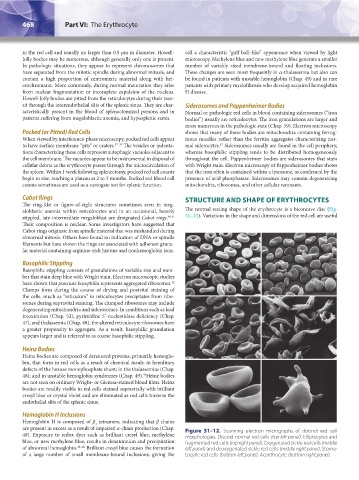
               aloblastic anemia within reticulocytes and in an occasional, heavily   The normal resting shape of the erythrocyte is a biconcave disc (Fig.
               stippled, late-intermediate megaloblast are designated Cabot rings. 40,41    31–12). Variations in the shape and dimensions of the red cell are useful
               Their composition is nuclear. Some investigators have suggested that
               Cabot rings originate from spindle material that was mishandled during
               abnormal mitosis. Others have found no indication of DNA or spindle
               filaments but have shown the rings are associated with adherent granu-
               lar material containing arginine-rich histone and nonhemoglobin iron.

               Basophilic Stippling
               Basophilic stippling consists of granulations of variable size and num-
               ber that stain deep blue with Wright stain. Electron microscopic studies
                                                                 42
               have shown that punctate basophilia represents aggregated ribosomes.
               Clumps form during the course of drying and postvital staining of
               the cells, much as “reticulum” in reticulocytes precipitates from ribo-
               somes during supravital staining. The clumped ribosomes may include
               degenerating mitochondria and siderosomes. In conditions such as lead
               intoxication (Chap. 52), pyrimidine 5′-nucleotidase deficiency (Chap.
               47), and thalassemia (Chap. 48), the altered reticulocyte ribosomes have
               a greater propensity to aggregate. As a result, basophilic granulation
               appears larger and is referred to as coarse basophilic stippling.

               Heinz Bodies
               Heinz bodies are composed of denatured proteins, primarily hemoglo-
               bin, that form in red cells as a result of chemical insult; in hereditary
               defects of the hexose monophosphate shunt; in the thalassemias (Chap.
                                                        43
               48); and in unstable hemoglobin syndromes (Chap. 49). Heinz bodies
               are not seen on ordinary Wright- or Giemsa-stained blood films. Heinz
               bodies are readily visible in red cells stained supravitally with brilliant
               cresyl blue or crystal violet and are eliminated as red cells traverse the
               endothelial slits of the splenic sinus.
               Hemoglobin H Inclusions
               Hemoglobin H is composed of β  tetramers, indicating that β chains
                                        4
               are present in excess as a result of impaired α-chain production (Chap.   Figure  31–12.  Scanning electron micrographs of distinct red cell
               48). Exposure to redox dyes such as brilliant cresyl blue, methylene   morphologies. Discoid normal red cells (top left panel). Elliptocytes and
               blue, or new methylene blue, results in denaturation and precipitation   fragmented red cells (top right panel). Oxygenated sickle red cells (middle
               of abnormal hemoglobin. 44–46  Brilliant cresyl blue causes the formation   left panel) and deoxygenated sickle red cells (middle right panel). Stoma-
               of a large number of small membrane-bound inclusions, giving the   tocytic red cells (bottom left panel). Acanthocyte (bottom right panel).


          Kaushansky_chapter 31_p0459-0478.indd   468                                                                   9/18/15   10:59 PM

