


Page 494 - Williams Hematology ( PDFDrive )
P. 494
468  Part VI:  The Erythrocyte                   Chapter 31:  Structure and Composition of the Erythrocyte            469


                  in the differential diagnosis of anemias. Normal human red cells have   TABLE 31–1.  Human Erythrocyte Protein and Water
                  a diameter of 7 to 8 μm, and the diameter decreases slightly with cell
                  age. The size decrease likely results from loss of membrane surface area   Content
                  during erythrocyte life span by spleen-facilitated vesiculation. The cells   Component  mg/mL RBC  Reference(s)
                  have an average volume of approximately 90 fL and a surface area of   Water  721 ± 17.3    71
                  approximately 140 μm.  The membrane is present in sufficient excess to
                                  2
                  allow the cell to swell to a sphere of approximately 150 fL or to deform so   Total protein  371  71
                  as to enter a capillary with a diameter of 2.8 μm. The normal erythrocyte   Nonhemoglobin   9.2  71, 72
                  stains reddish-brown with Wright-stained blood films and pink with   protein
                  Giemsa stain. The central third of the cell appears relatively pale com-  Insoluble stroma   6.3  72
                  pared with the periphery, reflecting its biconcave shape. Many artifacts   protein
                  can be produced in the preparation of the blood film. They may result   Enzyme proteins  2.9  72
                  from contamination of the glass slide or coverslip with traces of fat, deter-
                  gent, or other impurities. Friction and surface tension involved in the   Extensive study by   73, 74
                  preparation of the blood film produce fragmentation, “doughnut cells”   proteomic methods
                  or anulocytes, and crescent-shaped cells. Observed under the phase-
                  contrast or interference microscope, the red cell shows a characteristic
                                                   48
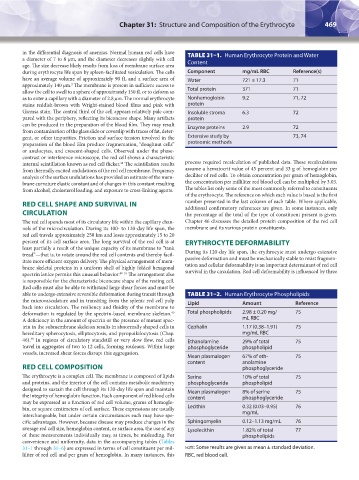
                  internal scintillation known as red cell flicker.  The scintillation results   process required recalculation of published data. These recalculations
                  from thermally excited undulations of the red cell membrane. Frequency   assume a hematocrit value of 45 percent and 33 g of hemoglobin per
                  analysis of the surface undulations has provided an estimate of the mem-  deciliter of red cells. To obtain concentration per gram of hemoglobin,
                  brane curvature elastic constant and of changes in this constant resulting   the concentration per milliliter red blood cell can be multiplied by 3.03.
                  from alcohol, cholesterol loading, and exposure to cross-linking agents.  The tables list only some of the most commonly referred to constituents
                                                                        of the erythrocyte. The reference on which each value is based is the first
                  RED CELL SHAPE AND SURVIVAL IN                        number presented in the last column of each table. Where applicable,
                                                                        additional confirmatory references are given. In some instances, only
                  CIRCULATION                                           the percentage of the total of the type of constituent present is given.
                  The red cell spends most of its circulatory life within the capillary chan-  Chapter 46 discusses the detailed protein composition of the red cell
                  nels of the microcirculation. During its 100- to 120-day life span, the   membrane and its various protein constituents.
                  red cell travels approximately 250 km and loses approximately 15 to 20
                  percent of its cell surface area. The long survival of the red cell is at   ERYTHROCYTE DEFORMABILITY
                  least partially a result of the unique capacity of its membrane to “tank
                  tread”—that is, to rotate around the red cell contents and thereby facil-  During its 120-day life span, the erythrocyte must undergo extensive
                  itate more efficient oxygen delivery. The physical arrangement of mem-  passive deformation and must be mechanically stable to resist fragmen-
                  brane skeletal proteins in a uniform shell of highly folded hexagonal   tation and cellular deformability is an important determinant of red cell
                  spectrin lattice permits this unusual behavior. 49–51  The arrangement also   survival in the circulation. Red cell deformability is influenced by three
                  is responsible for the characteristic biconcave shape of the resting cell.
                  Red cells must also be able to withstand large shear forces and must be
                  able to undergo extensive reversible deformation during transit through   TABLE 31–2.  Human Erythrocyte Phospholipids
                  the microvasculature and in transiting from the splenic red cell pulp   Lipid  Amount      Reference
                  back into circulation. The resiliency and fluidity of the membrane to
                  deformation is regulated by the spectrin-based membrane skeleton.    Total phospholipids  2.98 ± 0.20 mg/  75
                                                                    49
                  A deficiency in the amount of spectrin or the presence of mutant spec-    mL RBC
                  trin in the submembrane skeleton results in abnormally shaped cells in   Cephalin  1.17 (0.38–1.91)   75
                  hereditary spherocytosis, elliptocytosis, and pyropoikilocytosis (Chap.   mg/mL RBC
                  46).  In regions of circulatory standstill or very slow flow, red cells   Ethanolamine   29% of total   75
                     49
                  travel in aggregates of two to 12 cells, forming rouleaux. Within large   phosphoglyceride  phospholipid
                  vessels, increased shear forces disrupt this aggregation.
                                                                         Mean plasmalogen   67% of eth-      75
                                                                         content            anolamine
                  RED CELL COMPOSITION                                                      phosphoglyceride
                  The erythrocyte is a complex cell. The membrane is composed of lipids   Serine   10% of total   75
                  and proteins, and the interior of the cell contains metabolic machinery   phosphoglyceride  phospholipid
                  designed to sustain the cell through its 120-day life span and maintain   Mean plasmalogen   8% of serine   75
                  the integrity of hemoglobin function. Each component of red blood cells   content  phosphoglyceride
                  may be expressed as a function of red cell volume, grams of hemoglo-
                  bin, or square centimeters of cell surface. These expressions are usually   Lecithin  0.32 (0.03–0.95)   76
                  interchangeable, but under certain circumstances each may have spe-       mg/mL
                  cific advantages. However, because disease may produce changes in the   Sphingomyelin  0.12–1.13 mg/mL  76
                  average red cell size, hemoglobin content, or surface area, the use of any   Lysolecithin  1.82% of total   77
                  of these measurements individually may, at times, be misleading. For      phospholipids
                  convenience and uniformity, data in the accompanying tables (Tables
                  31–1 through 31–6) are expressed in terms of cell constituent per mil-  note: Some results are given as mean ± standard deviation.
                  liliter of red cell and per gram of hemoglobin. In many instances, this   RBC, red blood cell.


          Kaushansky_chapter 31_p0459-0478.indd   469                                                                   9/18/15   10:59 PM

