


Page 548 - Williams Hematology ( PDFDrive )
P. 548
522  Part VI:  The Erythrocyte                         Chapter 35:  Aplastic Anemia: Acquired and Inherited           523


                                                                                 157
                           Survival after allogeneic transplants for SAA, 2001-2011  age 20 years.  These guidelines are subject to the unique or special cir-
                    100                                                 cumstances of an individual case. For example, if patients with aplastic
                                       ≤20 y, sibling donor (N = 1,371)
                                                                        anemia undergo gene sequencing and a mutation known to be a driver
                     80                >20 y, sibling donor (N = 1,392)  mutation for myelodysplasia or AML is found, allogeneic hematopoietic
                                                                        stem cell transplantation may prove to be a preferred approach.
                   Probability, %  60  ≤20 y, unrelated donor (N = 703)  Components of Anti–T-Lymphocyte (Immunosuppressive)

                                                                        Therapy
                     40
                                       >20 y, unrelated donor (N = 704)
                                                                        Antilymphocyte Serum and Antithymocyte Globulin ATG and ALG
                                                                        act principally by reducing cytotoxic T cells. This involves ATG-induced
                     20
                                                                        apoptosis  through  both  FAS  and  TNF  pathways.   Cathepsin  B  also
                                                                                                             161
                         P < 0.001                                      plays a role in T-cell cytotoxicity at clinical concentrations of ATG, but
                                                                                                           162
                      0                                                 may involve an independent apoptosis pathway.  ATG and ALG also
                       0       1      2       3      4       5      6   release hematopoietic growth factors from T cells. 163,164  Horse and rabbit
                                            Years                       ATG are licensed in the United States. Skin tests against horse serum
                                                    By donor type and age
                                                                        should be performed prior to administration.  If positive, the patient
                                                                                                         165
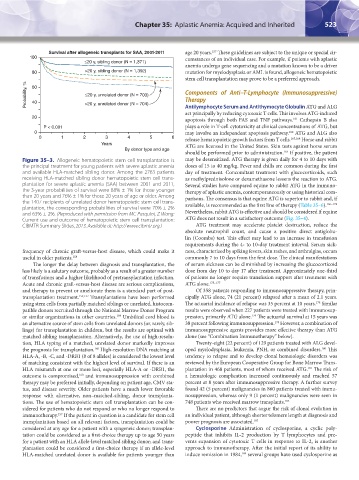
                  Figure 35–3.  Allogeneic hematopoietic stem cell transplantation is   may be desensitized. ATG therapy is given daily for 4 to 10 days with
                  the principal treatment for young patients with severe aplastic anemia   doses of 15 to 40 mg/kg. Fever and chills are common during the first
                  and available HLA-matched sibling donor. Among the 2763 patients   day of treatment. Concomitant treatment with glucocorticoids, such
                  receiving HLA-matched sibling donor hematopoietic stem cell trans-  as methylprednisolone or dexamethasone lessens the reaction to ATG.
                  plantation for severe aplastic anemia (SAA) between 2001 and 2011,   Several studies have compared equine to rabbit ATG in the immuno-
                  the 3-year probabilities of survival were 88% ± 1% for those younger   therapy of aplastic anemia, contemporaneously or using historical com-
                  than 20 years and 76% ± 1% for those 20 years of age or older. Among   parisons. The consensus is that equine ATG is superior to rabbit and, if
                  the 1407 recipients of unrelated donor hematopoietic stem cell trans-  available, is recommended as the first line of therapy (Table 35–6). 166–174
                  plantation, the corresponding probabilities of survival were 70% ± 2%
                  and 63% ± 2%. (Reproduced with permission from MC Pasquini, Z Wang:    Nevertheless, rabbit ATG is effective and should be considered if equine
                  Current use and outcome of hematopoietic stem cell transplantation:   ATG does not result in a satisfactory outcome (Fig. 35–4).
                  CIBMTR Summary Slides, 2013. Available at: http://www.cibmtr.org.)  ATG treatment may accelerate platelet destruction, reduce the
                                                                        absolute neutrophil count, and cause a positive direct antiglobu-
                                                                        lin (Coombs) test. This effect may lead to an increase in transfusion
                                                                        requirements during the 4- to 10-day treatment interval. Serum sick-
                  frequency  of  chronic  graft-versus-host  disease,  which  could  make  it   ness, characterized by spiking fevers, skin rashes, and arthralgias, occurs
                  useful in older patients. 158                         commonly 7 to 10 days from the first dose. The clinical manifestations
                     The longer the delay between diagnosis and transplantation, the   of serum sickness can be diminished by increasing the glucocorticoid
                  less likely is a salutary outcome, probably as a result of a greater number   dose from day 10 to day 17 after treatment. Approximately one-third
                  of transfusions and a higher likelihood of pretransplantation infection.   of patients no longer require transfusion support after treatment with
                  Acute and chronic graft-versus-host disease are serious complications,   ATG alone. 175–177
                  and therapy to prevent or ameliorate them is a standard part of post-  Of 358 patients responding to immunosuppressive therapy, prin-
                  transplantation treatment. 154,157  Transplantations have been performed   cipally ATG alone, 74 (21 percent) relapsed after a mean of 2.1 years.
                                                                                                                    178
                  using stem cells from partially matched siblings or unrelated, histocom-  The actuarial incidence of relapse was 35 percent at 10 years.  Similar
                  patible donors recruited through the National Marrow Donor Program   results were observed when 227 patients were treated with immunosup-
                                                                                               179
                  or similar organizations in other countries.  Umbilical cord blood is   pression, primarily ATG alone.  The actuarial survival at 15 years was
                                                 159
                  an alternative source of stem cells from unrelated donors (or, rarely, sib-  38 percent following immunosuppression.  However, a combination of
                                                                                                      178
                  lings) for transplantation in children, but the results are optimal with   immunosuppressive agents provides more effective therapy than ATG
                  matched sibling transplantation. Alternatively, the use of high-resolu-  alone (see “Combination Immunotherapy” below).
                  tion, HLA typing of a matched, unrelated donor markedly improves   Twenty-eight (22 percent) of 129 patients treated with ALG devel-
                  the prognosis for transplantation.  High-resolution DNA matching at   oped myelodysplasia, leukemia, PNH, or combined disorders.  This
                                                                                                                      180
                                          160
                  HLA-A, -B, -C, and -DRB1 (8 of 8 alleles) is considered the lowest level   tendency to relapse and to develop clonal hematologic disorders was
                  of matching consistent with the highest level of survival. If there is an   reviewed by the European Cooperative Group for Bone Marrow Trans-
                                                                                                                  181
                  HLA mismatch at one or more loci, especially HLA-A or -DRB1, the   plantation in 468 patients, most of whom received ATG.  The risk of
                  outcome is compromised,  and immunosuppression with combined   a hematologic complication increased continuously and reached 57
                                     160
                  therapy may be preferred initially, depending on patient age, CMV sta-  percent at 8 years after immunosuppressive therapy. A further survey
                  tus, and disease severity. Older patients have a much lower favorable   found 42 (5 percent) malignancies in 860 patients treated with immu-
                  response with alternative, non–matched-sibling, donor transplanta-  nosuppression, whereas only 9 (1 percent) malignancies were seen in
                  tions. The use of hematopoietic stem cell transplantation can be con-  748 patients who received marrow transplants. 182
                  sidered for patients who do not respond or who no longer respond to   There are no predictors that augur the risk of clonal evolution in
                  immunotherapy.  If the patient in question is a candidate for stem cell   an individual patient, although shorter telomere length at diagnosis and
                              157
                  transplantation based on all relevant factors, transplantation could be   poorer prognosis are associated. 183
                  considered at any age for a patient with a syngeneic donor; transplan-  Cyclosporine  Administration  of  cyclosporine,  a  cyclic  poly-
                  tation could be considered as a first-choice therapy up to age 50 years   peptide that inhibits IL-2 production by T lymphocytes and pre-
                  for a patient with an HLA allele-level matched sibling donor; and trans-  vents expansion of cytotoxic T cells in response to IL-2, is another
                  plantation could be considered a first-choice therapy if an allele-level   approach to immunotherapy. After the initial report of its ability to
                                                                                           184
                  HLA-matched unrelated donor is available for patients younger than   induce remission in 1984,  several groups have used cyclosporine as


          Kaushansky_chapter 35_p0513-0538.indd   523                                                                   9/19/15   12:24 AM

