


Page 620 - Williams Hematology ( PDFDrive )
P. 620
594  Part VI:  The Erythrocyte                  Chapter 41:  Folate, Cobalamin, and Megaloblastic Anemias             595


                           A                                           B


                           C                                           D

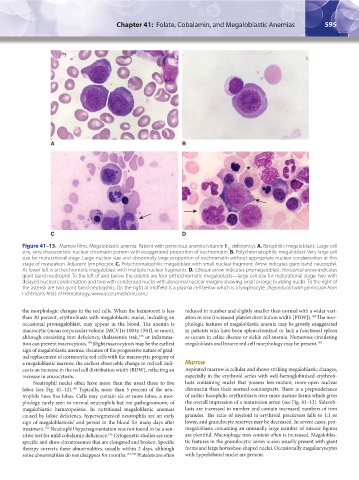
                  Figure 41–13.  Marrow films. Megaloblastic anemia. Patient with pernicious anemia (vitamin B  deficiency). A. Basophilic megaloblasts. Large cell
                                                                                       12
                  size, very characteristic nuclear chromatin pattern with exaggerated proportion of euchromatin. B. Polychromatophilic megaloblast. Very large cell
                  size for maturational stage. Large nuclear size and abnormally large proportion of euchromatin without appropriate nuclear condensation at this
                  stage of maturation. Adjacent lymphocyte. C. Polychromatophilic megaloblast with small nuclear fragment. Arrow indicates giant band neutrophil.
                  At lower left is orthochromatic megaloblast with multiple nuclear fragments. D. Oblique arrow indicates promegaloblast. Horizontal arrow indicates
                  giant band neutrophil. To the left of and below the asterisk are four orthochromatic megaloblasts—large cell size for maturational stage: two with
                  delayed nuclear condensation and two with condensed nuclei with abnormal nuclear margins showing small or large budding nuclei. To the right of
                  the asterisk are two giant band neutrophils. On the right at midfield is a plasma cell below which is a lymphocyte. (Reproduced with permission from
                  Lichtman’s Atlas of Hematology, www.accessmedicine.com.)


                  the morphologic changes in the red cells. When the hematocrit is less   reduced in number and slightly smaller than normal with a wider vari-
                  than 20 percent, erythroblasts with megaloblastic nuclei, including an   ation in size (increased platelet distribution width [PDW]).  The mor-
                                                                                                                   158
                  occasional  promegaloblast,  may  appear  in  the  blood.  The  anemia  is   phologic features of megaloblastic anemia may be grossly exaggerated
                  macrocytic (mean corpuscular volume [MCV] is 100 to 150 fL or more),   in patients who have been splenectomized or lack a functional spleen
                  although coexisting iron deficiency, thalassemia trait,  or inflamma-  as occurs in celiac disease or sickle cell anemia. Numerous circulating
                                                         153
                  tion can prevent macrocytosis.  Slight macrocytosis may be the earliest   megaloblasts and bizarre red cell morphology may be present. 159
                                        154
                  sign of megaloblastic anemia. Because of the progressive nature of grad-
                  ual replacement of normocytic red cells with the macrocytic progeny of
                  a megaloblastic marrow, the earliest observable change in red cell indi-  Marrow
                  ces is an increase in the red cell distribution width (RDW), reflecting an   Aspirated marrow is cellular and shows striking megaloblastic changes,
                  increase in anisocytosis.                             especially in the erythroid series with well-hemoglobinized erythrob-
                     Neutrophil nuclei often have more than the usual three to five   lasts containing nuclei that possess less-mature, more-open nuclear
                  lobes  (see  Fig. 41–12).  Typically, more  than 5 percent of  the neu-  chromatin than their normal counterparts. There is a preponderance
                                   155
                  trophils have five lobes. Cells may contain six or more lobes, a mor-  of earlier basophilic erythroblasts over more mature forms which gives
                  phology rarely seen in normal neutrophils but not pathognomonic of   the overall impression of a maturation arrest (see Fig. 41–13). Siderob-
                  megaloblastic hematopoiesis. In nutritional megaloblastic anemias   lasts are increased in number and contain increased numbers of iron
                  caused by folate deficiency, hypersegmented neutrophils are an early   granules. The ratio of myeloid to erythroid precursors falls to 1:1 or
                  sign of megaloblastosis  and persist in the blood for many days after   lower, and granulocyte reserves may be decreased. In severe cases, pro-
                                   5
                  treatment.  Neutrophil hypersegmentation was not found to be a sen-  megaloblasts containing an unusually large number of mitotic figures
                         155
                  sitive test for mild cobalamin deficiency.  Cytogenetic studies are non-  are plentiful. Macrophage iron content often is increased. Megaloblas-
                                               156
                  specific and show chromosomes that are elongated and broken. Specific   tic features in the granulocytic series is also usually present with giant
                  therapy corrects these abnormalities, usually within 2 days, although   forms and large horseshoe-shaped nuclei. Occasionally megakaryocytes
                  some abnormalities do not disappear for months. 151,157  Platelets are often   with hyperlobated nuclei are present.


          Kaushansky_chapter 41_p0583-0616.indd   595                                                                   9/17/15   6:24 PM

