


Page 616 - Williams Hematology ( PDFDrive )
P. 616
590  Part VI:  The Erythrocyte                  Chapter 41:  Folate, Cobalamin, and Megaloblastic Anemias             591


                        10
                  the N ,N -methylene FH  reductase reaction. For practical purposes,   because cobalamin binds much more tightly to HC than to intrin-
                      5
                                    4
                             5
                               10
                                                                                                      90
                  however, the N ,N -methylene FH  reductase reaction is irreversible in   sic factor at the acid pH of the stomach.  Upon entering the duode-
                                           4
                  vivo. 81                                              num, cobalamin is released from the cobalamin–HC protein complex
                                                                        through digestion by pancreatic proteases, which in normal subjects
                  FORMATE STARVATION HYPOTHESIS                         act by selectively degrading HC and the cobalamin–HC complex while
                                                                                          90
                  This hypothesis holds that formate starvation is the basis for folate-   sparing  intrinsic  factor.   Only  at  this  point  can  cobalamin  bind  to
                                                                        intrinsic factor to form the intrinsic factor–cobalamin complex.
                  responsive megaloblastic anemia of cobalamin deficiency.  This theory   The intrinsic factor–cobalamin complex, which is very resistant
                                                           82
                  is based on the diminished capacity of cobalamin-deficient lympho-  to digestion,  traverses the intestine until it reaches the intrinsic factor
                                                                                 91
                  blasts to incorporate formaldehyde into purine and methionine  and   receptor, cubilin,  a 460-kDa peripheral membrane glycoprotein located
                                                                79
                                                                                    92
                  on experiments showing that N -formyl FH  is more effective than FH    in the microvillus pits of the ileal mucosa brush-border. Cubilin forms
                                        5
                                                 4
                                                                    4
                  at correcting some of the abnormalities in folate metabolism seen in   part of a multifunctional epithelial receptor complex also found in the
                  cobalamin deficiency.  The hypothesis states that with the decrease in   yolk sac and renal proximal tubule cells.  In the kidney, it appears to
                                 83
                                                                                                      93
                  methionine production in cobalamin-deficient conditions, the gener-  serve a role in the overall body economy through tubular reabsorption
                  ation of formate is depressed (because normally the methyl group of   of cobalamin,  but the function of the cubilin receptor complex in the
                                                                                  94
                  excess methionine is rapidly oxidized to formate),  leading to a decline   kidney and other polarized epithelial surfaces extends beyond cobala-
                                                     84
                  in the production of N -formyl FH .
                                  5
                                           4                            min. The ileal cubilin receptor complex consists of two proteins, cubi-
                                                                        lin (CUB) and amnionless (AMN), the product of two distinct genes,
                  INTESTINAL ABSORPTION                                 CUB and AMN. Both proteins, which together have been designated
                  Intrinsic Factor                                      the “CUBAM complex,” colocalize in the endocytic compartment and
                                                                                                                  95
                  Intrinsic factor is one of a number of binding proteins in which cobal-  are required for the process of assimilation of cobalamin,  AMN serv-
                  amin is ensconced as it makes its way through the body (Table 41–2).   ing as a chaperon for endosomal targeting. Mutations affecting either
                  Intrinsic factor is needed for the absorption of cobalamins taken orally   of the two proteins disrupt the normal process of the intestinal phase
                  at physiologic dosage levels. Human intrinsic factor is a glycoprotein   of cobalamin absorption. In addition to the tightly embracing compo-
                                                                  85
                  (Mr approximately 44,000) encoded by a gene on chromosome 11.  It   nents of the CUBAM complex, a distinct large multifunctional protein,
                                                                                                                       96
                  has binding sites for cobalamin and a specific ileal receptor, the former   megalin, which belongs to the low-density lipoprotein family,  also
                  situated near the carboxy-terminus and the latter near the aminoter-  participates in the conformational changes that accompany internaliza-
                  minus of the intrinsic factor molecule.  Binding to cobalamin is very   tion. The concentration of the CUBAM complex rises progressively to
                                              86
                                                                                                    97
                  tight, and involves the 5,6-DMB lower axial ligand of the molecule. This   a maximum near the terminal ileum.  A specific site on the intrinsic
                  specificity allows for the exclusion of other noncobalamin corrinoids   factor molecule avidly attaches to the receptor in a binding reaction that
                                                                                                    2+
                                                   64
                  during the tightly regulated absorptive process.  The entrapment of the   requires a pH of 5.4 or greater and Ca  (or other divalent cations) but
                                                                                98
                  vitamin alters the conformation of intrinsic factor, producing a more   no energy.
                  compact form that is resistant to proteolytic digestion.  The intrinsic factor–cobalamin receptor complex is taken into
                                                                                                                     99
                     In humans, intrinsic factor is synthesized and secreted by the pari-  the ileal mucosal cells over 30 to 60 minutes by endocytosis,  where
                  etal cells of the cardiac and fundic mucosa.  Secretion of intrinsic fac-  the vitamin is processed and released into the portal blood over many
                                                 87
                  tor usually parallels that of hydrochloric acid (HCl). It is enhanced by   hours. The receptors recycle to the microvillus surface to shuttle another
                                                                                                         99
                  the presence of food in the stomach, vagal stimulation, histamine, and   load of intrinsic factor–cobalamin complex.  That this process has a
                  gastrin. Gastric juice also contains other cobalamin-binding glycopro-  limited capacity is evident from estimates of the maximum amount of
                      88
                  teins.  These proteins were known as the R proteins because of their   cobalamin that can be absorbed from a single dose via this physiologic
                                                                               64,100
                  rapid electrophoretic mobility compared with intrinsic factor. Elucida-  pathway.   Defects in the genes that regulate the complex mechanism
                  tion of the primary protein structure of the R proteins reveals that they   of ileal absorption are implicated in autosomal recessive megaloblastic
                  belong to the same family of isoproteins as the plasma haptocorrin (HC)   anemia (MGA1), caused by intestinal malabsorption of cobalamin (see
                  binder (previously known as transcobalamins I and III). These HC-like   “Selective  Malabsorption  of  Cobalamin,  Autosomal  Recessive  Meg-
                  proteins are produced mainly by the salivary glands.  aloblastic Anemia, Imerslund-Gräsbeck Disease” below).
                                                                            During its sojourn in the ileal enterocyte, the vitamin first appears
                  Absorption of Cobalamin: Cubilin                      in the lysosomes, but by 4 hours most of the vitamin is located in the
                                                                              101
                                                                    89
                  Cobalamins in foods are liberated in the stomach by peptic digestion.    cytosol.  During absorption, the entire intrinsic factor–cobalamin
                  They are then bound not to intrinsic factor but to the HC-like protein   complex appears to be taken into the cell, where the cobalamin is
                                                                        released while the intrinsic factor is degraded. 102
                                                                            Cobalamin from a small oral dose (10 to 20 mcg) starts to appear
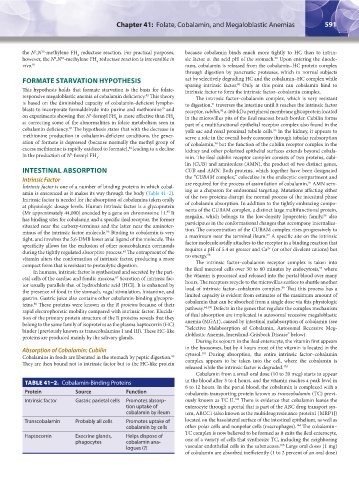
                   TABLE 41–2.  Cobalamin-Binding Proteins              in the blood after 3 to 4 hours, and the vitamin reaches a peak level in
                                                                        6 to 12 hours. In the portal blood, the cobalamin is complexed with a
                   Protein          Source           Function           cobalamin-transporting protein known as transcobalamin (TC) previ-
                                                                                         103
                   Intrinsic factor  Gastric parietal cells  Promotes absorp-  ously known as TC II.  There is evidence that cobalamin leaves the
                                                     tion uptake of     enterocyte through a portal that is part of the ABC drug transport sys-
                                                     cobalamin by ileum  tem, ABCC1 (also known as the multidrug resistance protein1 [MRP1])
                   Transcobalamin   Probably all cells  Promotes uptake of   located on the basolateral surface of the intestinal epithelium, as well as
                                                                                                              104
                                                     cobalamin by cells  other polar cells and nonpolar cells (macrophages).  The cobalamin–
                                                                        TC complex is now believed to be formed as it exits the ileal enterocyte,
                   Haptocorrin      Exocrine glands,   Helps dispose of
                                    phagocytes       cobalamin ana-     one of a variety of cells that synthesize TC, including the neighboring
                                                                                                        105
                                                     logues (?)         vascular endothelial cells in the submucosa.  Large oral doses (1 mg)
                                                                        of cobalamin are absorbed inefficiently (1 to 2 percent of an oral dose)
          Kaushansky_chapter 41_p0583-0616.indd   591                                                                   9/17/15   6:24 PM

