


Page 619 - Williams Hematology ( PDFDrive )
P. 619
594            Part VI:  The Erythrocyte                                                                                                                     Chapter 41:  Folate, Cobalamin, and Megaloblastic Anemias             595


                         A                                           B


                         C                                           D
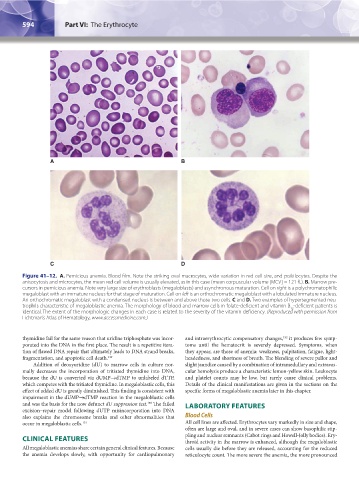
               Figure 41–12.  A. Pernicious anemia. Blood film. Note the striking oval macrocytes, wide variation in red cell size, and poikilocytes. Despite the
               anisocytosis and microcytes, the mean red cell volume is usually elevated, as in this case (mean corpuscular volume [MCV] = 121 fL). B. Marrow pre-
               cursors in pernicious anemia. Note very large size of erythroblasts (megaloblasts) and asynchronous maturation. Cell on right is a polychromatophilic
               megaloblast with an immature nucleus for that stage of maturation. Cell on left is an orthochromatic megaloblast with a lobulated immature nucleus.
               An orthochromatic megaloblast with a condensed nucleus is between and above those two cells. C and D. Two examples of hypersegmented neu-
               trophils characteristic of megaloblastic anemia. The morphology of blood and marrow cells in folate-deficient and vitamin B -deficient patients is
                                                                                                         12
               identical. The extent of the morphologic changes in each case is related to the severity of the vitamin deficiency. (Reproduced with permission from
               Lichtman’s Atlas of Hematology, www.accessmedicine.com.)

               thymidine fail for the same reason that uridine triphosphate was incor-  and intraerythrocytic compensatory changes,  it produces few symp-
                                                                                                       152
               porated into the DNA in the first place. The result is a repetitive itera-  toms until the hematocrit is  severely depressed. Symptoms,  when
               tion of flawed DNA repair that ultimately leads to DNA strand breaks,   they appear, are those of anemia: weakness, palpitation, fatigue, light-
               fragmentation, and apoptotic cell death. 149           headedness, and shortness of breath. The blending of severe pallor and
                   Addition of deoxyuridine (dU) to marrow cells in culture nor-  slight jaundice caused by a combination of intramedullary and extravas-
               mally decreases the incorporation of  tritiated thymidine into DNA,   cular hemolysis produce a characteristic lemon-yellow skin. Leukocyte
               because  the  dU is  converted  via  dUMP→dTMP  to  unlabeled  dTTP,   and platelet counts may be low, but rarely cause clinical problems.
               which competes with the tritiated thymidine. In megaloblastic cells, this   Details of the clinical manifestations are given in the sections on the
               effect of added dU is greatly diminished. This finding is consistent with   specific forms of megaloblastic anemia later in this chapter.
               impairment in the dUMP→dTMP reaction in the megaloblastic cells
               and was the basis for the now defunct dU suppression test.  The failed     LABORATORY FEATURES
                                                         150
               excision–repair model following dUTP misincorporation into DNA
               also explains the chromosome breaks and other abnormalities that   Blood Cells
               occur in megaloblastic cells. 151                      All cell lines are affected. Erythrocytes vary markedly in size and shape,
                                                                      often are large and oval, and in severe cases can show basophilic stip-
                                                                      pling and nuclear remnants (Cabot rings and Howell-Jolly bodies). Ery-
               CLINICAL FEATURES                                      throid activity in the marrow is enhanced, although the megaloblastic
               All megaloblastic anemias share certain general clinical features. Because   cells usually die before they are released, accounting for the reduced
               the anemia develops slowly, with opportunity for cardiopulmonary   reticulocyte count. The more severe the anemia, the more pronounced


          Kaushansky_chapter 41_p0583-0616.indd   594                                                                   9/17/15   6:24 PM

