


Page 618 - Williams Hematology ( PDFDrive )
P. 618
592  Part VI:  The Erythrocyte                  Chapter 41:  Folate, Cobalamin, and Megaloblastic Anemias             593


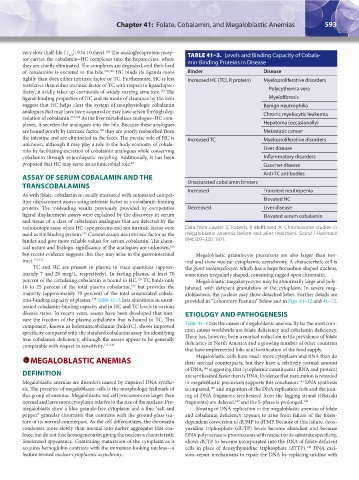
                  very slow (half-life [T ]: 9 to 10 days).  The asialoglycoprotein recep-  TABLE 41–3.  Levels and Binding Capacity of Cobala-
                                              128
                                 1/2
                  tor carries the cobalamin–HC complexes into the hepatocytes, where
                  they are chiefly eliminated. The complexes are degraded, and their load   min-Binding Proteins in Disease
                  of cobalamins is excreted in the bile. 106,129  HC binds its ligands more   Binder  Disease
                  tightly than does either intrinsic factor or TC. Furthermore, HC is less   Increased HC (TCI, R protein)  Myeloproliferative disorders
                  restrictive than either intrinsic factor or TC with respect to ligand spec-
                                                                130
                  ificity; it avidly takes up corrinoids of widely varying structure.  The           Polycythemia vera
                  ligand-binding properties of HC and its mode of clearance by the liver             Myelofibrosis
                  suggest that HC helps clear the system of nonphysiologic cobalamin               Benign neutrophilia
                  analogues that may have been acquired or may have arisen through deg-            Chronic myelocytic leukemia
                  radation of cobalamin. 131,132  As the liver metabolizes analogue–HC com-
                  plexes, it secretes the analogues into the bile. Because these analogues         Hepatoma (occasionally)
                                            130
                  are bound poorly by intrinsic factor,  they are poorly reabsorbed from           Metastatic cancer
                  the intestine and are eliminated in the feces. The precise role of HC is   Increased TC  Myeloproliferative disorders
                  unknown, although it may play a role in the body economy of cobala-
                  min by facilitating excretion of cobalamin analogues while conserving            Liver disease
                  cobalamin through enterohepatic recycling. Additionally, it has been             Inflammatory disorders
                  proposed that HC may serve an antimicrobial role. 64                             Gaucher disease
                  ASSAY OF SERUM COBALAMIN AND THE                                                 Anti-TC antibodies
                  TRANSCOBALAMINS                                        Unsaturated cobalamin binders
                  As with folate, cobalamin is usually measured with automated compet-  Increased  Transient neutropenia
                  itive displacement assays using intrinsic factor as a cobalamin-binding          Elevated HC
                  protein. The misleading results previously provided by competitive   Decreased   Liver disease
                  ligand displacement assays were explained by the discovery in serum              Elevated serum cobalamin
                  and tissue of a class of cobalamin analogues that are detected by the
                  radioisotope assay when HC-type proteins and not intrinsic factor were   Data from Lawler S, Roberts P, Hoffbrand A: Chromosome studies in
                  used as the binding protein.  Current assays use intrinsic factor as the   megaloblastic anaemia before and after treatment. Scand J Haematol
                                      133
                  binder and give more reliable values for serum cobalamin. The chem-  8(4):309–320, 1971.
                  ical nature and biologic significance of the analogues are unknown,
                                                                   134
                  but recent evidence suggests that they may arise in the gastrointestinal   Megaloblastic granulocyte precursors are also larger than nor-
                  tract. 131,132                                        mal and show nuclear-cytoplasmic asynchrony. A characteristic cell is
                     TC and HC are present in plasma in trace quantities (approx-  the giant metamyelocyte, which has a large horseshoe-shaped nucleus,
                  imately 7 and 20 mcg/L, respectively). In fasting plasma, at least 70   sometimes irregularly shaped, containing ragged open chromatin.
                  percent of the circulating cobalamin is bound to HC.  TC binds only    Megaloblastic megakaryocytes may be abnormally large and poly-
                                                        135
                                                      136
                  10 to 25 percent of the total plasma cobalamin,  but provides the   lobated,  with  deficient  granulation  of  the  cytoplasm.  In  severe  meg-
                  majority (approximately 75 percent) of the  total unsaturated cobala-  aloblastosis, the nucleus may show detached lobes. Further details are
                  min-binding capacity of plasma.  Table 41–3 lists alterations in unsat-  provided in “Laboratory Features” below and in Figs. 41–12 and 41–13.
                                         135
                  urated cobalamin-binding capacity and in HC and TC levels in various
                  disease states. In recent years, assays have been developed that mea-  ETIOLOGY AND PATHOGENESIS
                  sure the fraction of the plasma cobalamin that is bound to TC. This
                  component, known as holotranscobalamin (holoTC), shows improved   Table 41–4 lists the causes of megaloblastic anemia. By far the most com-
                  specificity compared with the standard cobalamin assay for identifying   mon causes worldwide are folate deficiency and cobalamin deficiency.
                  true cobalamin deficiency, although the assays appear to be generally   There has, however, been a marked reduction in the prevalence of folate
                  comparable with respect to sensitivity. 137–143       deficiency in North America and a growing number of other countries
                                                                        that have implemented folic acid fortification of the food supply.
                                                                            Megaloblastic cells have much more cytoplasm and RNA than do
                     MEGALOBLASTIC ANEMIAS                              their normal counterparts, but they have a relatively normal amount
                                                                        of DNA,  suggesting that cytoplasmic constituents (RNA and protein)
                                                                              144
                  DEFINITION                                            are synthesized faster than is DNA. Evidence that maturation is retarded
                  Megaloblastic anemias are disorders caused by impaired DNA synthe-  in megaloblastic precursors supports this conclusion.  DNA synthesis
                                                                                                               145
                  sis. The presence of megaloblastic cells is the morphologic hallmark of   is impaired,  and migration of the DNA replication fork and the join-
                                                                                 146
                  this group of anemias. Megaloblastic red cell precursors are larger than   ing of DNA fragments synthesized from the lagging strand (Okazaki
                  normal and have more cytoplasm relative to the size of the nucleus. Pro-  fragments) are delayed,  and the S-phase is prolonged. 146
                                                                                         147
                  megaloblasts show a blue granule-free cytoplasm and a fine “salt and   Slowing of DNA replication in the megaloblastic anemias of folate
                  pepper” granular chromatin that contrasts with the ground-glass tex-  and cobalamin deficiency appears to arise from failure of the folate-
                  ture of its normal counterpart. As the cell differentiates, the chromatin   dependent conversion of dUMP to dTMP. Because of this failure, deox-
                  condenses more slowly than normal into darker aggregates that coa-  yuridine triphosphate (dUTP) levels become abundant and because
                  lesce, but do not fuse homogeneously, giving the nucleus a characteristic   DNA polymerase is promiscuous with respect to its substrate specificity,
                  fenestrated appearance. Continuing maturation of the cytoplasm as it   allows dUTP to become incorporated into the DNA of folate-deficient
                  acquires hemoglobin contrasts with the immature-looking nucleus—a   cells  in  place  of  deoxythymidine  triphosphate  (dTTP).   DNA exci-
                                                                                                                 148
                  feature termed nuclear-cytoplasmic asynchrony.        sion–repair mechanisms to repair the DNA by replacing uridine with


          Kaushansky_chapter 41_p0583-0616.indd   593                                                                   9/17/15   6:24 PM

