


Page 643 - Williams Hematology ( PDFDrive )
P. 643
618            Part VI:  The Erythrocyte                                                                                                                                                   Chapter 42:  Iron Metabolism            619


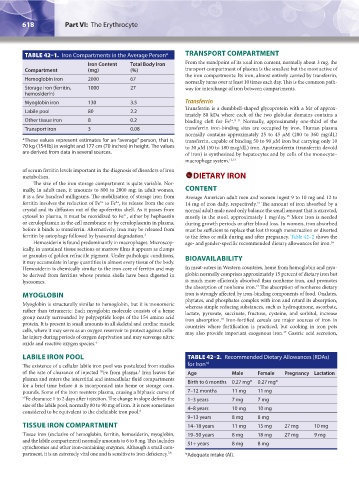
                TABLE 42–1.  Iron Compartments in the Average Person*  TRANSPORT COMPARTMENT
                                     Iron Content   Total Body Iron   From the standpoint of its total iron content, normally about 3 mg, the
                Compartment          (mg)           (%)               transport compartment of plasma is the smallest but the most active of
                                                                      the iron compartments: Its iron, almost entirely carried by transferrin,
                Hemoglobin iron      2000           67
                                                                      normally turns over at least 10 times each day. This is the common path-
                Storage iron (ferritin,   1000      27                way for interchange of iron between compartments.
                hemosiderin)
                Myoglobin iron       130            3.5               Transferrin
                                                                      Transferrin is a dumbbell-shaped glycoprotein with a Mr of approx-
                Labile pool          80             2.2
                                                                      imately 80 kDa where each of the two globular domains contains a
                Other tissue iron    8              0.2               binding cleft for Fe .   Normally, approximately one-third of the
                                                                                     3+ 9–11
                Transport iron       3              0.08              transferrin iron-binding sites are occupied by iron. Human plasma
                                                                      normally contains approximately 25 to 45  μM (200 to 360 mg/dL)
               *These values represent estimates for an “average” person, that is,   transferrin, capable of binding 50 to 90 μM iron but carrying only 10
               70 kg (154 lb) in weight and 177 cm (70 inches) in height. The values   to 30 μM (50 to 180 mcg/dL) iron. Apotransferrin (transferrin devoid
               are derived from data in several sources.              of iron) is synthesized by hepatocytes and by cells of the monocyte–
                                                                      macrophage system. 12,13
               of serum ferritin levels important in the diagnosis of disorders of iron
               metabolism.                                               DIETARY IRON
                   The size of the iron storage compartment is quite variable. Nor-
               mally, in adult men, it amounts to 800 to 2000 mg; in adult women,   CONTENT
               it is a few hundred milligrams. The mobilization of storage iron from   Average American adult men and women ingest 9 to 10 mg and 12 to
               ferritin involves the reduction of Fe  to Fe , its release from the core   14 mg of iron daily, respectively.  The amount of iron absorbed by a
                                               2+
                                         3+
                                                                                              14
               crystal and its diffusion out of the apoferritin shell. As it passes from   normal adult male need only balance the small amount that is excreted,
               cytosol to plasma, it must be reoxidized to Fe , either by hephaestin   mostly in the stool, approximately 1 mg/day.  More iron is needed
                                                 3+
                                                                                                        15
               or ceruloplasmin in the cell membrane or by ceruloplasmin in plasma,   during growth periods or after blood loss. In women, iron absorbed
               before it binds to transferrin. Alternatively, iron may be released from   must be sufficient to replace that lost through menstruation or diverted
               ferritin by autophagy followed by lysosomal degradation. 3  to the fetus or milk during and after pregnancy. Table 42–2 shows the
                   Hemosiderin is found predominantly in macrophages. Microscop-  age- and gender-specific recommended dietary allowances for iron. 16
               ically, in unstained tissue sections or marrow films it appears as clumps
               or granules of golden refractile pigment. Under pathologic conditions,   BIOAVAILABILITY
               it may accumulate in large quantities in almost every tissue of the body.
               Hemosiderin is chemically similar to the iron core of ferritin and may   In meat-eaters in Western countries, heme from hemoglobin and myo-
               be derived from ferritins whose protein shells have been digested in   globin normally comprises approximately 15 percent of dietary iron but
               lysosomes.                                             is much more efficiently absorbed than nonheme iron, and promotes
                                                                      the absorption of nonheme iron.  The absorption of nonheme dietary
                                                                                              17
               MYOGLOBIN                                              iron is strongly affected by iron-binding components of food. Oxalates,
               Myoglobin is structurally similar to hemoglobin, but it is monomeric   phytates, and phosphates complex with iron and retard its absorption,
                                                                      whereas simple reducing substances, such as hydroquinone, ascorbate,
               rather than tetrameric: Each myoglobin molecule consists of a heme   lactate, pyruvate, succinate, fructose, cysteine, and sorbitol, increase
               group nearly surrounded by polypeptide loops of the 154 amino acid   iron absorption.  Iron-fortified cereals are major sources of iron in
                                                                                  18
               protein. It is present in small amounts in all skeletal and cardiac muscle   countries where fortification is practiced, but cooking in iron pots
               cells, where it may serve as an oxygen reservoir to protect against cellu-  may also provide important exogenous iron.  Gastric acid secretion,
                                                                                                       17
               lar injury during periods of oxygen deprivation and may scavenge nitric
               oxide and reactive oxygen species. 4
               LABILE IRON POOL                                        TABLE 42–2.  Recommended Dietary Allowances (RDAs)
               The existence of a cellular labile iron pool was postulated from studies   for Iron 16
               of the rate of clearance of injected  Fe from plasma.  Iron leaves the   Age  Male  Female  Pregnancy Lactation
                                         59
                                                      5
               plasma and enters the interstitial and intracellular fluid compartments
               for a brief time before it is incorporated into heme or storage com-  Birth to 6 months  0.27 mg*  0.27 mg*
               pounds. Some of the iron reenters plasma, causing a biphasic curve of   7–12 months  11 mg  11 mg
               59 Fe clearance 1 to 2 days after injection. The change in slope defines the   1–3 years  7 mg  7 mg
               size of the labile pool, normally 80 to 90 mg of iron. It is now sometimes
               considered to be equivalent to the chelatable iron pool. 6  4–8 years  10 mg   10 mg
                                                                       9–13 years     8 mg    8 mg
               TISSUE IRON COMPARTMENT                                 14–18 years    11 mg   15 mg    27 mg     10 mg
               Tissue iron (exclusive of hemoglobin, ferritin, hemosiderin, myoglobin,   19–50 years  8 mg  18 mg  27 mg  9 mg
               and the labile compartment) normally amounts to 6 to 8 mg. This includes   51+ years  8 mg  8 mg
               cytochromes and other iron-containing enzymes. Although a small com-
               partment, it is an extremely vital one and is sensitive to iron deficiency. 7,8  *Adequate intake (AI).


          Kaushansky_chapter 42_p0617-0626.indd   618                                                                   9/17/15   6:26 PM

