


Page 647 - Williams Hematology ( PDFDrive )
P. 647
622            Part VI:  The Erythrocyte                                                                                                                                                   Chapter 42:  Iron Metabolism            623


                                                                                                                  80
               Regulation of Hepcidin by Erythropoiesis               but other cytokines including activin B may also contribute.  Chronic
               Intestinal iron absorption is increased severalfold after hemorrhage   inflammation impairs iron supply to erythropoiesis and combines with
               or erythropoietin administration, and is chronically increased in   other effects of inflammation to cause anemia of inflammation (anemia
               patients with ineffective erythropoiesis but not in aplastic anemia.    of chronic disease, see Chap. 37).
                                                                 73
               These observations led to the hypothesis that the marrow generates an
               “erythroid regulator”  that modulates intestinal iron absorption. Later
                               73
               studies in mouse models  provided evidence that the erythroid reg-  TRANSPORT OF IRON
                                  56
               ulator is a marrow-derived suppressor of hepcidin. Erythroferrone is
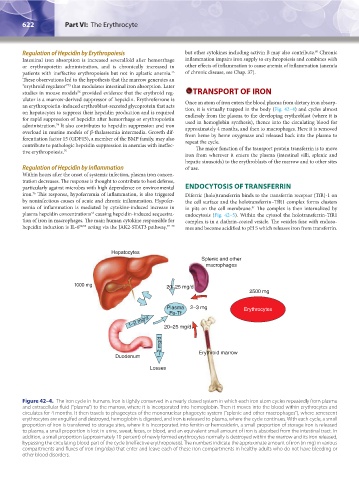
               an erythropoietin-induced erythroblast-secreted glycoprotein that acts   Once an atom of iron enters the blood plasma from dietary iron absorp-
               on hepatocytes to suppress their hepcidin production and is required   tion, it is virtually trapped in the body (Fig. 42–4) and cycles almost
               for rapid suppression of hepcidin after hemorrhage or erythropoietin   endlessly from the plasma to the developing erythroblast (where it is
               administration.  It also contributes to hepcidin suppression and iron   used in hemoglobin synthesis), thence into the circulating blood for
                           74
               overload in murine models of β-thalassemia intermedia. Growth dif-  approximately 4 months, and then to macrophages. Here it is removed
               ferentiation factor 15 (GDF15), a member of the BMP family, may also   from heme by heme oxygenase and released back into the plasma to
               contribute to pathologic hepcidin suppression in anemias with ineffec-  repeat the cycle.
               tive erythropoiesis. 75                                    The major function of the transport protein transferrin is to move
                                                                      iron from wherever it enters the plasma (intestinal villi, splenic and
                                                                      hepatic sinusoids) to the erythroblasts of the marrow and to other sites
               Regulation of Hepcidin by Inflammation                 of use.
               Within hours after the onset of systemic infection, plasma iron concen-
               tration decreases. The response is thought to contribute to host defense,
               particularly against microbes with high dependence on environmental   ENDOCYTOSIS OF TRANSFERRIN
               iron.  This response, hypoferremia of inflammation, is also triggered   Diferric (holo)transferrin binds to the transferrin receptor (TfR)-1 on
                   76
               by noninfectious causes of acute and chronic inflammation. Hypofer-  the cell surface and the holotransferrin–TfR1 complex forms clusters
               remia of inflammation is mediated by cytokine-induced increase in   in pits on the cell membrane.  The complex is then internalized by
                                                                                            81
               plasma hepcidin concentrations  causing hepcidin-induced sequestra-  endocytosis (Fig. 42–5). Within the cytosol the holotransferrin-TfR1
                                      54
               tion of iron in macrophages. The main human cytokine responsible for   complex is in a clathrin-coated vesicle. The vesicles fuse with endoso-
               hepcidin induction is IL-6 52,53  acting via the JAK2-STAT3 pathway, 77–79    mes and become acidified to pH 5 which releases iron from transferrin.


                                             Hepatocytes
                                                                           Splenic and other
                                                                             macrophages


                                 1000 mg                        20–25 mg/d
                                                                                            2500 mg

                                                                Plasma  2–3 mg            Erythrocytes

                                                                 Fe-Tf
                                                   1–2 mg/d    20–25 mg/d


                                                              1–2 mg/d

                                               Duodenum                    Erythroid marrow

                                                          Losses


               Figure 42–4.  The iron cycle in humans. Iron is tightly conserved in a nearly closed system in which each iron atom cycles repeatedly from plasma
               and extracellular fluid (“plasma”) to the marrow, where it is incorporated into hemoglobin. Then it moves into the blood within erythrocytes and
               circulates for 4 months. It then travels to phagocytes of the mononuclear phagocyte system (“splenic and other macrophages”), where senescent
               erythrocytes are engulfed and destroyed, hemoglobin is digested, and iron is released to plasma, where the cycle continues. With each cycle, a small
               proportion of iron is transferred to storage sites, where it is incorporated into ferritin or hemosiderin, a small proportion of storage iron is released
               to plasma, a small proportion is lost in urine, sweat, feces, or blood, and an equivalent small amount of iron is absorbed from the intestinal tract. In
               addition, a small proportion (approximately 10 percent) of newly formed erythrocytes normally is destroyed within the marrow and its iron released,
               bypassing the circulating blood part of the cycle (ineffective erythropoiesis). The numbers indicate the approximate amount of iron (in mg) in various
               compartments and fluxes of iron (mg/day) that enter and leave each of these iron compartments in healthy adults who do not have bleeding or
               other blood disorders.


          Kaushansky_chapter 42_p0617-0626.indd   622                                                                   9/17/15   6:26 PM

