


Page 646 - Williams Hematology ( PDFDrive )
P. 646
620  Part VI:  The Erythrocyte                                                Chapter 42:  Iron Metabolism            621


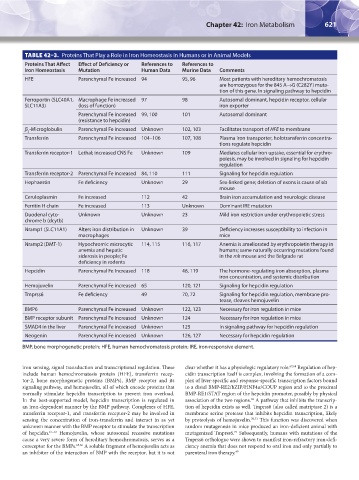
                   TABLE 42–3.  Proteins That Play a Role in Iron Homeostasis in Humans or in Animal Models
                   Proteins That Affect   Effect of Deficiency or   References to   References to
                   Iron Homeostasis  Mutation             Human Data   Murine Data  Comments
                   HFE               Parenchymal Fe increased 94       95, 96       Most patients with hereditary hemochromatosis
                                                                                    are homozygous for the 845 A→G (C282Y) muta-
                                                                                    tion of this gene. In signaling pathway to hepcidin
                   Ferroportin (SLC40A1,  Macrophage Fe increased  97  98           Autosomal dominant, hepcidin receptor, cellular
                   SLC11A3)          (loss of function)                             iron exporter
                                     Parenchymal Fe increased  99, 100  101         Autosomal dominant
                                     (resistance to hepcidin)
                   β -Microglobulin  Parenchymal Fe increased Unknown  102, 103     Facilitates transport of HFE to membrane
                    2
                   Transferrin       Parenchymal Fe increased 104–106  107, 108     Plasma iron transporter, holotransferrin concentra-
                                                                                    tions regulate hepcidin
                   Transferrin receptor-1  Lethal; increased CNS Fe  Unknown  109   Mediates cellular iron uptake, essential for erythro-
                                                                                    poiesis, may be involved in signaling for hepcidin
                                                                                    regulation
                   Transferrin receptor-2  Parenchymal Fe increased 84, 110  111    Signaling for hepcidin regulation
                   Hephaestin        Fe deficiency        Unknown      29           Sex-linked gene; deletion of exons is cause of sla
                                                                                    mouse
                   Ceruloplasmin     Fe increased         112          42           Brain iron accumulation and neurologic disease
                   Ferritin H chain  Fe increased         113          Unknown      Dominant IRE mutation
                   Duodenal cyto-    Unknown              Unknown      23           Mild iron restriction under erythropoietic stress
                   chrome b (dcytb)
                   Nramp1 (SLC11A1)  Alters iron distribution in   Unknown  39      Deficiency increases susceptibility to infection in
                                     macrophages                                    mice
                   Nramp2 (DMT-1)    Hypochromic microcytic   114, 115  116, 117    Anemia is ameliorated by erythropoietin therapy in
                                     anemia and hepatic                             humans; same naturally occurring mutations found
                                     siderosis in people; Fe                        in the mk mouse and the Belgrade rat
                                     deficiency in rodents
                   Hepcidin          Parenchymal Fe Increased 118      46, 119      The hormone-regulating iron absorption, plasma
                                                                                    iron concentration, and systemic distribution
                   Hemojuvelin       Parenchymal Fe increased 65       120, 121     Signaling for hepcidin regulation
                   Tmprss6           Fe deficiency        49           70, 72       Signaling for hepcidin regulation, membrane pro-
                                                                                    tease, cleaves hemojuvelin
                   BMP6              Parenchymal Fe increased Unknown  122, 123     Necessary for iron regulation in mice
                   BMP receptor subunit Parenchymal Fe increased Unknown  124       Necessary for iron regulation in mice
                   SMAD4 in the liver  Parenchymal Fe increased Unknown  125        In signaling pathway for hepcidin regulation
                   Neogenin          Parenchymal Fe increased Unknown  126, 127     Necessary for hepcidin regulation
                  BMP, bone morphogenetic protein; HFE, human hemochromatosis protein; IRE, iron-responsive element.


                  iron sensing, signal transduction and transcriptional regulation. These   clear whether it has a physiologic regulatory role. 67,68  Regulation of hep-
                  include human hemochromatosis protein (HFE), transferrin recep-  cidin transcription itself is complex, involving the formation of a com-
                  tor-2, bone morphogenetic proteins (BMPs), BMP receptor and its   plex of liver-specific and response-specific transcription factors bound
                  signaling pathway, and hemojuvelin, all of which encode proteins that   to a distal BMP-RE2/bZIP/HNF4α/COUP region and to the proximal
                  normally  stimulate  hepcidin  transcription  to  prevent  iron overload.   BMP-RE1/STAT region of the hepcidin promoter, possibly by physical
                  In the best-supported model, hepcidin transcription is regulated in   association of the two regions.  A pathway that inhibits the transcrip-
                                                                                              69
                  an iron-dependent manner by the BMP pathway. Complexes of HFE,   tion of hepcidin exists as well. Tmprss6 (also called matriptase 2) is a
                  transferrin receptor-1, and transferrin receptor-2 may be involved in   membrane serine protease that inhibits hepcidin transcription, likely
                  sensing the concentration of iron-transferrin and interact in as yet   by proteolysis of hemojuvelin. 70,71  This function was discovered when
                  unknown manner with the BMP receptor to stimulate the transcription   random mutagenesis in mice produced an iron-deficient animal with
                                                                                         72
                  of hepcidin. 61–64  Hemojuvelin, whose autosomal recessive mutations   mutagenized Tmprss6.  Subsequently, humans with mutations of the
                  cause a very severe form of hereditary hemochromatosis, serves as a   Tmprss6 orthologue were shown to manifest iron-refractory iron-defi-
                  coreceptor for the BMPs. 65,66  A soluble fragment of hemojuvelin acts as   ciency anemia that does not respond to oral iron and only partially to
                  an inhibitor of the interaction of BMP with the receptor, but it is not   parenteral iron therapy. 49


          Kaushansky_chapter 42_p0617-0626.indd   621                                                                   9/17/15   6:26 PM

