


Page 645 - Williams Hematology ( PDFDrive )
P. 645
620            Part VI:  The Erythrocyte                                                                                                                                                   Chapter 42:  Iron Metabolism            621


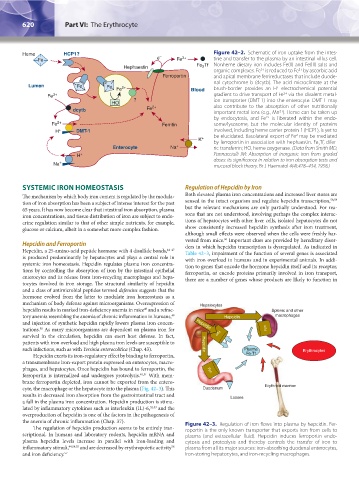
               Heme          HCP1?                           –                  Figure 42–2.  Schematic of iron uptake from the intes-
                     Fe                                      e     Fe 3+        tine and transfer to the plasma by an intestinal villus cell.
                                                 Hephaestin               Fe Tf  Nonheme dietary iron includes Fe(II) and Fe(III) salts and
                                                                            2
                                                                                organic complexes. Fe  is reduced to Fe  by ascorbic acid
                                                                                               3+
                                                                                                            2+
                                                              Ferroportin       and apical membrane ferrireductases that include duode-
                                                                                nal cytochrome b (dcytb). The acid microclimate at the
                 Lumen            Fe        Fe  Fe 2+                   Blood   brush-border provides an H  electrochemical potential
                                                                                                     +
                                                                                                       2+
                        Fe 3+                                                   gradient to drive transport of Fe  via the divalent metal-
                                             HO      ?                          ion transporter (DMT-1) into the enterocyte. DMT-1 may
                                                                                also  contribute  to  the  absorption  of  other  nutritionally
                                dcytb                    Fe 2+                  important metal ions (e.g., Mn ). Heme can be taken up
                                                                                                      2+
                                                                                by endocytosis, and Fe  is liberated within the endo-
                                                                                                 2+
                         Fe 2+                                Ferritin          some/lysosome, but the molecular  identity of proteins
                          H +    DMT-1                                          involved, including heme carrier protein 1 (HCP1), is yet to
                                                                                be elucidated. Basolateral export of Fe  may be mediated
                                                                                                           2
                                                                          K +   by ferroportin in association with hephaestin. Fe Tf, difer-
                                                                                                                   2
                                              Enterocyte         Na +           ric transferrin; HO, heme oxygenase. (Data from Smith MD,
                                  H +                                           Pannacciulli IM: Absorption of inorganic iron from graded
                                                                                doses: its significance in relation to iron absorption tests and
                          Na +                                                  mucosal block theory. Br J Haematol 4(4):428–434, 1958.)
               SYSTEMIC IRON HOMEOSTASIS                              Regulation of Hepcidin by Iron
               The mechanism by which body iron content is regulated by the modula-  Both elevated plasma iron concentrations and increased liver stores are
               tion of iron absorption has been a subject of intense interest for the past   sensed in the intact organism and regulate hepcidin transcription, 58,59
               65 years. It has now become clear that intestinal iron absorption, plasma   but the relevant mechanisms are only partially understood. For rea-
               iron concentrations, and tissue distribution of iron are subject to endo-  sons that are not understood, involving perhaps the complex interac-
               crine regulation similar to that of other simple nutrients, for example,   tions of hepatocytes with other liver cells, isolated hepatocytes do not
               glucose or calcium, albeit in a somewhat more complex fashion.  show consistently increased hepcidin synthesis after iron treatment,
                                                                      although small effects were observed when the cells were freshly har-
                                                                      vested from mice.  Important clues are provided by hereditary disor-
                                                                                   60
               Hepcidin and Ferroportin                               ders in which hepcidin transcription is dysregulated. As indicated in
               Hepcidin, a 25-amino-acid peptide hormone with 4 disulfide bonds, 44–47    Table 42–3, impairment of the function of several genes is associated
               is produced predominantly by hepatocytes and plays a central role in    with iron overload in humans and in experimental animals. In addi-
               systemic iron homeostasis. Hepcidin regulates plasma iron concentra-  tion to genes that encode the hormone hepcidin itself and its receptor,
               tions by controlling the absorption of iron by the intestinal epithelial   ferroportin, or encode proteins primarily involved in iron transport,
               enterocytes and its release from iron-recycling macrophages and hepa-  there are a number of genes whose products are likely to function in
               tocytes  involved  in  iron  storage.  The structural  similarity  of  hepcidin
               and a class of antimicrobial peptides termed defensins suggests that the
               hormone evolved from the  latter to  modulate iron  homeostasis as a
               mechanism of body defense against microorganisms. Overexpression of   Hepatocytes
               hepcidin results in marked iron-deficiency anemia in mice  and a refrac-            Splenic and other
                                                        48
               tory anemia resembling the anemia of chronic inflammation in humans,    Hepcidin     macrophages
                                                                 49
               and injection of synthetic hepcidin rapidly lowers plasma iron concen-  Hepcidin
               trations.  As many microorganisms are dependent on plasma iron for                Fpn
                     50
               survival in the circulation, hepcidin can exert host defense. In fact,   Fpn
               patients with iron overload and high plasma iron levels are susceptible to   Hepcidin
               such infections, such as with Yersinia enterocolitica (Chap. 43).          Plasma             Erythrocytes
                   Hepcidin exerts its iron-regulatory effect by binding to ferroportin,   Fe-Tf
               a transmembrane iron-export protein expressed on enterocytes, macro-
               phages, and hepatocytes. Once hepcidin has bound to ferroportin, the   Fpn
               ferroportin is internalized and undergoes proteolysis. 40,51  With mem-
               brane ferroportin depleted, iron cannot be exported from the entero-
               cyte, the macrophage or the hepatocyte into the plasma (Fig. 42–3). This   Duodenum  Erythroid marrow
               results in decreased iron absorption from the gastrointestinal tract and   Losses
               a fall in the plasma iron concentration. Hepcidin production is stimu-
               lated by inflammatory cytokines such as interleukin (IL)-6, 52,53  and the
               overproduction of hepcidin is one of the factors in the pathogenesis of
               the anemia of chronic inflammation (Chap. 37).         Figure 42–3.  Regulation of iron flows into plasma by hepcidin. Fer-
                   The regulation of hepcidin production seems to be entirely tran-  roportin is the only known transporter that exports iron from cells to
               scriptional. In humans and laboratory rodents, hepcidin mRNA and   plasma (and extracellular fluid). Hepcidin induces ferroportin endo-
               plasma hepcidin levels increase in parallel with iron-loading and   cytosis and proteolysis and thereby controls the transfer of iron to
               inflammatory stimuli, 44,54,55  and are decreased by erythropoietic activity    plasma from all its major sources: iron-absorbing duodenal enterocytes,
                                                                 56
               and iron deficiency. 57                                iron-storing hepatocytes, and iron-recycling macrophages.


          Kaushansky_chapter 42_p0617-0626.indd   620                                                                   9/17/15   6:26 PM

