


Page 644 - Williams Hematology ( PDFDrive )
P. 644
618  Part VI:  The Erythrocyte                                                Chapter 42:  Iron Metabolism            619


                  the transit time, and mucus secretion all play roles in iron absorption.   the intestinal villus cell by the divalent metal transporter (DMT)-1. 24,25
                  Red wine, contrary to popular belief, inhibits iron absorption, probably   How iron transits within the enterocytes is not yet known. Basolateral
                                               19
                  because of the presence of polyphenols.  In mice, alcohol suppresses   export of ferrous iron is mediated by ferroportin 26–28  in association with
                                                                                                     30
                                         20
                  the response of hepcidin to iron,  and this may contribute to iron load-  hephaestin  and plasma ceruloplasmin  to oxidize iron to the ferric
                                                                                29
                  ing that is seen in some alcoholic subjects.          state. Ferric iron is taken up by plasma apotransferrin. Figure 42–2 illus-
                                                                        trates some of the steps that are thought to regulate iron transport across
                     IRON ABSORPTION                                    the mucosal cell.
                  Iron normally enters the body through the gastrointestinal tract,
                  mostly through the enterocytes of the duodenum. The amount of iron   IRON RECYCLING
                  absorbed is normally tightly regulated according to body needs. Active   Role of the Monocyte–Macrophage System
                  erythropoiesis and/or iron deficiency increase absorption; iron over-  In humans, the destruction and production of erythrocytes generates
                  load and systemic inflammation decrease absorption. Nevertheless, the   most of the iron flux in and out of plasma (20 to 25 mg/day recycled in
                  amount of iron absorbed increases with the administered dose even   adults compared to 1 to 2 mg/day absorbed). Iron from other cell types
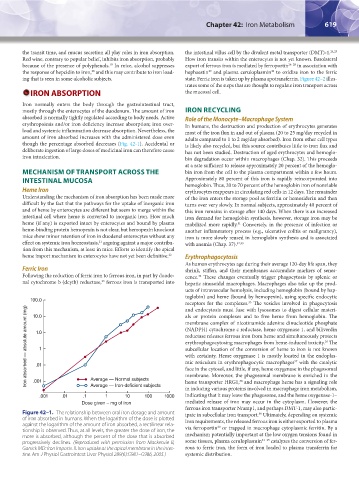
                  though the percentage absorbed decreases (Fig. 42-1). Accidental or   is likely also recycled, but this source contributes little to iron flux and
                  deliberate ingestion of large doses of medicinal iron can therefore cause   has not been studied. Destruction of aged erythrocytes and hemoglo-
                  iron intoxication.                                    bin degradation occur within macrophages (Chap. 32). This proceeds
                                                                        at a rate sufficient to release approximately 20 percent of the hemoglo-
                  MECHANISM OF TRANSPORT ACROSS THE                     bin iron from the cell to the plasma compartment within a few hours.
                  INTESTINAL MUCOSA                                     Approximately 80 percent of this iron is rapidly reincorporated into
                                                                        hemoglobin. Thus, 20 to 70 percent of the hemoglobin iron of nonviable
                  Heme Iron                                             erythrocytes reappears in circulating red cells in 12 days. The remainder
                  Understanding the mechanism of iron absorption has been made more   of the iron enters the storage pool as ferritin or hemosiderin and then
                  difficult by the fact that the pathways for the uptake of inorganic iron   turns over very slowly. In normal subjects, approximately 40 percent of
                  and of heme by enterocytes are different but seem to merge within the   this iron remains in storage after 140 days. When there is an increased
                  intestinal cell where heme is converted to inorganic iron. How much   iron demand for hemoglobin synthesis, however, storage iron may be
                  heme (if any) is exported intact by enterocytes and bound by plasma   mobilized more rapidly.  Conversely, in the presence of infection or
                                                                                          31
                  heme-binding protein hemopexin is not clear, but hemopexin knockout   another inflammatory process (e.g., ulcerative colitis or malignancy),
                  mice show minor retention of iron in duodenal enterocytes without any   iron is more slowly reused in hemoglobin synthesis and is associated
                  effect on systemic iron homeostasis,  arguing against a major contribu-  with anemia (Chap. 37). 32,33
                                           21
                  tion from this mechanism, at least in mice. Efforts to identify the apical
                  heme import mechanism in enterocytes have not yet been definitive. 22  Erythrophagocytosis
                                                                        As human erythrocytes age during their average 120-day life span, they
                  Ferric Iron                                           shrink, stiffen, and their membranes accumulate markers of senes-
                  Following the reduction of ferric iron to ferrous iron, in part by duode-  cence.  These changes eventually trigger phagocytosis by splenic or
                                                                             34
                                            23
                  nal cytochrome b (dcytb) reductase,  ferrous iron is transported into   hepatic sinusoidal macrophages. Macrophages also take up the prod-
                                                                        ucts of intravascular hemolysis, including hemoglobin (bound by hap-
                                                                        toglobin) and heme (bound by hemopexin), using specific endocytic
                    100.0
                                                                        receptors  for  the  complexes.   The  vesicles  involved  in  phagocytosis
                                                                                              35
                   Iron absorbed — absolute amount (mg)  .01 1          (NADPH) cytochrome c reductase, heme oxygenase 1, and biliverdin
                                                                        and endocytosis must fuse with lysosomes to digest cellular materi-
                                                                        als  or  protein  complexes  and  to  free  heme  from  hemoglobin.  The
                     10.0
                                                                        membrane complex of nicotinamide adenine dinucleotide phosphate
                      1.0
                                                                        reductase releases ferrous iron from heme and simultaneously protects
                                                                        erythrophagocytosing macrophages from heme-induced toxicity.  The
                                                                                                                       36
                                                                        subcellular location of the conversion of heme to iron is not known
                                                                        with certainty. Heme oxygenase 1 is mostly located in the endoplas-
                                                                        mic reticulum in erythrophagocytic macrophages  with the catalytic
                                                                                                             37
                                                                        face in the cytosol, and little, if any, heme oxygenase in the phagosomal
                                                                        membrane. Moreover, the phagosomal membrane is enriched in the
                                         Average — Normal subjects
                                                                        heme transporter HRG1,  and macrophage heme has a signaling role
                     .001
                                                                                           38
                                         Average — Iron-deficient subjects
                                                                        in inducing various proteins involved in macrophage iron metabolism,
                       .001    .01    .1      1     10     100   1000   indicating that it may leave the phagosome, and the heme oxygenase-1–
                                      Dose given – mg of iron           mediated release of iron may occur in the cytoplasm. However, the
                                                                        ferrous iron transporter Nramp1, and perhaps DMT-1, may also partic-
                  Figure 42–1.  The relationship between oral iron dosage and amount   ipate in subcellular iron transport.  Ultimately, depending on systemic
                                                                                                 39
                  of iron absorbed in humans. When the logarithm of the dose is plotted   iron requirements, the released ferrous iron is either exported to plasma
                  against the logarithm of the amount of iron absorbed, a rectilinear rela-  via ferroportin  or trapped in macrophage cytoplasmic ferritin. By a
                                                                                   40
                  tionship is observed. Thus, at all levels, the greater the dose of iron, the
                  more is absorbed, although the percent of the dose that is absorbed   mechanism potentially important at the low oxygen tensions found in
                  progressively  declines.  (Reproduced with permission from Mackenzie B,   some tissues, plasma ceruloplasmin 41–43  catalyzes the conversion of fer-
                  Garrick MD: Iron Imports. II. Iron uptake at the apical membrane in the intes-  rous to ferric iron, the form of iron loaded to plasma transferrin for
                  tine. Am J Physiol Gastrointest Liver Physiol 289(6):G981–G986, 2005.)  systemic distribution.


          Kaushansky_chapter 42_p0617-0626.indd   619                                                                   9/17/15   6:26 PM

