


Page 692 - Williams Hematology ( PDFDrive )
P. 692
666  Part VI:  The Erythrocyte                                Chapter 46:  Erythrocyte Membrane Disorders             667


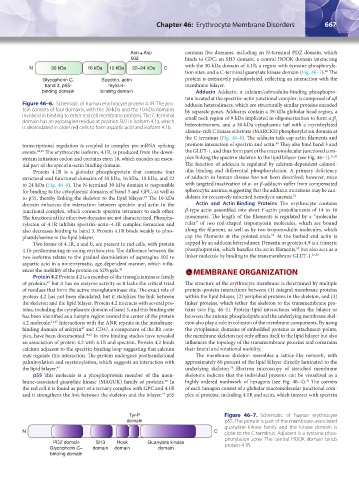
                                                      Asn  Asp          contains five domains, including an N-terminal PDZ domain, which
                                                      502               binds to GPC; an SH3 domain; a central HOOK domain interacting
                                                                        with the 30-kDa domain of 4.1R; a region with tyrosine phosphoryla-
                    N      30 kDa       16 kDa  10 kDa  22–24 kDa  C
                                                                                                                       48
                                                                        tion sites; and a C-terminal guanylate kinase domain (Fig. 46–7).  The
                         Glycophorin C,     Spectrin, actin             protein is extensively palmitoylated, reflecting an interaction with the
                         band 3, p55-          myosin-                  membrane bilayer.
                        binding domain      binding domain                  Adducin  Adducin, a calcium/calmodulin-binding phosphopro-
                                                                        tein located at the spectrin–actin junctional complex, is composed of αβ
                  Figure 46–6.  Schematic of human erythrocyte protein 4.1R. The pro-  adducin heterodimers, which are structurally similar proteins encoded
                  tein consists of four domains, with the 30-kDa and the 10-kDa domains   by separate genes. Adducins contain a 39-kDa globular head region, a
                  involved in binding to other red cell membrane proteins. The C-terminal   small neck region of 9 kDa implicated in oligomerization to form α β
                                                                                                                         2 2
                  domain has an asparagine residue at position 502 in isoform 4.1a, which   heterotetramers,  and  a  30-kDa  cytoplasmic  tail  with  a  myristoylated
                  is deamidated in older red cells to form aspartic acid and isoform 4.1b.
                                                                        alanine-rich C kinase substrate (MARCKS) phosphorylation domain at
                                                                        the C terminus (Fig. 46–8). The adducin tails cap actin filaments and
                                                                                                       49
                  transcriptional regulation is coupled to complex pre-mRNA splicing   promote interaction of spectrin and actin.  They also bind band 3 and
                  events. 44,45  The erythrocyte isoform, 4.1R, is produced from the down-  the GLUT-1, and thus form part of the macromolecular junctional com-
                  stream initiation codon and contains exon 16, which encodes an essen-  plex linking the spectrin skeleton to the lipid bilayer (see Fig. 46–1). 21,50
                  tial part of the spectrin-actin binding domain.       The function of adducin is regulated by calcium-dependent calmod-
                     Protein  4.1R is a  globular  phosphoprotein that  contains four   ulin  binding  and  differential phosphorylation.  A  primary  deficiency
                  structural and functional domains of 30 kDa, 16 kDa, 10 kDa, and 22   of adducin in human disease has not been described; however, mice
                  to 24 kDa (Fig. 46–6). The N-terminal 30-kDa domain is responsible   with targeted inactivation of α- or β-adducin suffer from compensated
                  for binding to the cytoplasmic domains of band 3 and GPC, as well as   spherocytic anemia, suggesting that the adducin mutations may be can-
                  to p55, thereby linking the skeleton to the lipid bilayer.  The 10-kDa   didates for recessively inherited hemolytic anemia. 51
                                                           19
                  domain  enhances  the  interaction between  spectrin  and  actin  in  the   Actin and Actin-Binding Proteins  The erythrocyte  contains
                  junctional complex, which connects spectrin tetramers to each other.   β-type actin assembled into short F-actin protofilaments of 14 to 16
                  The functions of the other two domains are not characterized. Phospho-  monomers. The length of the filaments is regulated by a “molecular
                  rylation of 4.1R inhibits spectrin–actin–4.1R complex formation and   ruler” of two rod-shaped tropomyosin molecules, which are bound
                  also decreases binding to band 3. Protein 4.1R binds weakly to phos-  along the filament, as well as by two tropomodulin molecules, which
                                                                                                     52
                  phatidylserine in the lipid bilayer.                  cap the filaments at the pointed ends.  At the barbed end actin is
                     Two forms of 4.1R, a and b, are present in red cells, with protein   capped by an adducin heterodimer. Dematin or protein 4.9 is a trimeric
                                                                                                              53
                  4.1b predominating in young erythrocytes. The difference between the   phosphoprotein, which bundles the actin filaments,  but also acts as a
                  two isoforms relates to the gradual deamidation of asparagine 502 to   linker molecule by binding to the transmembrane GLUT-1. 21,50
                  aspartic acid in a nonenzymatic, age-dependent manner, which influ-
                  ences the mobility of the protein on SDS gels. 46        MEMBRANE ORGANIZATION
                     Protein 4.2 Protein 4.2 is a member of the transglutaminase family
                  of proteins,  but it has no enzyme activity as it lacks the critical triad   The structure of the erythrocyte membrane is determined by multiple
                          47
                  of residues that form the active transglutaminase site. The exact role of   protein–protein interactions between (1) integral membrane proteins
                  protein 4.2 has not been elucidated, but it stabilizes the link between   within the lipid bilayer, (2) peripheral proteins in the skeleton, and (3)
                  the skeleton and the lipid bilayer. Protein 4.2 interacts with several pro-  linker proteins, which tether the skeleton to the transmembrane pro-
                  teins, including the cytoplasmic domain of band 3, and this binding site   teins (see Fig. 46–1). Protein–lipid interactions within the bilayer or
                  has been identified as a hairpin region toward the center of the protein   between the anionic phospholipids and the underlying membrane skel-
                  4.2 molecule. 11,47  Interactions with the ANK repeats in the membrane-   eton also play a role in cohesion of the membrane components. By using
                                      47
                  binding domain of ankyrin  and CD47, a component of the Rh com-  the cytoplasmic domains of embedded proteins as attachment points,
                  plex, have been documented. 19,47  In vitro binding studies have revealed   the membrane skeleton not only affixes itself to the lipid bilayer but also
                  an association of protein 4.2 with 4.1R and spectrin. Protein 4.2 binds   influences the topology of the transmembrane proteins and constrains
                  calcium adjacent to the spectrin-binding loop suggesting that calcium   their lateral and rotational mobility.
                  may regulate this interaction. The protein undergoes posttranslational   The  membrane  skeleton  resembles  a lattice-like  network,  with
                  palmitoylation and myristoylation, which suggests an interaction with   approximately 60 percent of the lipid bilayer directly laminated to the
                                                                                        36
                  the lipid bilayer. 47                                 underlying skeleton.  Electron microscopy of stretched membrane
                     p55  This molecule is a phosphoprotein member of the mem-  skeletons indicate that the individual proteins can be visualized as a
                                                                                                                 36
                  brane-associated guanylate kinase (MAGUK) family of proteins.  In   highly ordered meshwork of hexagons (see Fig. 46–4).  The corners
                                                                  48
                  the red cell it is found as part of a ternary complex with GPC and 4.1R   of each hexagon consist of a globular macromolecular junctional com-
                  and it strengthens the link between the skeleton and the bilayer.  p55   plex of proteins, including 4.1R and actin, which interact with spectrin
                                                                 19
                                                      Tyr-P                           Figure 46–7.  Schematic of human erythrocyte
                                                     domain                           p55. The protein is part of the membrane-associated
                                                                                      guanylate  kinase  family  and  the  kinase  domain  is
                  N                                                               C   close to the C terminus. Adjacent is a tyrosine phos-
                                                                                      phorylation zone. The central HOOK domain binds
                            PDZ domain    SH3    Hook       Guanylate kinase          protein 4.1R.
                           Glycophorin C–  domain  domain      domain
                           binding domain


          Kaushansky_chapter 46_p0661-0688.indd   667                                                                   9/17/15   6:41 PM

