


Page 759 - Williams Hematology ( PDFDrive )
P. 759
734            Part VI:  The Erythrocyte                                                                                                                    Chapter 48:  The Thalassemias: Disorders of Globin Synthesis           735


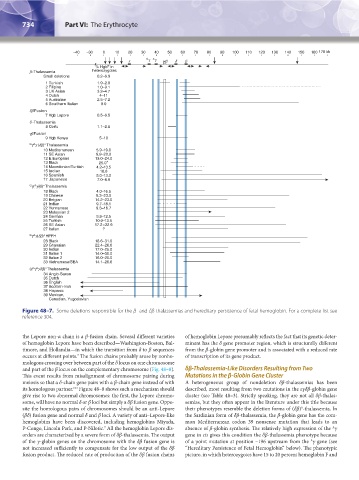
               Figure 48–7.  Some deletions responsible for the β- and δβ-thalassemias and hereditary persistence of fetal hemoglobin. For a complete list see
               reference 304.


               the Lepore non-α chain is a β-fusion chain. Several different varieties   of hemoglobin Lepore presumably reflects the fact that its genetic deter-
               of hemoglobin Lepore have been described—Washington-Boston, Bal-  minant has the δ gene promoter region, which is structurally different
               timore, and Hollandia—in which the transition from δ to β sequences   from the β-globin gene promoter and is associated with a reduced rate
               occurs at different points.  The fusion chains probably arose by nonho-  of transcription of its gene product.
                                  7
               mologous crossing over between part of the δ locus on one chromosome
               and part of the β locus on the complementary chromosome (Fig. 48–8).   δβ-Thalassemia-Like Disorders Resulting from Two
               This event results from misalignment of chromosome pairing during   Mutations in the β-Globin Gene Cluster
               meiosis so that a δ-chain gene pairs with a β-chain gene instead of with   A heterogeneous group of nondeletion  δβ-thalassemias has been
               its homologous partner.  Figure  48–8 shows such a mechanism should   described, most resulting from two mutations in the εγδβ-globin gene
                                103
               give rise to two abnormal chromosomes: the first, the Lepore chromo-  cluster (see Table  48–3). Strictly speaking, they are not all δβ-thalas-
               some, will have no normal δ or β loci but simply a δβ fusion gene. Oppo-  semias, but they often appear in the literature under this title because
               site the homologous pairs of chromosomes should be an anti-Lepore   their phenotypes resemble the deletion forms of (δβ) -thalassemia. In
                                                                                                             0
               (βδ) fusion gene and normal δ and β loci. A variety of anti–Lepore-like   the Sardinian form of δβ-thalassemia, the β-globin gene has the com-
               hemoglobins have been discovered, including hemoglobins Miyada,   mon  Mediterranean  codon  39  nonsense  mutation that  leads  to  an
               P-Congo, Lincoln Park, and P-Nilotic.  All the hemoglobin Lepore dis-  absence of β-globin synthesis. The relatively high expression of the  γ
                                                                                                                       A
                                           7
               orders are characterized by a severe form of δβ-thalassemia. The output   gene in cis gives this condition the δβ-thalassemia phenotype because
               of the γ-globin genes on the chromosome with the δβ fusion gene is   of a point mutation at position –196 upstream from the  γ gene (see
                                                                                                                A
               not increased sufficiently to compensate for the low output of the δβ   “Hereditary Persistence of Fetal Hemoglobin” below). The phenotypic
               fusion product. The reduced rate of production of the δβ fusion chains   picture, in which heterozygotes have 15 to 20 percent hemoglobin F and


          Kaushansky_chapter 48_p0725-0758.indd   734                                                                   9/18/15   2:57 PM

