


Page 758 - Williams Hematology ( PDFDrive )
P. 758
732  Part VI:  The Erythrocyte                 Chapter 48:  The Thalassemias: Disorders of Globin Synthesis           733


                  cytoplasm of the red cell precursors, whereas exon 3 mutations are asso-  TABLE 48–3.  δβ-Thalassemias
                  ciated with full-length but abnormal mRNA accumulation. The different
                                                                            +
                  phenotypes of these premature termination codons have been suggested   (δβ) -Thalassemia
                  to reflect a phenomenon called nonsense-mediated RNA decay, a sur-    Hgb Lepore thalassemia
                  veillance system to prevent transport of mRNA coding for truncated     Hgb Lepore Washington-Boston
                  peptides. Presumably this process is active in the case of exon 1 or 2
                  mutations, in which affected mRNAs are degraded, but is not active in     Hgb Lepore Hollandia
                  the case of exon 3 mutations. 95–97  A complete list of the mutations that     Hgb Lepore Baltimore
                  underlie the dominant β-thalassemias is given in reference 44.
                                                                           Phenocopies of (δβ) -thalassemia
                                                                                          +
                  Unstable β-Globin Variants                               Sardinian δβ-thalassemia
                  Some  β-globin chain variants are highly unstable but are capable of     Corfu δβ-thalassemia
                  forming a viable tetramer. The resulting unstable hemoglobins may pre-    Chinese δβ-thalassemia
                  cipitate in the red cell precursors or in the blood, giving rise to a spec-
                  trum of conditions ranging from dominantly inherited β-thalassemia to     β-Thalassemia with δ-thalassemia
                  a hemolytic anemia similar to the anemia associated with other unstable   (δβ)°-Thalassemia
                  hemoglobins. The first unstable hemoglobin to be described was hemo-    Sicilian
                  globin Indianapolis.  Its structure was characterized by DNA analysis
                                98
                  performed on stored autopsy material; however, the original description     Indian
                  proved to be incorrect. 99                               Japanese
                                                                           Spanish
                  Silent β-Thalassemia
                  A number of extremely mild β-thalassemia alleles are either silent or     Black
                  almost unidentifiable in heterozygotes (see Table  48–2). Some alleles     Eastern European
                  are in the region of the promoter boxes of the β-globin gene, but others     Macedonian
                  involve the CAP sites or the 5′ or 3′ untranslated regions.  These alleles
                                                          7,44
                  usually are identified by finding a form of β-thalassemia intermedia in     Turkish
                  which one parent has a typical thalassemia trait and the other parent     Laotian
                  appears to be normal but, in fact, is a carrier of one of the mild β-tha-    Thai
                  lassemia alleles.
                                                                         ( γδβ)°-Thalassemia
                                                                          A
                  β-Thalassemia Mutations Unlinked to the B-Globin Gene     Indian
                  Cluster                                                  German
                  Several family studies suggest the existence of mutations that result in
                  the  β-thalassemia phenotype but do not segregate with the  β-globin     Cantonese
                  genes ; however, their molecular basis has not been determined. Fur-    Turkish
                      100
                  ther evidence for the existence of novel mutations of this type can be     Malay 2
                  found in reference 7.
                                                                           Belgian
                  Variant Forms of β-Thalassemia                           Black
                  In several forms of β-thalassemia, the hemoglobin A  level is normal     Chinese
                                                         2
                  in heterozygotes. Some cases result from “silent” β-thalassemia alleles,
                  whereas others reflect the coinheritance of β- and δ-thalassemia. 7    Yunnanese
                                                                           Thai
                  δβ-THALASSEMIA                                           Italian
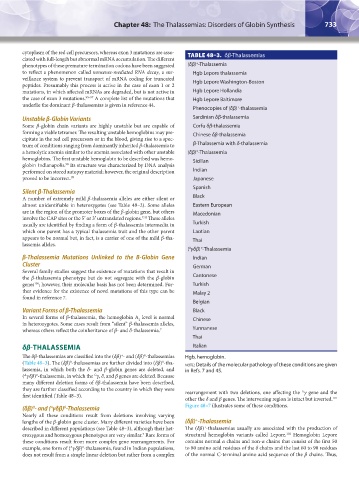
                  The δβ-thalassemias are classified into the (δβ) - and (δβ) -thalassemias   Hgb, hemoglobin.
                                                           0
                                                   +
                  (Table 48–3). The (δβ) -thalassemias are further divided into (δβ) -tha-  note: Details of the molecular pathology of these conditions are given
                                                                 0
                                  0
                  lassemia, in which both the  δ- and  β-globin genes are deleted, and   in Refs. 7 and 45.
                  ( γδβ) -thalassemia, in which the  γ, δ, and β genes are deleted. Because
                                          G
                      0
                  A
                  many different deletion forms of δβ-thalassemia have been described,
                  they are further classified according to the country in which they were                       A
                  first identified (Table  48–3).                       rearrangement with two deletions, one affecting the  γ gene and the
                                                                                                                          101
                                                                        other the δ and β genes. The intervening region is intact but inverted.
                  (δβ) - and ( γδβ) -Thalassemia                        Figure 48–7 illustrates some of these conditions.
                                0
                     0
                           A
                  Nearly all these conditions result from deletions involving varying
                                                                            +
                  lengths of the β-globin gene cluster. Many different varieties have been   (δβ) -Thalassemia
                                                                               +
                  described in different populations (see Table  48–3), although their het-  The (δβ) -thalassemias usually are associated with the production of
                                                                                                          102
                  erozygous and homozygous phenotypes are very similar.  Rare forms of   structural hemoglobin variants called Lepore.  Hemoglobin Lepore
                                                          7
                  these conditions result from more complex gene rearrangements. For   contains normal α chains and non-α chains that consist of the first 50
                  example, one form of ( γδβ) -thalassemia, found in Indian populations,   to 80 amino acid residues of the δ chains and the last 60 to 90 residues
                                      0
                                  A
                  does not result from a simple linear deletion but rather from a complex   of the normal C-terminal amino acid sequence of the β chains. Thus,
          Kaushansky_chapter 48_p0725-0758.indd   733                                                                   9/18/15   2:57 PM

