


Page 765 - Williams Hematology ( PDFDrive )
P. 765
740            Part VI:  The Erythrocyte                                                                                                                    Chapter 48:  The Thalassemias: Disorders of Globin Synthesis           741


                                                                      who also inherited α- or β-globin structural variants  provide a clear
                                                                                                            7,9
                                                                      picture of the action of the thalassemia determinants. In homozygous
                                           Excess                     β-thalassemia, β-globin synthesis is either absent or markedly reduced.
                                                                      The result is excessive production of α-globin chains. α-Globin chains
                                              Precipitation           are incapable of forming a viable hemoglobin tetramer, so the chains
                         HgbF                                         precipitate in red cell precursors. The resulting inclusion bodies can be
                    Selective survival of  Hemolysis  Destruction of RBC  demonstrated by both light and electron microscopy. 169,170  In the mar-
                    HgbF-containing cells             precursors      row, precipitation can be seen in the earliest hemoglobinized precursors
                                                                                                          171
                                                                      and throughout the erythroid maturation pathway.  These large inclu-
                                       Splenomegaly   Ineffective     sions are responsible for intramedullary destruction of red cell precur-
                                       (pooling, plasma  erythropoiesis  sors and hence for the ineffective erythropoiesis characterizing all the
                                       volume                         β-thalassemias. A large proportion of the developing erythroblasts are
                                       expansion)
                                                                      destroyed within the marrow in severe cases.  Any red cells that are
                                                                                                       172
                                                                      released are prematurely destroyed by mechanisms that are considered
                    High oxygen                Anemia
                    affinity of red cells                             below in “Mechanisms and Consequences of Erythroid Precursor and
                                                                      Red Cell Damage.” β-Thalassemia heterozygotes also have imbalanced
                                  Tissue hypoxia                      globin-chain synthesis, but the magnitude of α-chain excess is much
                                                                      less and presumably can be resolved by the proteolytic enzymes of the
                                  Erythropoietin        Transfusion
                                                                                    173
                                                                      red cell precursors.  Notwithstanding, a mild degree of ineffective ery-
                                                                      thropoiesis occurs.
                                Marrow expansion
                                                                          Although there is marked globin-chain imbalance in the severe
                                              Increased iron          α-thalassemias, 7,167  the excess γ and β chains form homotetramers that
                                              absorption              do not precipitate in the red cell precursors to the same extent as excess
                    Bone deformity                                    α chains in β-thalassemia. Hence the pathophysiology of anemia is fun-
                    Increased metabolic rate
                    Wasting                      Iron loading         damentally different between the two conditions.
                    Gout
                    Folate deficiency            Endocrine deficiencies
                                                 Cirrhosis
                                                 Cardiac failure      MECHANISMS AND CONSEQUENCES OF
                                                 Death                ERYTHROID PRECURSOR AND RED CELL
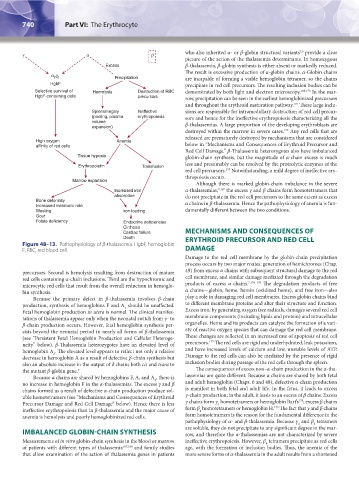
               Figure 48–13.  Pathophysiology of β-thalassemia. HgbF, hemoglobin
               F; RBC, red blood cell.                                DAMAGE
                                                                      Damage to the red cell membrane by the globin-chain precipitation
                                                                      process occurs by two major routes: generation of hemichromes (Chap.
               precursors. Second is hemolysis resulting from destruction of mature   49) from excess α chains with subsequent structural damage to the red
               red cells containing α-chain inclusions. Third are the hypochromic and   cell membrane, and similar damage mediated through the degradation
               microcytic red cells that result from the overall reduction in hemoglo-  products of excess  α chains. 7,174–176  The degradation products of free
               bin synthesis.                                         α chains—globin, heme, hemin (oxidized heme), and free iron—also
                   Because the primary defect in  β-thalassemia involves  β-chain   play a role in damaging red cell membranes. Excess globin chains bind
               production, synthesis of hemoglobins F and A  should be unaffected.   to different membrane proteins and alter their structure and function.
                                                  2
               Fetal hemoglobin production in utero is normal. The clinical manifes-  Excess iron, by generating oxygen free radicals, damages several red cell
               tations of thalassemia appear only when the neonatal switch from γ- to   membrane components (including lipids and protein) and intracellular
               β-chain production occurs. However, fetal hemoglobin synthesis per-  organelles. Heme and its products can catalyze the formation of a vari-
               sists beyond the neonatal period in nearly all forms of β-thalassemia   ety of reactive oxygen species that can damage the red cell membrane.
               (see “Persistent Fetal Hemoglobin Production and Cellular Heteroge-  These changes are reflected in an increased rate of apoptosis of red cell
                                                                              177
               neity”  below).  β-Thalassemia heterozygotes have an elevated  level of   precursors.  The red cells are rigid and underhydrated, leak potassium,
               hemoglobin A . The elevated level appears to reflect not only a relative   and have increased levels of calcium and low, unstable levels of ATP.
                          2
               decrease in hemoglobin A as a result of defective β-chain synthesis but   Damage to the red cells can also be mediated by the presence of rigid
               also an absolute increase in the output of δ chains both cis and trans to   inclusion bodies during passage of the red cells through the spleen.
               the mutant β-globin gene. 7                                The consequences of excess non–α-chain production in the α-tha-
                   Because α chains are shared by hemoglobins F, A, and A , there is   lassemias are quite different. Because α chains are shared by both fetal
                                                            2
               no increase in hemoglobin F in the α-thalassemias. The excess γ and β   and adult hemoglobin (Chaps. 6 and 48), defective α-chain production
               chains formed as a result of defective α-chain production produce sol-  is manifest in both fetal and adult life. In the fetus, it leads to excess
               uble homotetramers (see “Mechanisms and Consequences of Erythroid   γ-chain production; in the adult, it leads to an excess of β chains. Excess
                                                                                                            178
               Precursor Damage and Red Cell Damage” below). Hence there is less   γ chains form γ  homotetramers or hemoglobin Bart’s ; excess β chains
                                                                                 4
                                                                                                    179
               ineffective erythropoiesis than in β-thalassemia and the major cause of   form β  homotetramers or hemoglobin H.  The fact that γ and β chains
                                                                           4
               anemia is hemolysis and poorly hemoglobinized red cells.  form homotetramers is the reason for the fundamental difference in the
                                                                      pathophysiology of α- and β-thalassemia. Because γ  and β  tetramers
                                                                                                            4
                                                                                                                 4
                                                                      are soluble, they do not precipitate to any significant degree in the mar-
               IMBALANCED GLOBIN-CHAIN SYNTHESIS                      row, and therefore the α-thalassemias are not characterized by severe
               Measurements of in vitro globin-chain synthesis in the blood or marrow   ineffective erythropoiesis. However, β  tetramers precipitate as red cells
                                                                                                 4
               of patients with different types of thalassemia 167,168  and family studies   age, with the formation of inclusion bodies. Thus, the anemia of the
               that allow examination of the action of thalassemia genes in patients   more severe forms of α-thalassemia in the adult results from a shortened


          Kaushansky_chapter 48_p0725-0758.indd   740                                                                   9/18/15   2:57 PM

