


Page 764 - Williams Hematology ( PDFDrive )
P. 764
738  Part VI:  The Erythrocyte                 Chapter 48:  The Thalassemias: Disorders of Globin Synthesis           739


                       Hgb Seal Rock Hgb Pakse   ?       Hgb A          conditions, which can occur in any racial groups, include α-thalassemia
                          A(Glu)      (Tyr)   UUA(Leu)    UGA           associated with mental retardation or leukemia. Their importance lies
                           GAA        UAU              (terminate)      with the diagnostic problems they may present and, more importantly,
                                                          UAG           the light that elucidation of the α-thalassemia pathology may shed on
                                                                        broader disease mechanisms.
                                         HgbA                           Molecular Pathology of the α-Thalassemia Mental
                                          UAA                           Retardation Syndrome
                                         a142
                                                                        The first descriptions of noninherited forms of α-thalassemia associ-
                                                                        ated with mental retardation suggested the lesions involving the α-glo-
                                                                        bin gene locus were acquired in the paternal germ cells and that their
                             AAA          CAA         UCA               molecular pathology might help elucidate the associated developmental
                             (Lys)       (Gln)        (Ser)             changes.  Two separate syndromes of this type now are evident. In one
                                                                               156
                           Hgb lcaria   Hgb CS    Hgb Koya Dora
                                                                        group of patients, long deletions involve the α-globin gene cluster and
                                                                                       157
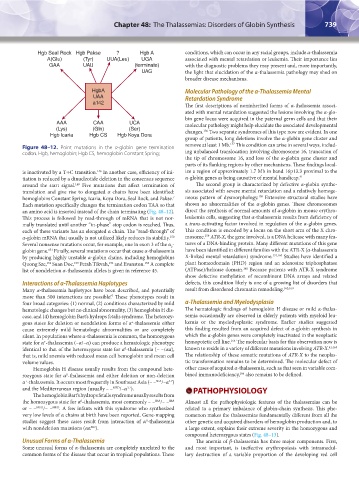
                  Figure 48–12.  Point mutations in the  α-globin gene termination   remove at least 1 Mb.  This condition can arise in several ways, includ-
                  codon. Hgb, hemoglobin; Hgb CS, hemoglobin Constant Spring;  ing unbalanced translocation involving chromosome 16, truncation of
                                                                        the tip of chromosome 16, and loss of the α-globin gene cluster and
                                                                        parts of its flanking regions by other mechanisms. These findings local-
                  is inactivated by a T→C transition.  In another case, efficiency of ini-  ize a region of approximately 1.7 Mb in band 16p13.3 proximal to the
                                           146
                  tiation is reduced by a dinucleotide deletion in the consensus sequence   α-globin genes as being causative of mental handicap. 41
                  around the start signal.  Five mutations that affect termination of   The second group is characterized by defective α-globin synthe-
                                    149
                  translation and give rise to elongated  α chains have been identified:   sis associated with severe mental retardation and a relatively homoge-
                                                                                                 158
                  hemoglobins Constant Spring, Icaria, Koya Dora, Seal Rock, and Pakse.    neous  pattern  of  dysmorphology.   Extensive  structural  studies  have
                                                                    7
                  Each mutation specifically changes the termination codon TAA so that   shown no abnormalities of the  α-globin genes. These chromosomes
                  an amino acid is inserted instead of the chain terminating (Fig. 48–12).   direct the synthesis of normal amounts of α-globin in mouse erythro-
                  This process is followed by read-through of mRNA that is not nor-  leukemia cells, suggesting that α-thalassemia results from deficiency of
                  mally translated until another “in-phase” stop codon is reached. Thus,   a trans-activating factor involved in regulation of the α-globin genes.
                  each of these variants has an elongated α chain. The “read-through” of   This condition is encoded by a locus on the short arm of the X chro-
                                                                               159
                  α-globin mRNA that usually is not utilized likely reduces its stability.    mosome.  ATR-X, the gene involved, is a DNA helicase with many fea-
                                                                   150
                  Several nonsense mutations occur, for example, one in exon 3 of the α -   tures of a DNA-binding protein. Many different mutations of this gene
                                                                    2
                  globin gene.  Finally, several mutations occur that cause α-thalassemia   have been identified in different families with the ATR-X (α-thalassemia
                          151
                  by producing highly unstable α-globin chains, including hemoglobins   X-linked mental retardation) syndrome. 131,160  Studies have identified a
                  Quong Sze,  Suan Doc,  Petah Tikvah,  and Evanston.  A complete   plant homeodomain (PHD) region and an adenosine triphosphatase
                                               154
                          152
                                   153
                                                           155
                                                                                            161
                  list of nondeletion α-thalassemia alleles is given in reference 45.  (ATPase)/helicase domain.  Because patients with ATR-X syndrome
                                                                        show defective methylation of recombinant DNA arrays and related
                  Interactions of α-Thalassemia Haplotypes              defects, this condition likely is one of a growing list of disorders that
                  Many α-thalassemia haplotypes have been described, and potentially   result from disordered chromatin remodeling. 162,163
                  more than 500 interactions are possible!  These phenotypes result in
                                                7
                  four broad categories: (1) normal, (2) conditions characterized by mild   α-Thalassemia and Myelodysplasia
                  hematologic changes but no clinical abnormality, (3) hemoglobin H dis-  The hematologic findings of hemoglobin H disease or mild α-thalas-
                  ease, and (4) hemoglobin Bart’s hydrops fetalis syndrome. The heterozy-  semia occasionally are observed in elderly patients with myeloid leu-
                  gous states for deletion or nondeletion forms of α -thalassemia either   kemia or the myelodysplastic syndrome. Earlier studies suggested
                                                      +
                  cause extremely mild hematologic abnormalities or are completely   this finding resulted from an acquired defect of α-globin synthesis in
                  silent. In populations where α-thalassemia is common, the homozygous   which the α-globin genes were completely inactivated in the neoplastic
                                                                                        164
                  state for α -thalassemia (–α/–α) can produce a hematologic phenotype   hemopoietic cell line.  The molecular basis for this observation now is
                         +
                  identical to that of the heterozygous state for α -thalassemia (– –/αα),   known to reside in a variety of different mutations involving ATR-X. 41,165
                                                    0
                  that is, mild anemia with reduced mean cell hemoglobin and mean cell   The relationship of these somatic mutations of ATR-X to the neoplas-
                  volume values.                                        tic transformation remains to be determined. The molecular defect of
                     Hemoglobin H disease usually results from the compound hete-  other cases of acquired α-thalassemia, such as that seen in variable com-
                                                                                           166
                  rozygous state for α -thalassemia and either deletion or non-deletion   bined immunodeficiency,  also remains to be defined.
                                0
                  α -thalassemia. It occurs most frequently in Southeast Asia (– – /–α )
                   +
                                                               SEA
                                                                   3.7
                  and the Mediterranean region (usually – – MED /–α ).     PATHOPHYSIOLOGY
                                                     3.7
                     The hemoglobin Bart’s hydrops fetalis syndrome usually results from
                  the homozygous state for α -thalassemia, most commonly – – SEA /– – SEA     Almost all the pathophysiologic features of the thalassemias can be
                                     0
                  or – – MED /– – MED . A few infants with this syndrome who synthesized   related to a primary imbalance of globin-chain synthesis. This phe-
                  very low levels of α chains at birth have been reported. Gene-mapping   nomenon makes the thalassemias fundamentally different from all the
                  studies suggest these cases result from interaction of  α -thalassemia   other genetic and acquired disorders of hemoglobin production and, to
                                                           0
                  with nondeletion mutations (αα ).                     a large extent, explains their extreme severity in the homozygous and
                                         ND
                                                                        compound heterozygous states (Fig. 48–13).
                  Unusual Forms of α-Thalassemia                            The anemia of β-thalassemia has three major components. First,
                  Some unusual forms of α-thalassemia are completely unrelated to the   and most important, is ineffective erythropoiesis with intramedul-
                  common forms of the disease that occur in tropical populations. These   lary destruction of a variable proportion of the developing red cell
          Kaushansky_chapter 48_p0725-0758.indd   739                                                                   9/18/15   2:57 PM

