


Page 762 - Williams Hematology ( PDFDrive )
P. 762
736  Part VI:  The Erythrocyte                 Chapter 48:  The Thalassemias: Disorders of Globin Synthesis           737


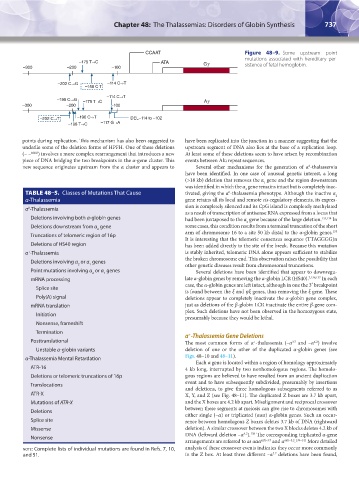
                                                           CCAAT                            Figure 48–9.  Some upstream point
                                                                                            mutations  associated with  hereditary  per-
                                     –175 T→C                   ATA            Gγ           sistence of fetal hemoglobin.
                  –300           –200           –100

                              –202 C→G        –114 C→T
                                       –158 C T
                                              –114 C→T
                             –195 C→G  –175 T→C                                Aγ
                  –300           –200           –100
                        –202 C→T    –196 C→T          DEL–114 to –102
                                 –198 T→C   –117 G→A

                  points during replication. This mechanism has also been suggested to   have been replicated into the junction in a manner suggesting that the
                  underlie some of the deletion forms of HPFH. One of these deletions   upstream segment of DNA also lies at the base of a replication loop.
                  (– – MED ) involves a more complex rearrangement that introduces a new   At least some of these deletions seem to have arisen by recombination
                  piece of DNA bridging the two breakpoints in the α-gene cluster. This   events between Alu repeat sequences.
                  new sequence originates upstream from the α cluster and appears to   Several other mechanisms for the generation of  α -thalassemia
                                                                                                                  0
                                                                        have  been  identified.  In  one case  of unusual  genetic  interest,  a  long
                                                                        (>18 kb) deletion that removes the α  gene and the region downstream
                                                                                                   1
                                                                        was identified in which the α  gene remains intact but is completely inac-
                                                                                             2
                   TABLE 48–5.  Classes of Mutations That Cause         tivated, giving the α -thalassemia phenotype. Although the inactive α
                                                                                       0
                                                                                                                           2
                   α-Thalassemia                                        gene retains all its local and remote cis-regulatory elements, its expres-
                   α -Thalassemia                                       sion is completely silenced and its CpG island is completely methylated
                    0
                                                                        as a result of transcription of antisense RNA expressed from a locus that
                     Deletions involving both α-globin genes            had been juxtaposed to the α  gene because of the large deletion. 133,134  In
                                                                                             2
                     Deletions downstream from α  gene                  some cases, this condition results from a terminal truncation of the short
                                           2                                                                              135
                     Truncations of telomeric region of 16p             arm of chromosome 16 to a site 50 kb distal to the α-globin genes.
                                                                        It is interesting that the telomeric consensus sequence (TTAGGGG)n
                     Deletions of HS40 region                           has been added directly to the site of the break. Because this mutation
                   α -Thalassemia                                       is stably inherited, telomeric DNA alone appears sufficient to stabilize
                    +
                                                                        the broken chromosome end. This observation raises the possibility that
                     Deletions involving α  or α  genes
                                    2   1                               other genetic diseases result from chromosomal truncations.
                     Point mutations involving α  or α  genes               Several deletions have been identified that appear to downregu-
                                         2   1
                     mRNA processing                                    late α-globin genes by removing the α-globin LCR (HS40). 7,136,137  In each
                                                                        case, the α-globin genes are left intact, although in one the 3′ breakpoint
                      Splice site
                                                                        is found between the ξ and ψξ genes, thus removing the ξ gene. These
                      Poly(A) signal                                    deletions appear to completely inactivate the α-globin gene complex,
                     mRNA translation                                   just as deletions of the β-globin LCR inactivate the entire β-gene com-
                                                                        plex. Such deletions have not been observed in the homozygous state,
                      Initiation
                                                                        presumably because they would be lethal.
                      Nonsense, frameshift
                       Termination
                                                                        α -Thalassemia Gene Deletions
                                                                          +
                     Posttranslational                                  The most common forms of  α -thalassemia (–α  and –α ) involve
                                                                                               +
                                                                                                                    4.2
                                                                                                            3.7
                      Unstable α-globin variants                        deletion of one or the other of the duplicated  α-globin genes (see
                   α-Thalassemia Mental Retardation                     Figs. 48–10 and 48–11).
                                                                            Each α gene is located within a region of homology approximately
                     ATR-16                                             4 kb long, interrupted by two nonhomologous regions. The homolo-
                     Deletions or telomeric truncations of 16p          gous regions are believed to have resulted from an ancient duplication
                     Translocations                                     event and to have subsequently subdivided, presumably by insertions
                                                                        and deletions, to give three homologous subsegments referred to as
                     ATR-X                                              X, Y, and Z (see Fig. 48–11). The duplicated Z boxes are 3.7 kb apart,
                     Mutations of ATR-X                                 and the X boxes are 4.2 kb apart. Misalignment and reciprocal crossover
                                                                        between these segments at meiosis can give rise to chromosomes with
                     Deletions
                                                                        either single (–α) or triplicated (ααα) α-globin genes. Such an occur-
                     Splice site                                        rence between homologous Z boxes deletes 3.7 kb of DNA (rightward
                     Missense                                           deletion). A similar crossover between the two X blocks deletes 4.2 kb of
                                                                        DNA (leftward deletion –α ).  The corresponding triplicated α-gene
                                                                                            4.2 138
                     Nonsense
                                                                        arrangements are referred to as ααα anti–3.7  and α anti–4.2 139–141  More detailed
                                                                                                             .
                  note: Complete lists of individual mutations are found in Refs. 7, 10,   analysis of these crossover events indicates they occur more commonly
                                                                                                      3.7
                  and 51.                                               in the Z box. At least three different –α  deletions have been found,

          Kaushansky_chapter 48_p0725-0758.indd   737                                                                   9/18/15   2:57 PM

