


Page 959 - Williams Hematology ( PDFDrive )
P. 959
934            Part VII:  Neutrophils, Eosinophils, Basophils, and Mast Cells                                                         Chapter 60:  Structure and Composition of Neutrophils, Eosinophils, and Basophils            935


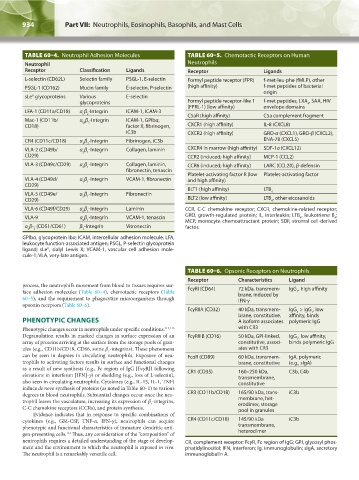
                TABLE 60–4.  Neutrophil Adhesion Molecules             TABLE 60–5.  Chemotactic Receptors on Human
                Neutrophil                                             Neutrophils
                Receptor           Classification  Ligands             Receptor                 Ligands
                L-selectin (CD62L)  Selectin family  PSGL-1, E-selectin  Formyl peptide receptor (FPR)   f-met-leu-phe (fMLP), other
                PSGL-1 (CD162)     Mucin family   E-selectin, P-selectin  (high affinity)       f-met peptides of bacterial
                                                                                                origin
                sLe  glycoproteins  Various       E-selectin
                   X
                                   glycoproteins                       Formyl peptide receptor-like 1   f-met peptides, LXA , SAA, HIV
                                                                                                               4
                                                                       (FPRL-1) (low affinity)  envelope domains
                LFA-1 (CD11a/CD18)  α β -Integrin  ICAM-1, ICAM-3
                                    L 2                                C5aR (high affinity)     C5a complement fragment
                Mac-1 (CD11b/      α β -Integrin  ICAM-1, GPIbα,
                                    M 2
                CD18)                             factor X, fibrinogen,   CXCR1 (high affinity)  IL-8 (CXCL8)
                                                  iC3b                 CXCR2 (high affinity)    GRO-α (CXCL1), GRO-β (CXCL2),
                CR4 (CD11c/CD18)   α β -Integrin  Fibrinogen, iC3b                              ENA-78 (CXCL5)
                                    X 2
                VLA-2 (CD49b/      α β -Integrin  Collagen, laminin    CXCR4 in marrow (high affinity)  SDF-1α (CXCL12)
                                    2 1
                CD29)                                                  CCR2 (induced; high affinity)  MCP-1 (CCL2)
                VLA-3 (CD49c/CD29)  α β -Integrin  Collagen, laminin,   CCR6 (induced; high affinity)  LARC (CCL20), β-defensin
                                    3 1
                                                  fibronectin, tenascin
                                                                       Platelet-activating factor R (low  Platelet-activating factor
                VLA-4 (CD49d/      α β -Integrin  VCAM-1, fibronectin  and high affinity)
                                    4 1
                CD29)
                                                                       BLT1 (high affinity)     LTB
                VLA-5 (CD49e/      α β -Integrin  Fibronectin                                      4
                                    5 1
                CD29)                                                  BLT2 (low affinity)      LTB , other eicosanoids
                                                                                                   4
                VLA-6 (CD49f/CD29)  α β -Integrin  Laminin            CCR,  C-C  chemokine  receptor;  CXCR,  chemokine-related  receptor;
                                    6 1
                VLA-9              α β -Integrin  VCAM-1, tenascin    GRO, growth-regulated protein; IL, interleukin; LTB , leukotriene B ;
                                                                                                                        4
                                                                                                            4
                                    9 1                               MCP, monocyte chemoattractant protein; SDF, stromal cell-derived
                α β-  (CD51/CD61)  β -Integrin    Vitronectin         factor.
                 v  3               3
               GPIbα, glycoprotein Ibα; ICAM, intercellular adhesion molecule; LFA,
               leukocyte function-associated antigen; PSGL, P-selectin glycoprotein
               ligand; sLe , sialyl Lewis X;  VCAM-1, vascular cell adhesion mole-
                        X
               cule-1; VLA, very-late antigen.
                                                                       TABLE 60–6.  Opsonic Receptors on Neutrophils
                                                                       Receptor         Characteristics  Ligand
               process, the neutrophil’s movement from blood to tissues requires sur-
               face  adhesion  molecules  (Table  60–4),  chemotactic  receptors (Table   FcγRI (CD64)  72 kDa, transmem-  IgG , high affinity
                                                                                                           1
                                                                                        brane, induced by
               60–5), and the requirement to phagocytize microorganisms through         IFN-γ
               opsonin receptors (Table 60–6).
                                                                       FcγRIIA (CD32)   40 kDa, transmem-  IgG  > IgG , low
                                                                                                           3
                                                                                                                1
                                                                                        brane, constitutive,   affinity, binds
               PHENOTYPIC CHANGES                                                       A isoform associates  polymeric IgG
               Phenotypic changes occur in neutrophils under specific conditions. 112,113    with CR3
               Degranulation results in marked changes in surface expression of an   FcγRIIIB (CD16)  50 kDa, GPI-linked,   IgG , low affinity,
                                                                                                           1
               array of proteins arriving at the surface from the storage pools of gran-  constitutive, associ-  binds polymeric IgG
               ules (e.g., CD11b/CD18, CD66, some β -integrins). These phenomena        ates with CR3
                                            1
               can be seen in degrees in circulating neutrophils. Exposure of neu-  FcαR (CD89)  60 kDa, transmem-  IgA, polymeric
               trophils to activating factors results in surface and functional changes   brane, constitutive  (e.g., sIgA)
               as a result of new synthesis (e.g., Fc region of IgG [FcγR]I following   CR1 (CD35)  160–250 kDa,   C3b, C4b
               elevations in interferon [IFN]-γ) or shedding (e.g., loss of L-selectin),   transmembrane,
               also seen in circulating neutrophils. Cytokines (e.g., IL-15, IL-1, TNF)   constitutive
               induce de novo synthesis of proteins (as noted in Table  60–1) to various
               degrees in blood neutrophils. Substantial changes occur once the neu-  CR3 (CD11b/CD18)  165/90 kDa, trans-  iC3b
               trophil leaves the vasculature, increasing its expression of β -integrins,   membrane, het-
                                                                                        erodimer, storage
                                                          1
               C-C chemokine receptors (CCRs), and protein synthesis.                   pool in granules
                   Evidence indicates that in response to specific combinations of
               cytokines (e.g., GM-CSF, TNF-α, IFN-γ), neutrophils can acquire   CR4 (CD11c/CD18)  145/90 kDa   iC3b
               phenotypic and functional characteristics of immature dendritic anti-    transmembrane,
                              112
               gen-presenting cells.  Thus, any consideration of the “composition” of   heterodimer
               neutrophils requires a detailed understanding of the stage of develop-  CR, complement receptor; FcγR, Fc region of IgG; GPI, glycosyl phos-
               ment and the environment to which the neutrophil is exposed in vivo.   phatidylinositol; IFN, interferon; Ig, immunoglobulin; sIgA, secretory
               The neutrophil is a remarkably versatile cell.         immunoglobulin A.


          Kaushansky_chapter 60_p0923-0938.indd   934                                                                   9/18/15   10:35 PM

