


Page 1032 - Clinical Immunology_ Principles and Practice ( PDFDrive )
P. 1032
CHaPter 74  Immunological Ocular Disease                995


            TABLE 74.1  Diagnostic Categories
            of Uveitis
            Diagnostic Group      Diagnosis
            Infectious   Viral    Herpes simplex, Herpes zoster
             causes               Cytomegalovirus (CMV) infection
                                  Chikungunya
                                  Human T-lymphotropic virus 1
                                    (HTLV-1) infection
                                  Mumps
                                  West Nile virus infection
                                  Ebola
                                  Zika virus infection
                     Bacterial or   Atypical Mycobacterium infection
                      spirochetal  Bacterial endocarditis
                                  Bartonella infection
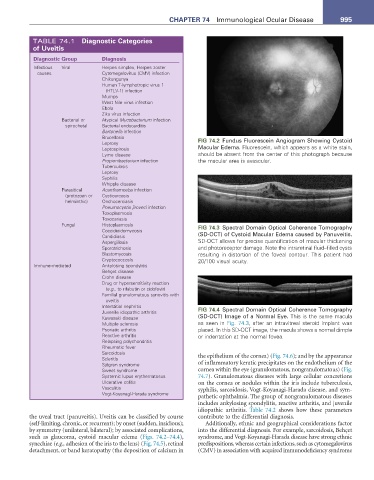
                                  Brucellosis                     FIG 74.2  Fundus Fluorescein Angiogram Showing Cystoid
                                  Leprosy
                                  Leptospirosis                   Macular Edema. Fluorescein, which appears as a white stain,
                                  Lyme disease                    should be absent from the center of this photograph because
                                  Propionibacterium infection     the macular area is avascular.
                                  Tuberculosis
                                  Leprosy
                                  Syphilis
                                  Whipple disease
                     Parasitical   Acanthamoeba infection
                      (protozoan or   Cysticercosis
                      helminthic)  Onchocerciasis
                                  Pneumocystis jiroveci infection
                                  Toxoplasmosis
                                  Toxocariasis
                     Fungal       Histoplasmosis                  FIG 74.3  Spectral Domain Optical Coherence Tomography
                                  Coccidioidomycosis
                                  Candidiasis                     (SD-OCT) of Cystoid Macular Edema caused by Panuveitis.
                                  Aspergillosis                   SD-OCT allows for precise quantification of macular thickening
                                  Sporotrichosis                  and photoreceptor damage. Note the intraretinal fluid–filled cysts
                                  Blastomycosis                   resulting in distortion of the foveal contour. This patient had
                                  Cryptococcosis                  20/100 visual acuity.
            Immune-mediated       Ankylosing spondylitis
                                  Behçet disease
                                  Crohn disease
                                  Drug or hypersensitivity reaction
                                    (e.g., to rifabutin or cidofovir)
                                  Familial granulomatous synovitis with
                                    uveitis
                                  Interstitial nephritis          FIG 74.4  Spectral Domain Optical Coherence Tomography
                                  Juvenile idiopathic arthritis
                                  Kawasaki disease                (SD-OCT) Image of a Normal Eye. This is the same macula
                                  Multiple sclerosis              as seen in  Fig. 74.3, after an intravitreal steroid implant was
                                  Psoriatic arthritis             placed. In this SD-OCT image, the macula shows a normal dimple
                                  Reactive arthritis              or indentation at the normal fovea.
                                  Relapsing polychondritis
                                  Rheumatic fever
                                  Sarcoidosis                     the epithelium of the cornea) (Fig. 74.6); and by the appearance
                                  Scleritis
                                  Sjögren syndrome                of inflammatory keratic precipitates on the endothelium of the
                                  Sweet syndrome                  cornea within the eye (granulomatous, nongranulomatous) (Fig.
                                  Systemic lupus erythematosus    74.7). Granulomatous diseases with large cellular concretions
                                  Ulcerative colitis              on the cornea or nodules within the iris include tuberculosis,
                                  Vasculitis                      syphilis, sarcoidosis, Vogt-Koyanagi-Harada disease, and sym-
                                  Vogt-Koyanagi-Harada syndrome
                                                                  pathetic ophthalmia. The group of nongranulomatous diseases
                                                                  includes ankylosing spondylitis, reactive arthritis, and juvenile
                                                                  idiopathic arthritis.  Table 74.2 shows how these parameters
           the uveal tract (panuveitis). Uveitis can be classified by course   contribute to the differential diagnosis.
           (self-limiting, chronic, or recurrent); by onset (sudden, insidious);   Additionally, ethnic and geographical considerations factor
           by symmetry (unilateral, bilateral); by associated complications,   into the differential diagnosis. For example, sarcoidosis, Behçet
           such as glaucoma, cystoid macular edema (Figs. 74.2–74.4),   syndrome, and Vogt-Koyanagi-Harada disease have strong ethnic
           synechiae (e.g., adhesion of the iris to the lens) (Fig. 74.5), retinal   predispositions, whereas certain infections, such as cytomegalovirus
           detachment, or band keratopathy (the deposition of calcium in   (CMV) in association with acquired immunodeficiency syndrome

