


Page 1162 - Clinical Immunology_ Principles and Practice ( PDFDrive )
P. 1162
CHaPtEr 82  Immune Reconstitution Therapy for Immunodeficiency                  1127


           of mAbs against CD117 (c-kit) has been proposed to displace   5.  Kwan A, Abraham RS, Currier R, et al. Newborn screening for severe
           autologous stem cells and favor engraftment of donor-derived   combined immunodeficiency in 11 screening programs in the United
           cells, while avoiding the drug-related toxicity of chemotherapy   States. JAMA 2014;312:729–38.
                         48
           and radiotherapy.  Recognition that B-cell engraftment after   6.  Grunebaum E, Mazzolari E, Porta F, et al. Bone marrow transplantation
                                                                    for severe combined immunodeficiency. JAMA 2006;295:508–18.
           HSCT  is  hampered  by  competition  between  host  and  donor   7.  Gennery AR, Cant AJ. Cord blood stem cell transplantation in primary
                            49
           early B-cell precursors  may prompt novel forms of conditioning   immune deficiencies. Curr Opin Allergy Clin Immunol 2007;7:528–34.
           regimens targeted to host pro-B lymphocytes, in an attempt to   8.  Hassan A, Lee P, Maggina P, et al. Host natural killer immunity is a key
           facilitate development of donor-derived B cells, even in the   indicator of permissiveness for donor cell engraftment in patients with
           unconditioned HLA-identical setting.                     severe combined immunodeficiency. J Allergy Clin Immunol
             Strategies aimed at improving thymic function after HSCT   2014;133:1660–6.
           may include  (i) protection of thymic stroma that supports   9.  Slatter MA, Rao K, Amrolia P, et al. Treosulfan-based conditioning
           thymopoiesis and (ii) direct stimulation of early T-cell progenitors.   regimens for hematopoietic stem cell transplantation in children with
           Keratinocyte growth factor (KGF) is potentially attractive because   primary immunodeficiency: United Kingdom experience. Blood
           it protects the thymic stroma. Administration of KGF before   2011;117:4367–75.
           HSCT has been shown to enhance thymopoiesis and peripheral   10.  Ferrara JL, Levine JE, Reddy P, et al. Graft-versus-host disease. Lancet
                                                                    2009;373:1550–61.
           T-cell numbers and to reduce the incidence and severity of GvHD   11.  Wolff D, Gerbitz A, Ayuk F, et al. Consensus conference on clinical
                                 50
           in murine models of HSCT.  However, more must be learned   practice in chronic graft-versus-host disease (GVHD): first-line and
           about the long-term outcome of this treatment before clinical   topical treatment of chronic GVHD. Biol Blood Marrow Transplant
           trials can be started.                                   2010;16:1611–28.
             Attempts to accelerate immune reconstitution might be based   12.  Wolff D, Schleuning M, von Harsdorf S, et al. Consensus conference on
           on the use of cytokines, such as IL-7, which promote T-cell   clinical practice in chronic GVHD: second-line treatment of chronic
           development and maturation in the thymus. However, experience   graft-versus-host disease. Biol Blood Marrow Transplant 2011;17:1–17.
           in severely immunodeficient mice has shown that infusion of   13.  Tomblyn M, Chiller T, Einsele H, et al. Guidelines for preventing
           IL-7 provides limited benefit in the MHC-compatible or partially   infectious complications among hematopoietic cell transplantation
           compatible setting, whereas it has facilitated T-cell development   recipients: a global perspective. Biol Blood Marrow Transplant
                                                                    2009;15:1143–238. Erratum in: Biol Blood Marrow Transplant
           in a fully mismatched setting.                           2010;16:294.
                                              14
             Finally, besides use of virus-specific CTLs,  infusion of donor   14.  Naik S, Nicholas SK, Martinez CA, et al. Adoptive immunotherapy for
           T cells that have antiinfective activity but no GvHD activity   primary immunodeficiency disorders with virus-specific T lymphocytes. J
           might help reduce infection-related mortality after HSCT. Such   Allergy Clin Immunol 2016;137:1498–505.
           strategy could be based on removal of alloreactive cells by negative   15.  Teigland CL, Parrott RE, Buckley RH. Long-term outcome of
           selection using anti-CD25 or anti-CD69 antibodies.       non-ablative BMT in patients with SCID. Bone Marrow Transplant
                                                                    2013;48:1050–5.
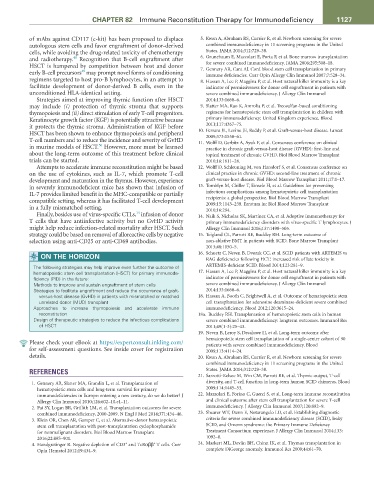
               ON tHE HOrIZON                                     16.  Schuetz C, Neven B, Dvorak CC, et al. SCID patients with ARTEMIS vs
                                                                    RAG deficiencies following HCT: increased risk of late toxicity in
            The following strategies may help improve even further the outcome of   ARTEMIS-deficient SCID. Blood 2014;123:281–9.
            hematopoietic stem cell transplantation (HSCT) for primary immunode-  17.  Hassan A, Lee P, Maggina P, et al. Host natural killer immunity is a key
            ficiency (PID) in the future:                           indicator of permissiveness for donor cell engraftment in patients with
            Methods to improve and sustain engraftment of stem cells  severe combined immunodeficiency. J Allergy Clin Immunol
            Strategies to facilitate engraftment and reduce the occurrence of graft-  2014;133:1660–6.
              versus-host disease (GvHD) in patients with mismatched or matched   18.  Hassan A, Booth C, Brightwell A, et al. Outcome of hematopoietic stem
              unrelated donor (MUD) transplant                      cell transplantation for adenosine deaminase-deficient severe combined
            Approaches to increase thymopoiesis and accelerate immune   immunodeficiency. Blood 2012;120:3615–24.
              reconstitution                                      18a.  Buckley RH. Transplantation of hematopoietic stem cells in human
            Design of therapeutic strategies to reduce the infectious complications   severe combined immunodeficiency: longterm outcomes. Immunol Res
              of HSCT                                               2011;49(1-3):25–43.
                                                                  19.  Neven B, Leroy S, Decaluwe H, et al. Long-term outcome after
                                                                    hematopoietic stem cell transplantation of a single-center cohort of 90
           Please check your eBook at https://expertconsult.inkling.com/   patients with severe combined immunodeficiency. Blood
           for self-assessment questions. See inside cover for registration   2009;113:4114–24.
           details.                                               20.  Kwan A, Abraham RS, Currier R, et al. Newborn screening for severe
                                                                    combined immunodeficiency in 11 screening programs in the United
           REFERENCES                                               States. JAMA 2014;312:729–38.
                                                                  21.  Sarzotti-Kelsoe M, Win CM, Parrott RE, et al. Thymic output, T-cell
           1.  Gennery AR, Slatter MA, Grandin L, et al. Transplantation of   diversity, and T-cell function in long-term human SCID chimeras. Blood
             hematopoietic stem cells and long-term survival for primary   2009;114:1445–53.
             immunodeficiencies in Europe: entering a new century, do we do better? J   22.  Mazzolari E, Forino C, Guerci S, et al. Long-term immune reconstitution
             Allergy Clin Immunol 2010;126:602–10.e1–11.            and clinical outcome after stem cell transplantation for severe T-cell
           2.  Pai SY, Logan BR, Griffith LM, et al. Transplantation outcomes for severe   immunodeficiency. J Allergy Clin Immunol 2007;120:892–9.
             combined immunodeficiency, 2000-2009. N Engl J Med 2014;371:434–46.  23.  Shearer WT, Dunn E, Notarangelo LD, et al. Establishing diagnostic
           3.  Klein OR, Chen AR, Gamper C, et al. Alternative-donor hematopoietic   criteria for severe combined immunodeficiency disease (SCID), leaky
             stem cell transplantation with post-transplantation cyclophosphamide    SCID, and Omenn syndrome: the Primary Immune Deficiency
             for nonmalignant disorders. Biol Blood Marrow Transplant   Treatment Consortium experience. J Allergy Clin Immunol 2014;133:
             2016;22:895–901.                                       1092–8.
                                          +
                                                   +
           4.  Handgretinger R. Negative depletion of CD3  and TcRαββ  T cells. Curr   24.  Markert ML, Devlin BH, Chinn IK, et al. Thymus transplantation in
             Opin Hematol 2012;19:434–9.                            complete DiGeorge anomaly. Immunol Res 2009;44:61–70.

