


Page 1286 - Clinical Immunology_ Principles and Practice ( PDFDrive )
P. 1286
1248         Part ElEvEn  Diagnostic Immunology


                                    No Ag                      chicken erythrocytes) should be used as an internal reference
                10 4                                           for evaluating DNA content and evaluating the cell cycle
                                                               distribution.
                                                                  It should be noted that several different computer algorithms
                10 3                                           have been developed to determine the relative proportion of
                                                               each cell  cycle compartment,  and the selection of a software
                                                               program is not a trivial process. The major instrument manu-
                                                               facturers supply cell cycle analysis programs, and third-party
                10 2                                           programs are also available. Generally, the optimal program
                                                               should be capable of modeling two or more aneuploid popula-
                                                               tions, subtracting debris (particularly if formalin-fixed, paraffin-
                                                               embedded [FFPE] archival material is used) and accurately
                10 1                                           estimating S-phase cells. 49,50  The combination of a surface marker
                                                               and the cell cycle has been very useful in differentiating normal
            IFN-γ                                              cell populations from tumor cell populations. One example is
                                                               the use of anti-κ-, anti-λ-, or B-cell reagents to separate the
                10 0                                           aneuploid B-cell clone from the remaining normal, reactive B
                  10 0     10 1     10 2     10 3     10 4     cells in a lymphoid cell mixture. Another uses cytokeratin as a
                                                               marker to distinguish between tumor cells and inflammatory
                    IL-4                                       cells.
                                                                  The other major event that has occurred in cell cycle analysis
                                    M.Tb                       has been the development of technology using the incorporation
                10 4                                           of bromodeoxyuridine.  This thymidine analogue is used to
                                                                                  51
                                                               directly determine the percentage of S-phase cells. Additionally,
                                                               when used in kinetic studies, it permits determination of indi-
                10 3                                           vidual times for the components of the cell cycle and determina-
                                                               tion of the growth fraction. Finally, recent developments have
                                                               resulted in the availability of two anticyclin reagents to evaluate
                                                               cell cycle transition points in malignant cells. 52
                10 2
                                                               APOPTOSIS DETECTION
                                                               Flow cytometry has become the method of choice for the detection
                10 1                                           and quantification of cellular apoptosis,  in part because of its
                                                                                               53
                                                               capacity for rapid assessment of a large number of cells and
            IFN-γ                                              samples. Many distinct features of an apoptotic cell can be
                                                               evaluated by using flow cytometry based on light scatter, plasma
                10 0                                           membrane  changes, mitochondrial transmembrane  potential,
                  10 0     10 1     10 2     10 3     10 4
                                                               DNA content, and DNA integrity.
                                                                  The light scattering properties of a cell undergoing pro-
                    IL-4
                                        +
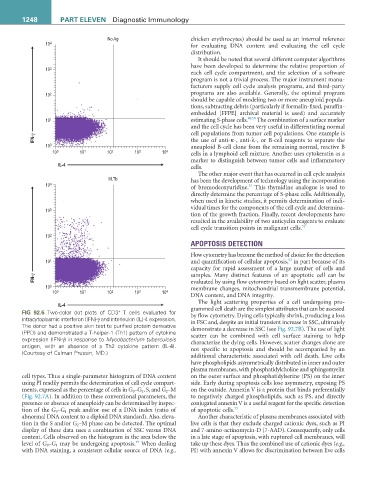
        FIG 92.6  Two-color dot plots of CD3  T cells evaluated for   grammed cell death are the simplest attributes that can be assessed
        intracytoplasmic interferon (IFN)-γ and interleukin (IL)-4 expression.   by flow cytometry. Dying cells typically shrink, producing a loss
        The donor had a positive skin test to purified protein derivative   in FSC and, despite an initial transient increase in SSC, ultimately
        (PPD) and demonstrated a T-helper-1 (Th1) pattern of cytokine   demonstrate a decrease in SSC (see Fig. 92.7B). The use of light
        expression (IFN-γ) in response to Mycobacterium tuberculosis   scatter can be combined with cell surface staining to help
        antigen,  with an absence  of a  Th2 cytokine pattern  (IL-4).   characterize the dying cells. However, scatter changes alone are
        (Courtesy of Calman Prussin, MD.)                      not specific to apoptosis and should be accompanied by an
                                                               additional characteristic associated with cell death. Live cells
                                                               have phospholipids asymmetrically distributed in inner and outer
                                                               plasma membranes, with phosphatidylcholine and sphingomyelin
        cell types. Thus a single-parameter histogram of DNA content   on the outer surface and phosphatidylserine (PS) on the inner
        using PI readily permits the determination of cell cycle compart-  side. Early during apoptosis cells lose asymmetry, exposing PS
        ments, expressed as the percentage of cells in G 0 –G 1 , S, and G 2 –M   on the outside. Annexin V is a protein that binds preferentially
        (Fig. 92.7A). In addition to these conventional parameters, the   to negatively charged phospholipids, such as PS, and directly
        presence or absence of aneuploidy can be determined by inspec-  conjugated annexin V is a useful reagent for the specific detection
        tion of the G 0 –G 1  peak and/or use of a DNA index (ratio of   of apoptotic cells. 53
        abnormal DNA content to a diploid DNA standard). Also, eleva-  Another characteristic of plasma membranes associated with
        tion in the S and/or G 2 –M phase can be detected. The optimal   live cells is that they exclude charged cationic dyes, such as PI
        display of these data uses a combination of SSC versus DNA   and 7-amino-actinomycin-D (7-AAD). Consequently, only cells
        content. Cells observed on the histogram in the area below the   in a late stage of apoptosis, with ruptured cell membranes, will
                                             49
        level of G 0–G 1 may be undergoing apoptosis.  When dealing   take up these dyes. Thus the combined use of cationic dyes (e.g.,
        with DNA staining, a consistent cellular source of DNA (e.g.,   PI) with annexin V allows for discrimination between live cells

