


Page 220 - Clinical Immunology_ Principles and Practice ( PDFDrive )
P. 220
CHaPTEr 13  Regulated Necrosis and Its Immunogenicity                199


             An inflammatory milieu is generated mainly by monocytes.   Metabolic perturbation  Stressed cell
           These become active as the survival response fails and the formerly   e.g. I/R  Class V DAMPs
           stressed cell succumbs to RN. Ferroptosis is the typical mode of
           RN within this process. The ferroptotic cell can “leech” redox
           equivalents, such as nicotinamide adenine dinucleotide phosphate
           (NADPH), from neighbored cells (see below), which subsequently
           undergo secondary necrosis. This secondary necrosis seems to   Adaptive immunity  Necroinflammatory loop  Necrotic cell
           involve necroptosis, but the mechanism of necroptosis induction   specific response  autoamplification  Class I/II DAMPs
           in this case remains to be elucidated. RN releases high amounts
           of DAMPs, so it can be named immunogenic cell death (ICD)
           in this context as well.
             Adenosine triphosphate (ATP) as a DAMP can reach the                         Innate immunity
           extracellular space (eATP). When the plasma membrane is intact,                 DAMP sensing
           the autophagy machinery seems to be necessary for ATP export.                   DC maturation
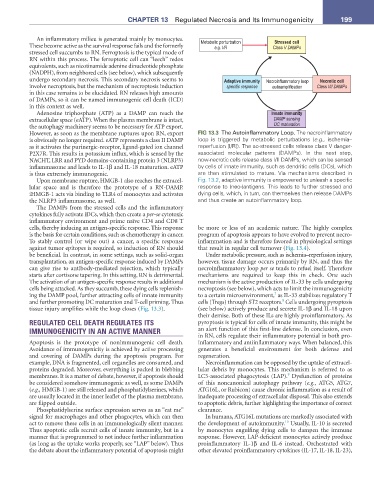
           However, as soon as the membrane ruptures upon RN, export   FIG 13.3  The Autoinflammatory Loop. The necroinflammatory
           is obviously no longer required. eATP represents a class II DAMP   loop is triggered by metabolic perturbations (e.g., ischemia–
           as it activates the purinergic-receptor, ligand-gated ion channel   reperfusion [I/R]). The so-stressed cells release class V danger-
           P2X7R. This results in potassium influx, which is sensed by the   associated molecular patterns (DAMPs). In the next step,
           NACHT, LRR and PYD domains-containing protein 3 (NLRP3)   now-necrotic cells release class I/II DAMPs, which can be sensed
           inflammasome and leads to IL-1β and IL-18 maturation. eATP   by cells of innate immunity, such as dendritic cells (DCs), which
           is thus extremely immunogenic.                         are then stimulated to mature. Via mechanisms described in
             Upon membrane rupture, HMGB-1 also reaches the extracel-  Fig. 13.2, adaptive immunity is empowered to unleash a specific
           lular space and is therefore the prototype of a RN-DAMP.   response to (neo-)antigens. This leads to further stressed and
           iHMGB-1 acts via binding to TLR4 of monocytes and activates   dying cells, which, in turn, can themselves then release DAMPs
           the NLRP3 inflammasome, as well.                       and thus create an autoinflammatory loop.
             The DAMPs from the stressed cells and the inflammatory
           cytokines fully activate iDCs, which then create a per-se cytotoxic
           inflammatory environment and prime naïve CD4 and CD8 T
           cells, thereby inducing an antigen-specific response. This response   be more or less of an academic nature. The highly complex
           is the basis for certain conditions, such as chemotherapy in cancer.   program of apoptosis appears to have evolved to prevent necro-
           To stably control (or wipe out) a cancer, a specific response   inflammation and is therefore favored in physiological settings
           against tumor epitopes is required, so induction of RN should   that result in regular cell turnover (Fig. 13.4).
           be beneficial. In contrast, in some settings, such as solid-organ   Under metabolic pressure, such as ischemia–reperfusion injury,
           transplantation, an antigen-specific response induced by DAMPs   however, tissue damage occurs primarily by RN, and thus the
           can give rise to antibody-mediated rejection, which typically   necroinflammatory loop per se tends to refuel itself. Therefore
           starts after cortisone tapering. In this setting, RN is detrimental.   mechanisms  are required to keep this  in check.  One such
           The activation of an antigen-specific response results in additional   mechanism is the active production of IL-33 by cells undergoing
           cells being attacked. As they succumb, these dying cells replenish-  necroptosis (see below), which acts to limit the immunogenicity
                                                                                           7
           ing the DAMP pool, further attracting cells of innate immunity   to a certain microenvironment,  as IL-33 stabilizes regulatory T
                                                                                             8
           and further promoting DC maturation and T-cell priming. Thus   cells (Tregs) through ST2 receptors.  Cells undergoing pyroptosis
           tissue injury amplifies while the loop closes (Fig. 13.3).  (see below) actively produce and secrete IL-1β and IL-18 upon
                                                                  their demise. Both of these ILs are highly proinflammatory. As
           REGULATED CELL DEATH REGULATES ITS                     pyroptosis is typical for cells of innate immunity, this might be
           IMMUNOGENICITY IN AN ACTIVE MANNER                     an alert function of this first-line defense. In conclusion, even
                                                                  in RN, cells regulate their inflammatory potential in both pro-
           Apoptosis is the prototype of nonimmunogenic cell death.   inflammatory and antiinflammatory ways. When balanced, this
           Avoidance of immunogenicity is achieved by active processing   generates a beneficial environment for both defense and
           and covering of DAMPs during the apoptosis program. For   regeneration.
           example, DNA is fragmented, cell organelles are consumed, and   Necroinflammation can be opposed by the uptake of extracel-
           proteins degraded. Moreover, everything is packed in blebbing   lular debris by monocytes. This mechanism is referred to as
                                                                                               9
           membranes. It is a matter of debate, however, if apoptosis should   LC3-associated phagocytosis (LAP).  Dysfunction of proteins
           be considered somehow immunogenic as well, as some DAMPs   of this noncanonical autophagy pathway (e.g., ATG5, ATG7,
           (e.g., HMGB-1) are still released and phosphatidylserines, which   ATG16L, or Rubicon) cause chronic inflammation as a result of
           are usually located in the inner leaflet of the plasma membrane,   inadequate processing of extracellular disposal. This also extends
           are flipped outside.                                   to apoptotic debris, further highlighting the importance of correct
             Phosphatidylserine surface expression serves as an “eat me”   clearance.
           signal for macrophages and other phagocytes, which can then   In humans, ATG16L mutations are markedly associated with
                                                                                              10
           act to remove these cells in an immunologically silent manner.   the development of autoimmunity.  Usually, IL-10 is secreted
           Thus apoptotic cells recruit cells of innate immunity, but in a   by monocytes engulfing dying cells to dampen the immune
           manner that is programmed to not induce further inflammation   response. However, LAP-deficient monocytes actively produce
           (as long as the uptake works properly, see “LAP” below). Thus   proinflammatory IL-1β  and IL-6  instead.  Orchestrated  with
           the debate about the inflammatory potential of apoptosis might   other elevated proinflammatory cytokines (IL-17, IL-18, IL-23),

