


Page 222 - Clinical Immunology_ Principles and Practice ( PDFDrive )
P. 222
CHaPTEr 13  Regulated Necrosis and Its Immunogenicity                201


                                             PATHWAYS OF REGULATED CELL DEATH (RCD)
                                Caspase-dependent                     Caspase-independent
                            Apoptosis    Pyroptosis   Necroptosis  Ferroptosis  Mitochondria-mediated necrosis

                          Extrinsic  Intrinsic               IFN
                                        Inflammasomes                           Parthanatos  MPT-RN
                          Caspase-8                  TLRs DR STAT3  GSH depletion
                                                                                  PARP1       Ca 2+
                                                             PKR               hyperactivation
                                Transient
                                MOMP
                                                     TRIF  RIPK1                PAR polymers

                                       Casp1                      GPX4 dysfunction  Persistent MOMP  Persistent MOMP
                                       Casp11          RIPK3
                            Casp3/ -6/ -7
                                                                  Lipid peroxidation
                                          Gasdermin D  DAI
                                       IL-1β            pMLKL     Loss of NAD(P)H  AIF release?  AIF release?
                             Blebbing   IL-18                       abundance


                          Persistent plasma
                          membrane integrity                            Plasma membrane burst


                          Nonimmunogenic
                             clearance                                     Inflammation


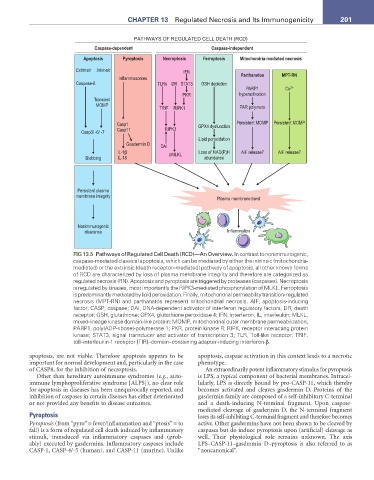
                         FIG 13.5  Pathways of Regulated Cell Death (RCD)—An Overview. In contrast to nonimmunogenic,
                         caspase-mediated classical apoptosis, which can be mediated by either the intrinsic (mitochondria-
                         mediated) or the extrinsic (death receptor–mediated) pathway of apoptosis, all other known forms
                         of RCD are characterized by loss of plasma membrane integrity and therefore are categorized as
                         regulated necrosis (RN). Apoptosis and pyroptosis are triggered by proteases (caspases). Necroptosis
                         is regulated by kinases, most importantly the RIPK3-mediated phosphorylation of MLKL. Ferroptosis
                         is predominantly mediated by lipid peroxidation. Finally, mitochondrial permeability transition- regulated
                         necrosis (MPT-RN) and parthanatos represent mitochondrial necrosis. AIF, apoptosis-inducing
                         factor; CASP, caspase; DAI, DNA-dependent activator of interferon regulatory factors; DR, death
                         receptor; GSH, glutathione; GPX4, glutathione peroxidase 4; IFN, interferon; IL, interleukin; MLKL,
                         mixed-lineage kinase domain-like protein; MOMP, mitochondrial outer membrane permeabilization;
                         PARP1, poly(ADP-ribose)-polymerase 1; PKR, protein kinase R; RIPK, receptor interacting protein
                         kinase; STAT3, signal transducer and activator of transcription 3; TLR, Toll-like receptor; TRIF,
                         toll–interleukin-1 receptor [TIR]–domain–containing adapter-inducing interferon-β.

           apoptosis,  are  not  viable.  Therefore  apoptosis  appears  to be   apoptosis, caspase activation in this context leads to a necrotic
           important for normal development and, particularly in the case   phenotype.
           of CASP8, for the inhibition of necroptosis.             An extraordinarily potent inflammatory stimulus for pyroptosis
             Other than hereditary autoimmune syndromes (e.g., auto-  is LPS, a typical component of bacterial membranes. Intracel-
           immune lymphoproliferative syndrome [ALPS]), no clear role   lularly, LPS is directly bound by pro-CASP-11, which thereby
           for apoptosis in diseases has been unequivocally reported, and   becomes activated and cleaves gasdermin D. Proteins of the
           inhibition of caspases in certain diseases has either deteriorated   gasdermin family are composed of a self-inhibitory C-terminal
           or not provided any benefits to disease outcomes.      and a death-inducing N-terminal fragment. Upon caspase-
                                                                  mediated cleavage of gasdermin D, the N-terminal fragment
           Pyroptosis                                             loses its self-inhibiting C-terminal fragment and therefore becomes
           Pyroptosis (from “pyro” = fever/inflammation and “ptosis” = to   active. Other gasdermins have not been shown to be cleaved by
           fall) is a form of regulated cell death induced by inflammatory   caspases but do induce pyroptosis upon (artificial) cleavage as
           stimuli, transduced via inflammatory caspases and (prob-  well. Their physiological role remains unknown. The axis
           ably) executed by gasdermins. Inflammatory caspases include   LPS–CASP-11–gasdermin D–pyroptosis is also referred to as
           CASP-1, CASP-4/-5 (human), and CASP-11 (murine). Unlike   “noncanonical”.

