


Page 218 - Clinical Immunology_ Principles and Practice ( PDFDrive )
P. 218
13


                                  Regulated Necrosis and Its Immunogenicity


                                                                                Wulf Tonnus, Andreas Linkermann


           For more than a century and a half, we have known that the    KEY CONCEPTS
           process of regulated cell death (RCD) is an integral part of life.
           The first insights into the mechanisms underlying RCD came   Necroinflammation—An Autoamplificatory
                                                    1
           from the identification of apoptotic pathways in 1972.  For almost   Feed-Forward Loop
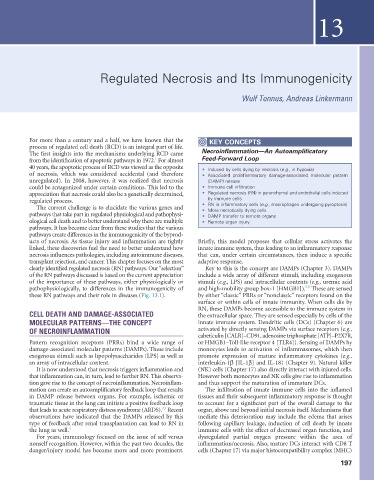
           40 years, the apoptotic process of RCD was viewed as the opposite   •  Induced by cells dying by necrosis (e.g., in hypoxia)
           of necrosis, which was considered accidental  (and therefore   •  Associated proinflammatory damage-associated molecular pattern
           unregulated). In 2008, however, it was realized that necrosis    (DAMP) release
           could be antagonized under certain conditions. This led to the   •  Immune cell infiltration
           appreciation that necrosis could also be a genetically determined,   •  Regulated necrosis (RN) in parenchymal and endothelial cells induced
           regulated process.                                        by immune cells
             The current challenge is to elucidate the various genes and   •  RN in inflammatory cells (e.g., macrophages undergoing pyroptosis)
                                                                   •  More necrotically dying cells
           pathways that take part in regulated physiological and pathophysi-  •  DAMP transfer to remote organs
           ological cell death and to better understand why there are multiple   •  Remote organ injury
           pathways. It has become clear from these studies that the various
           pathways create differences in the immunogenicity of the byprod-
           ucts of necrosis. As tissue injury and inflammation are tightly   Briefly, this model proposes that cellular stress activates the
           linked, these discoveries fuel the need to better understand how   innate immune system, thus leading to an inflammatory response
           necrosis influences pathologies, including autoimmune diseases,   that can, under certain circumstances, then induce a specific
           transplant rejection, and cancer. This chapter focuses on the most   adaptive response.
           clearly identified regulated necrosis (RN) pathways. Our “selection”   Key to this is the concept are DAMPs (Chapter 3). DAMPs
           of the RN pathways discussed is based on the current appreciation   include a wide array of different stimuli, including exogenous
           of the importance of these pathways, either physiologically or   stimuli (e.g., LPS) and intracellular contents (e.g., uremic acid
                                                                                                     5,6
           pathophysiologically,  to  differences  in the  immunogenicity  of   and high-mobility group box-1 [HMGB1]).  These are sensed
           these RN pathways and their role in diseases (Fig. 13.1).  by either “classic” PRRs or “nonclassic” receptors found on the
                                                                  surface or within cells of innate immunity. When cells die by
                                                                  RN, these DAMPs become accessible to the immune system in
           CELL DEATH AND DAMAGE-ASSOCIATED                       the extracellular space. They are sensed especially by cells of the
           MOLECULAR PATTERNS—THE CONCEPT                         innate immune system. Dendritic cells (DCs) (Chapter 6) are
           OF NECROINFLAMMATION                                   activated by directly sensing DAMPs via surface receptors (e.g.,
                                                                  calreticulin [CALR]–CD91, adenosine triphosphate [ATP]–P2X7R,
           Pattern recognition receptors (PRRs) bind a wide range of   or HMGB1–Toll-like receptor 4 [TLR4]). Sensing of DAMPs by
           damage-associated molecular patterns (DAMPs). These include   monocytes leads to activation of inflammasomes, which then
           exogenous stimuli such as lipopolysaccharides (LPS) as well as   promote expression of mature inflammatory cytokines (e.g.,
           an array of intracellular content.                     interleukin-1β [IL-1β] and IL-18) (Chapter 9). Natural killer
             It is now understood that necrosis triggers inflammation and   (NK) cells (Chapter 17) also directly interact with injured cells.
           that inflammation can, in turn, lead to further RN. This observa-  However both monocytes and NK cells give rise to inflammation
           tion gave rise to the concept of necroinflammation. Necroinflam-  and thus support the maturation of immature DCs.
           mation can create an autoamplificatory feedback loop that results   The infiltration of innate immune cells into the inflamed
           in  DAMP  release  between  organs.  For  example,  ischemic  or   tissues and their subsequent inflammatory response is thought
           traumatic tissue in the lung can initiate a positive feedback loop   to account for a significant part of the overall damage to the
                                                      2,3
           that leads to acute respiratory distress syndrome (ARDS).  Recent   organ, above and beyond initial necrosis itself. Mechanisms that
           observations have indicated that the DAMPs released by this   mediate this deterioration may include the edema that arises
           type of feedback after renal transplantation can lead to RN in   following capillary leakage, induction of cell death by innate
           the lung as well. 4                                    immune cells with the effect of decreased organ function, and
             For years, immunology focused on the issue of self versus   dysregulated partial oxygen pressure within the area of
           nonself recognition. However, within the past two decades, the   inflammation/necrosis. Also, mature DCs interact with CD8 T
           danger/injury model has become more and more prominent.   cells (Chapter 17) via major histocompatibility complex (MHC)

                                                                                                                197

