


Page 223 - Clinical Immunology_ Principles and Practice ( PDFDrive )
P. 223
202          ParT ONE  Principles of Immune Response


           The canonical pathway is initiated by inflammasomes as         Virus    Bacteria/ DAMPs  TNFα
        NLRP3 (Chapter 3), which forms upon stimuli that include
        pathogen-associated molecular patterns (PAMPs), DAMPs, and         DAI        TLR3/4       TNFR1
        absent in melanoma-2 (AIM2) as a response to cytosolic DNA.
        These inflammasomes recruit CASP-1 via adapter molecule ASC                    TRIF        RIPK1
        (apoptosis-associated speck-like protein containing a C-terminal
        caspase recruitment domain) and lead to gasdermin D cleavage
        and IL-1β/IL-18 maturation.                                       RIPK3        RIPK3       pRIPK3
           As both the noncanonical and canonical pathways lead to
        necrotic cell death, the question about its mechanism arose. It
        is clear that proinflammatory cytokines pro-IL-1β and pro-IL-18   pMLKL       pMLKL        pMLKL
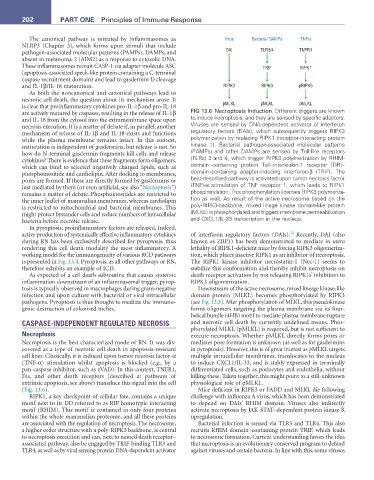
        are actively matured by caspases, resulting in the release of IL-1β   FIG 13.6  Necroptosis Induction. Different triggers are known
        and IL-18 from the cytosol into the extramembrane space upon   to induce necroptosis, and they are sensed by specific adaptors.
        necrosis execution. It is a matter of debate if, in parallel, another   Viruses are sensed by DNA-dependent activator of interferon
        mechanism of release of IL-1β and IL-18 exists and functions   regulatory factors (DAIs), which subsequently triggers RIPK3
        while the plasma membrane remains intact. In this context,   polymerization by replacing RIPK1 (receptor-interacting protein
        maturation is independent of gasdermins, but release is not. So   kinase 1). Bacterial pathogen-associated molecular patterns
        how do N-terminal gasdermin fragments kill cells and release   (PAMPs) and other DAMPs are sensed by Toll-like receptors
        cytokines? There is evidence that these fragments form oligomers,   (TLRs) 3 and 4, which trigger RIPK3 polymerization by RHIM-
        which can bind to selected negatively charged lipids, such as   domain containing protein Toll–interleukin-1 receptor [TIR]–
        phosphoinositide and cardiolipin. After docking to membranes,   domain–containing adapter-inducing interferon-β (TRIF). The
        pores are formed. If these are directly formed by gasdermins or   best-described pathway is activated upon tumor necrosis factor
        just mediated by them (or even artificial, see also “Necroptosis”)   (TNF)-α  stimulation  of  TNF  receptor  1,  which  leads  to  RIPK1
        remains a matter of debate. Phosphoinositides are restricted to   phosphorylation. This phosphorylation licenses RIPK3 polymeriza-
        the inner leaflet of mammalian membranes, whereas cardiolipin   tion as well. As result of the active necrosome based on the
        is restricted to mitochondrial and bacterial membranes. This   poly-RIPK3-backbone, mixed linage kinase domain-like protein
        might protect bystander cells and reduce numbers of intracellular   (MLKL) is phosphorylated and triggers membrane permeabilization
        bacteria before necrotic release.                      and CXCL1/IL-33 transcription in the nucleus.
           In pyroptosis, proinflammatory factors are released. Indeed,
                                                                                                12
        active production of systemically effective inflammatory cytokines   of interferon regulatory factors (DAIs).  Recently, DAI (also
        during RN has been exclusively described for pyroptosis, thus   known  as ZBP1) has  been demonstrated  to mediate  in utero
        rendering this cell death modality the most inflammatory. A   lethality of RIPK1-deficient mice by forcing RIPK3 oligomeriza-
        working model for the immunogenicity of various RCD pathways   tion, which places inactive RIPK1 as an inhibitor of necroptosis.
        is presented in Fig. 13.4. Pyroptosis, as all other pathways or RN,   The  RIPK1  kinase  inhibitor  necrostatin-1  (Nec-1)  seems  to
        therefore exhibits an example of ICD.                  stabilize this conformation and thereby inhibit necroptosis on
           As expected of a cell death subroutine that causes systemic   death receptor activation by not releasing RIPK1s’ inhibition to
        inflammation downstream of an inflammasomal trigger, pyrop-  RIPK3 oligomerization.
        tosis is typically observed in macrophages during gram-negative   Downstream of the active necrosome, mixed lineage kinase-like
        infection and upon culture with bacterial or viral intracellular   domain protein (MLKL) becomes phosphorylated by RIPK3
        pathogens. Pyroptosis is thus thought to mediate the immuno-  (see Fig. 13.5). After phosphorylation of MLKL, this pseudokinase
        genic destruction of colonized niches.                 forms oligomers targeting the plasma membrane via its four-
                                                               helical bundle (4HB) motif to mediate plasma membrane rupture
        CASPASE-INDEPENDENT REGULATED NECROSIS                 and necrotic cell death by currently undefined means. Phos-
                                                               phorylated MLKL (pMLKL) is required, but is not sufficient to
        Necroptosis                                            execute necroptosis. Whether pMLKL directly forms pores or
        Necroptosis is the best characterized mode of RN. It was dis-  mediates pore formation is unknown (as well as for gasdermins
        covered as a type of necrotic cell death in apoptosis-resistant   in pyroptosis). However, this is of great interest as pMLKL targets
        cell lines. Classically, it is induced upon tumor necrosis factor-α   multiple intracellular membranes, translocates to the nucleus
        (TNF-α)  stimulation  whilst apoptosis is  blocked (e.g.,  by a   to induce CXCL1/IL-33, and is stably expressed in terminally
        pan-caspase inhibitor, such as zVAD). In this context, TNFR1,   differentiated cells, such as podocytes and endothelia, without
        Fas, and other death receptors (described at pathways of     killing these. Taken together, this might point to a still-unknown
        extrinsic apoptosis, see above) transduce this signal into the cell   physiological role of pMLKL.
        (Fig. 13.6).                                              Mice deficient in RIPK3 or FADD and MLKL die following
           RIPK1, a key checkpoint of cellular fate, contains a unique   challenge with influenza A virus, which has been demonstrated
        motif next to its DD referred to as RIP homotypic interacting   to depend on DAIs’ RHIM domain.  Viruses also indirectly
        motif (RHIM). This motif is contained in only four proteins   activate necroptosis by JAK-STAT–dependent protein kinase R
        within the whole mammalian proteome, and all these proteins   upregulation.
        are associated with the regulation of necroptosis. The necrosome,   Bacterial infection is sensed via TLR3 and TLR4. This also
        a higher order structure with a poly-RIPK3 backbone, is central   recruits RHIM domain–containing protein TRIF, which leads
        to necroptosis execution and can, next to named death receptor–  to necrosome formation. Current understanding favors the idea
        associated pathway, also be engaged by TRIF-binding TLR3 and   that necroptosis is an evolutionary conserved program to defend
        TLR4, as well as by viral sensing protein DNA-dependent activator   against viruses and certain bacteria. In line with this, some viruses

