


Page 29 - Clinical Immunology_ Principles and Practice ( PDFDrive )
P. 29
CHaPter 1  The Human Immune Response                     15


           intracellular bacteria, and tumor cells. These responses involve
           the production of inflammatory cytokines by CD4 Th1 cells, as
           well as the direct cytolytic activity of CD8 CTLs. In contrast,
           host defenses to most antigens encountered primarily in the
           extracellular milieu are largely dependent on humoral mechanisms
           (antibody and complement) for antigen neutralization, precipita-
           tion, or opsonization and subsequent destruction by phagocytes.
           Targets of antibody-mediated immunity include extracellular
           virus particles, bacteria, and toxins (or other foreign proteins).
           It is worth reiterating, however, that induction of an effective
           antibody response (including isotype switching) and development
           of immunological memory (resulting from B-cell clonal expansion
           and B memory cell differentiation) require antigen activation
           not only of specific B cells but also CD4 T cells, particularly of
           the Th2 type. Additionally, antibacterial and antifungal responses
           that involve prominent responses by neutrophils require CD4
           T cells of the Th17 type.

               KeY ConCePtS
            Characteristic Infections Associated With Immune
            Deficiency Syndromes
            Deficiencies of t Cell–Mediated Immunity
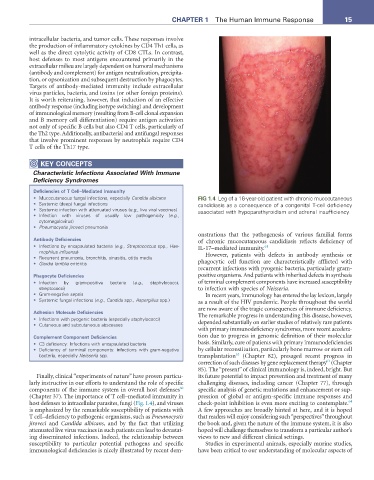
            •  Mucocutaneous fungal infections, especially Candida albicans  FIG 1.4  Leg of a 16-year-old patient with chronic mucocutaneous
            •  Systemic (deep) fungal infections                  candidiasis as a consequence of a congenital T-cell deficiency
            •  Systemic infection with attenuated viruses (e.g., live viral vaccines)  associated with hypoparathyroidism and adrenal insufficiency.
            •  Infection with viruses of usually low pathogenicity (e.g.,
              cytomegalovirus)
            •  Pneumocystis jiroveci pneumonia
                                                                  onstrations that the pathogenesis of various familial  forms
            antibody Deficiencies                                 of chronic mucocutaneous candidiasis reflects deficiency of
            •  Infections by encapsulated bacteria (e.g., Streptococcus spp., Hae-  IL-17–mediated immunity. 61
              mophilus influenza)
            •  Recurrent pneumonia, bronchitis, sinusitis, otitis media  However, patients with defects in antibody synthesis or
            •  Giardia lamblia enteritis                          phagocytic cell  function  are characteristically  afflicted with
                                                                  recurrent infections with pyogenic bacteria, particularly gram-
            Phagocyte Deficiencies                                positive organisms. And patients with inherited defects in synthesis
            •  Infection  by  gram-positive  bacteria  (e.g.,  staphylococci,  of terminal complement components have increased susceptibility
              streptococci)                                       to infection with species of Neisseria.
            •  Gram-negative sepsis                                 In recent years, immunology has entered the lay lexicon, largely
            •  Systemic fungal infections (e.g., Candida spp., Aspergillus spp.)  as a result of the HIV pandemic. People throughout the world
                                                                  are now aware of the tragic consequences of immune deficiency.
            adhesion Molecule Deficiencies                        The remarkable progress in understanding this disease, however,
            •  Infections with pyogenic bacteria (especially staphylococci)
            •  Cutaneous and subcutaneous abscesses               depended substantially on earlier studies of relatively rare patients
                                                                  with primary immunodeficiency syndromes, more recent accelera-
            Complement Component Deficiencies                     tion due to progress in genomic definition of their molecular
            •  C3 deficiency: Infections with encapsulated bacteria  basis. Similarly, cure of patients with primary immunodeficiencies
            •  Deficiency of terminal components: infections with gram-negative   by cellular reconstitution, particularly bone marrow or stem cell
              bacteria, especially Neisseria spp.                 transplantation  (Chapter 82), presaged recent progress in
                                                                              62
                                                                                                            63
                                                                  correction of such diseases by gene replacement therapy  (Chapter
                                                                  85). The “present” of clinical immunology is, indeed, bright. But
             Finally, clinical “experiments of nature” have proven particu-  its future potential to impact prevention and treatment of many
           larly instructive in our efforts to understand the role of specific   challenging diseases, including cancer (Chapter 77), through
                                                            60
           components of the immune system in overall host defenses    specific analysis of genetic mutations and enhancement or sup-
           (Chapter 37). The importance of T cell–mediated immunity in   pression of global or antigen-specific immune responses and
                                                                                                                   64
           host defenses to intracellular parasites, fungi (Fig. 1.4), and viruses   check-point inhibition is even more exciting to contemplate.
           is emphasized by the remarkable susceptibility of patients with   A few approaches are broadly hinted at here, and it is hoped
           T cell–deficiency to pathogenic organisms, such as Pneumocystis   that readers will enjoy considering such “perspectives” throughout
           jiroveci and  Candida albicans, and by the fact that utilizing   the book and, given the nature of the immune system, it is also
           attenuated live virus vaccines in such patients can lead to devastat-  hoped will challenge themselves to transform a particular author’s
           ing disseminated infections. Indeed, the relationship between   views to new and different clinical settings.
           susceptibility to particular potential pathogens and specific   Studies in experimental animals, especially murine studies,
           immunological deficiencies is nicely illustrated by recent dem-  have been critical to our understanding of molecular aspects of

