


Page 259 - Clinical Immunology_ Principles and Practice ( PDFDrive )
P. 259
240          PArT TwO  Host Defense Mechanisms and Inflammation


         TABLE 16.2  T-Cell Effector responses to                                 Th1   NK
         Selected Pathogens
                                                                                       IFNγ
          Organism            Nature of the Immune response             TLR
                                                                                 DC            Stat 1, 4
          Bacteria                                                                   Tcell      Tbet      Th1
          Borrelia burgdorferi  T-helper (Th1) responses associated                        IL-4  Hlx
                                with protection and joint pathology             IL-12, IL-18
          Chlamydia trachomatis  Th1 responses protective and source   A        IL-23, IL-27  Th2
                                of pathology
          Helicobacter pylori  Th1 responses involved in ulcer
                                formation
          Legionella pneumophila  Th1 responses associated with
                                immunity                                          Th2         Mast cell
          Listeria monocytogenes  Th1 responses are protective:
                                interferon (IFN)-γ from γδ T cells and                    IL-4
                                CD8 T cells is important                         DC
                                                                                                Stat 6
          Mycobacterium leprae  Severity and phenotype of disease                              GATA 3     Th2
                                depends on Th1 and Th2                            ?         IFNγ
                                predominance                                         Naive
          Mycobacterium tuberculosis  Th1 responses control infection  B             Cell  Th1
          Treponema pallidum  Th1 resolves infection; Th2 chronic
          Yersinia pestis     Th1 and Th17 responses associated
                                with immunity
          Fungi                                                                     TGFβ
                                                                                     IL-6
          Aspergillus fumigatus  Th2 production predominates; does           DC
                                Th1 offer protection?                                           RORγt      Th17
          Blastomyces dermatitidis  Th1 protects; Th2 switch in progressive   IL-23  Naive  IFNγ  IL-4
                                disease                            C             Cell  Th1  Th2
          Candida albicans    Th17 responses are protective
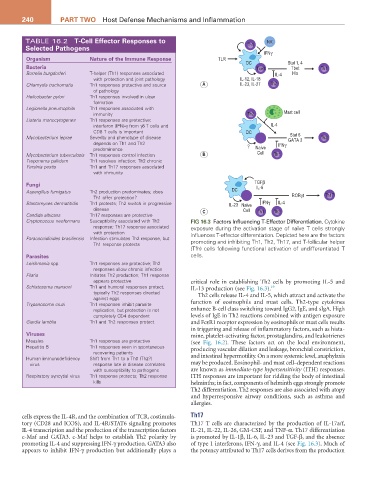
          Cryptococcus neoformans  Susceptibility associated with Th2   FIG 16.3  Factors Influencing T-Effector Differentiation. Cytokine
                                response; Th17 response associated   exposure during the activation stage of naïve T cells strongly
                                with protection                influences T-effector differentiation. Depicted here are the factors
          Paracoccidioides brasiliensis  Infection stimulates Th2 response, but   promoting and inhibiting Th1, Th2, Th17, and T-follicular helper
                                Th1 response protects
                                                               (Tfh) cells following functional activation of undifferentiated T
          Parasites                                            cells.
          Leishmania spp.     Th1 responses are protective; Th2
                                responses allow chronic infection
          Filaria             Initiates Th2 production; Th1 response
                                appears protective             critical role in establishing Th2 cells by promoting IL-5 and
          Schistosoma mansoni  Th1 and humoral responses protect;   IL-13 production (see Fig. 16.3). 19
                                typically Th2 responses directed   Th2 cells release IL-4 and IL-5, which attract and activate the
                                against eggs
          Trypanosoma cruzi   Th1 responses inhibit parasite   function of eosinophils and mast cells. Th2-type cytokines
                                replication, but protection is not   enhance B-cell class switching toward IgG2, IgE, and sIgA. High
                                completely CD4 dependent       levels of IgE in Th2 reactions combined with antigen exposure
          Giardia lamblia     Th1 and Th2 responses protect    and FcεR1 receptor expression by eosinophils or mast cells results
                                                               in triggering and release of inflammatory factors, such as hista-
          Viruses                                              mine, platelet-activating factor, prostaglandins, and leukotrienes
          Measles             Th1 responses are protective     (see  Fig. 16.2). These  factors act on the local  environment,
          Hepatitis B         Th1 responses seen in spontaneous   producing vascular dilation and leakage, bronchial constriction,
                                recovering patients
          Human immunodeficiency   Shift from Th1 to a Th0 (Th2?)   and intestinal hypermotility. On a more systemic level, anaphylaxis
           virus                response late in disease correlates   may be produced. Eosinophil- and mast cell–dependent reactions
                                with susceptibility to pathogens  are known as immediate-type hypersensitivity (ITH) responses.
          Respiratory syncytial virus  Th1 response protects; Th2 response   ITH responses are important for ridding the body of intestinal
                                kills                          helminths; in fact, components of helminth eggs strongly promote
                                                               Th2 differentiation. Th2 responses are also associated with atopy
                                                               and hyperresponsive airway conditions, such as asthma and
                                                               allergies.
        cells express the IL-4R, and the combination of TCR, costimula-  Th17
        tory (CD28 and ICOS), and IL-4R/STAT6 signaling promotes   Th17 T cells are characterized by the production of IL-17a/f,
        IL-4 transcription and the production of the transcription factors   IL-21, IL-22, IL-26, GM-CSF, and TNF-α. Th17 differentiation
        c-Maf and  GATA3. c-Maf helps  to establish Th2  polarity by   is promoted by IL-1β, IL-6, IL-23 and TGF-β, and the absence
        promoting IL-4 and suppressing IFN-γ production. GATA3 also   of type 1 interferons, IFN-γ, and IL-4 (see Fig. 16.3). Much of
        appears to inhibit IFN-γ production but additionally plays a   the potency attributed to Th17 cells derives from the production

