


Page 262 - Clinical Immunology_ Principles and Practice ( PDFDrive )
P. 262
CHAPTEr 16  Helper T-Cell Subsets and Control of the Inflammatory Response                 243


           phenotypes are maintained through active signaling and chro-  TERMINATION OF T-CELL RESPONSES
           mosomal modification.
             Third, polarization is incomplete at the population level.
           Following exposure to antigen, responding T cells may collectively    CLINICAL rELEVANCE
           possess multiple phenotypes. Heterogeneity of Th phenotypes   Diseases Associated With CD4
           is a common feature of some diseases, such as asthma, where   T-Effector Responses
           Th2, Th9, and Th17 responses are thought to contribute to disease;
           in psoriasis, where Th1, Th17, and Th22 cell types are detectable;   Th1
           and in multiple sclerosis, where Th1, Th17, and Th22 cells are   •  Multiple sclerosis
           thought to mediate inflammation. A portion of the T cells may   •  Psoriasis
                                                                   •  Type 1 diabetes mellitus
           persist in a naïve phenotype or as uncommitted T cm  or T scm  that   •  Tuberculoid leprosy
           may give rise to T cells of a different phenotype upon antigen   •  Transplant rejection
           reexposure.
             Fourth, there is limited plasticity in T-cell effector phenotypes.   Th2
           Effector phenotypes are reinforced by “master” transcription   •  Allergy and asthma
           factors and epigenetic modifications (Fig. 16.4). For example,   •  Helminthic infections
           established Th1 cells do not express Th2 cytokines despite   •  Lepromatous leprosy
           extended culture in Th2-skewing conditions. There is, however,   Th9
           growing evidence of interconversion between certain T-helper   •  Asthma
                 32
           subsets.  Experiments tracing T-cell lineage commitment have   •  Helminthic infections
           shown  that T cells that  once  expressed FoxP3 could become
           effector cells. It is not clear if plasticity is occurs between all   Th17
           phenotypes or if phenotype conversion can occur at any stages   •  Asthma
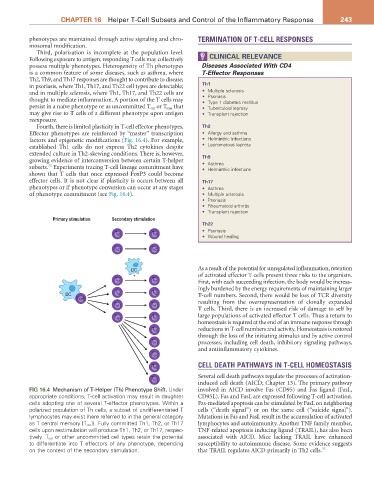
           of phenotype commitment (see Fig. 16.4).                •  Multiple sclerosis
                                                                   •  Psoriasis
                                                                   •  Rheumatoid arthritis
                                                                   •  Transplant rejection
                  Primary stimulation  Secondary stimulation
                                                                   Th22
                                       T h9        T h9            •  Psoriasis
                                                                   •  Wound healing
                                      T h22       T h22


                                            DC                    As a result of the potential for unregulated inflammation, retention
                                             +                    of activated effector T cells present three risks to the organism.
                                       T h1        T h1           First, with each succeeding infection, the body would be increas-
                                                                  ingly burdened by the energy requirements of maintaining larger
                      DC               T h2        T h2           T-cell numbers. Second, there would be loss of TCR diversity
                          Tcell

                                      T h17       T h17           resulting  from  the  overrepresentation  of  clonally expanded
                                                                  T cells. Third, there is an increased risk of damage to self by
                                       T cm        T h1           large populations of activated effector T cells. Thus a return to
                                                                  homeostasis is required at the end of an immune response through
                                                   T h2           reductions in T-cell numbers and activity. Homeostasis is restored
                                                                  through the loss of the initiating stimulus and by active control
                                                  T h17           processes, including cell death, inhibitory signaling pathways,
                                                                  and antiinflammatory cytokines.
                                                   T cm
                                                   T h9           CELL DEATH PATHWAYS IN T-CELL HOMEOSTASIS
                                                  T h22           Several cell death pathways regulate the processes of activation-
                                                                  induced cell death (AICD; Chapter 13). The primary pathway
           FIG 16.4  Mechanism of T-Helper (Th) Phenotype Shift. Under   involved in  AICD involve Fas (CD95) and Fas ligand (FasL,
           appropriate conditions, T-cell activation may result in daughter   CD95L). Fas and FasL are expressed following T-cell activation.
           cells adopting one of several T-effector phenotypes. Within a   Fas-mediated apoptosis can be stimulated by FasL on neighboring
           polarized population of Th cells, a subset of undifferentiated T   cells (“death signal”) or on the same cell (“suicide signal”).
           lymphocytes may exist (here referred to in the general category   Mutations in Fas and FasL result in the accumulation of activated
           as T central memory [T cm]). Fully committed Th1, Th2, or Th17   lymphocytes and autoimmunity. Another TNF family member,
           cells upon restimulation will produce Th1, Th2, or Th17, respec-  TNF-related apoptosis inducing ligand (TRAIL), has also been
           tively. T cm or other uncommitted cell types retain the potential   associated with  AICD. Mice lacking TRAIL have enhanced
           to differentiate into T effectors of any phenotype, depending   susceptibility to autoimmune disease. Some evidence suggests
           on the context of the secondary stimulation.           that TRAIL regulates AICD primarily in Th2 cells. 33

