


Page 260 - Clinical Immunology_ Principles and Practice ( PDFDrive )
P. 260
CHAPTEr 16  Helper T-Cell Subsets and Control of the Inflammatory Response                 241


           of IL-17 and GM-CSF. IL-17, together with TNF-α, strongly   cells may play roles in regulating inflammation in other epithelial
           promotes inflammation by inducing the expression of adhesion   tissues.
           molecules, proinflammatory cytokines (including IL-6, GM-CSF,
           granulocyte–colony-stimulating factor [G-CSF]), chemokines,
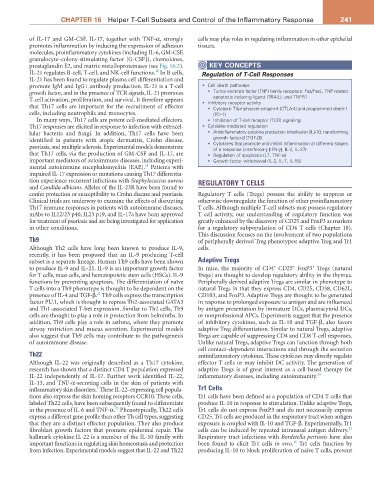
           prostaglandin E2, and matrix metalloproteinases (see Fig. 16.2).    KEY CONCEPTS
                                                    20
           IL-21 regulates B-cell, T-cell, and NK-cell functions.  In B cells,   Regulation of T-Cell Responses
           IL-21 has been found to regulate plasma cell differentiation and
           promote IgM and IgG1 antibody production. IL-21 is a T-cell   •  Cell death pathways
           growth factor, and in the presence of TCR signals, IL-21 promotes   •  Tumor necrosis factor (TNF) family receptors: Fas/FasL, TNF-related
                                                                       apoptosis inducing ligand (TRAIL), and TNFR1
           T-cell activation, proliferation, and survival. It therefore appears   •  Inhibitory receptor activity
           that Th17 cells are important for the recruitment of effector   •  Cytotoxic T lymphocyte antigen-4 (CTLA-4) and programmed death-1
           cells, including neutrophils and monocytes.                 (PD-1)
             In many ways, Th17 cells are potent cell-mediated effectors.   •  Inhibition of T-cell receptor (TCR) signaling
           Th17 responses are elicited in response to infection with extracel-  •  Cytokine-mediated regulation
           lular bacteria and fungi. In addition, Th17 cells have been   •  Antiinflammatory cytokine production (interleukin [IL]-10, transforming
           identified in patients with atopic dermatitis, Crohn disease,   growth factor-β [TGF-β])
           psoriasis, and multiple sclerosis. Experimental models demonstrate   •  Cytokines that promote and inhibit inflammation at different stages
                                                                       of a response (interferon-γ [IFN-γ], IL-2, IL-27)
           that Th17 cells, via the production of GM-CSF and IL-17, are   •  Regulation of apoptosis (LT, TNF-α)
           important mediators of autoimmune diseases, including experi-  •  Growth factor withdrawal (IL-2, IL-7, IL-15)
                                                21
           mental autoimmune encephalomyelitis (EAE).  Patients with
           impaired IL-17 expression or mutations causing Th17 differentia-
           tion experience recurrent infections with Staphylococcus aureus   REGULATORY T CELLS
           and Candida albicans. Alleles of the IL-23R have been found to
           confer protection or susceptibility to Crohn disease and psoriasis.   Regulatory T cells (Tregs) possess the ability to suppress or
           Clinical trials are underway to examine the effects of disrupting   otherwise downregulate the function of other proinflammatory
           Th17 immune responses in patients with autoimmune diseases.   T cells. Although multiple T-cell subsets may possess regulatory
           mAbs to IL12/23 p40, IL23 p19, and IL-17a have been approved   T cell activity, our understanding of regulatory function was
           for treatment of psoriasis and are being investigated for application   greatly enhanced by the discovery of CD25 and FoxP3 as markers
           in other conditions.                                   for a regulatory subpopulation of CD4 T cells (Chapter 18).
                                                                  This discussion focuses on the involvement of two populations
           Th9                                                    of peripherally derived Treg phenotypes: adaptive Treg and Tr1
           Although Th2 cells have long been known to produce IL-9,   cells.
           recently,  it  has  been  proposed  that  an  IL-9  producing  T-cell
           subset is a separate lineage. Human Th9 cells have been shown   Adaptive Tregs
                                                                                           +
                                                                                                       +
                                                                                                 +
           to produce IL-9 and IL-21. IL-9 is an important growth factor   In mice, the majority of CD4  CD25  FoxP3  Tregs (natural
           for T cells, mast cells, and hematopoietic stem cells (HSCs). IL-9   Tregs) are thought to develop regulatory ability in the thymus.
           functions by preventing apoptosis. The differentiation of naïve   Peripherally derived adaptive Tregs are similar in phenotype to
           T cells into a Th9 phenotype is thought to be dependent on the   natural Tregs in that they express CD4, CD25, CD38, CD62L,
                                 22
           presence of IL-4 and TGF-β.  Th9 cells express the transcription   CD103, and FoxP3. Adaptive Tregs are thought to be generated
           factor PU.1, which is thought to repress Th2-associated GATA3   in response to prolonged exposure to antigen and are influenced
           and Th1-associated T-bet expression. Similar to Th2 cells, Th9   by antigen presentation by immature DCs, plasmacytoid DCs,
           cells are thought to play a role in protection from helminths. In   or nonprofessional APCs. Experiments suggest that the presence
           addition, Th9 cells play a role in asthma, where they promote   of inhibitory cytokines, such as IL-10 and TGF-β, also favors
           airway restriction and mucus secretion. Experimental models   adaptive Treg differentiation. Similar to natural Tregs, adaptive
           also suggest that Th9 cells may contribute to the pathogenesis   Tregs are capable of suppressing CD4 and CD8 T-cell responses.
           of autoimmune disease.                                 Unlike natural Tregs, adaptive Tregs can function through both
                                                                  cell contact–dependent interactions and through the secretion
           Th22                                                   antiinflammatory cytokines. These cytokines may directly regulate
           Although IL-22 was originally described as a Th17 cytokine,   effector T cells or may inhibit DC activity. The generation of
           research has shown that a distinct CD4 T population expressed   adaptive Tregs is of great interest as a cell-based therapy for
           IL-22 independently of IL-17. Further work identified IL-22,   inflammatory diseases, including autoimmunity. 24
           IL-13, and TNF-α-secreting cells in the skin of patients with
                                 3
           inflammatory skin disorders.  These IL-22–expressing cell popula-  Tr1 Cells
           tions also express the skin homing receptors CCR10. These cells,   Tr1 cells have been defined as a population of CD4 T cells that
           labeled Th22 cells, have been subsequently found to differentiate   produce IL-10 in response to stimulation. Unlike adaptive Tregs,
                                       23
           in the presence of IL-6 and TNF-α.  Phenotypically, Th22 cells   Tr1 cells do not express FoxP3 and do not necessarily express
           express a different gene profile than other Th cell types, suggesting   CD25. Tr1 cells are produced in the respiratory tract when antigen
           that they are a distinct effector population. They also produce   exposure is coupled with IL-10 and TGF-β. Experimentally, Tr1
                                                                                                                   25
           fibroblast growth factors that promote epidermal repair. The   cells can be induced by repeated intranasal antigen delivery.
           hallmark cytokine IL-22 is a member of the IL-10 family with   Respiratory tract infections with Bordetella pertussis have also
                                                                                                 26
           important functions in regulating skin homeostasis and protection   been found to elicit Tr1 cells  in vivo.  Tr1 cells function by
           from infection. Experimental models suggest that IL-22 and Th22   producing IL-10 to block proliferation of naïve T cells, prevent

