


Page 271 - Clinical Immunology_ Principles and Practice ( PDFDrive )
P. 271
252          PART TwO  Host Defense Mechanisms and Inflammation


                   Primary infection                             TABLE 17.2  Human and Mouse Natural
            10 4
                              1.2%                               Killer (NK) Cell Receptors (Partial List)

            10 3                                                             Species              Ligands
                                                                             (H, Human;
                                                                                                  (H, Human; M,
           NP tetramer  10 2                                     Receptor    M, Mouse)  Function  Mouse)
                                                                             H, M
                                                                                        Inhibitory
                                                                 LILRB1
                                                                                                  HLA-class I
            10 1                            NP tetramer +        KIR2DL1, 2, 3  H       Inhibitory  HLA-C
                                                                             H
                                                                 KIR2DL4
                                                                                                  HLA-G
                                                                                        Activating
                                                                 KIR2DL5     H          Inhibitory  ?
                                                  CD62L
            10 0                                                 KIR3DL1     H          Inhibitory  HLA-Bw4
              10 0  10 1  10 2  10 3  10 4                       KIR3DL2     H          Inhibitory  HLA-A3, A11
                                                                 KIR3DL3     H          Inhibitory  ?
                  Secondary infection
            10 4                                                 KIR2DS1, 2,   H        Activating  HLA-class I
                              23.7%                               3, 4, 5
                                                                 KIR3DS1     H          Activating  HLA-Bw4
            10 3                                                 CD94/NKG2A  H, M       Inhibitory  H; HLA-E
                                                                                                  M; Qa-1b
           NP tetramer  10 2                                     CD94/NKG2C,   H, M     Activating  H; HLA-E,
                                                                                                  M; Qa-1b
                                                                  E
                                                                                                  M; H60, MULT1,
            10 1                            NP tetramer –        NKG2D       H, M       Activating  H; MICA/B, ULBP1–4,
                                                  CD62L                                            RAE1
                                                                 CD16 (FcγRIII)  H, M   Activating  Immune complexes
            10 0                                                 CD27        H, M       Activating  CD70
              10 0  10 1  10 2  10 3  10 4
                                                                 CD244 (2B4)  H, M      Activating/  CD48
                                                                                         Inhibitory
            10 4                                                 Ly49A-C, E-G,   M      Inhibitory  MHC-class I
                                                                  I-O
                                                                 Ly49D       M          Activating  H-2D d
            10 3                                                 Ly49H       M          Activating  MCMV m157
                                                                                                     k
                                                                 Ly49P       M          Activating  H-2D /MCMV m04
           IFNγ  10 2                                            KLRG1       H, M       Inhibitory  E-, R-, N-cadherins
                                                                                        Inhibitory
                                                                 NKR-P1A
                                                                             H
                                                                                                  LLT1 (CLEC2D)
                                                                 NKR-P1A, B,   M        Activating/  Clr family
            10 1                                                  C, E, F                Inhibitory
                                                                 NKR-P1B, D  M          Inhibitory  Clr-b, Clr-g
                                                                 PILRα/PILRβ  M         Activating/  O-glycosylated CD99
            10 0
              10 0  10 1  10 2  10 3  10 4                                               Inhibitory
                       CD8                                       NKp46       H, M       Activating  Viral hemagglutinin,
                                                                                                   HSPG
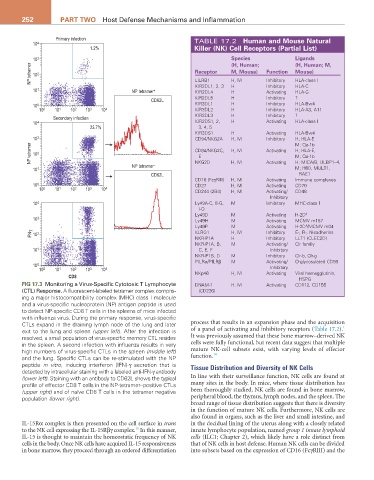
        FIG 17.3  Monitoring a Virus-Specific Cytotoxic T Lymphocyte   DNAM-1   H, M    Activating  CD112, CD155
        (CTL) Response. A fluorescent-labeled tetramer complex compris-  (CD226)
        ing a major histocompatibility complex (MHC) class I molecule
        and a virus-specific nucleoprotein (NP) antigen peptide is used
        to detect NP-specific CD8 T cells in the spleens of mice infected
        with influenza virus. During the primary response, virus-specific
        CTLs expand in the draining lymph node of the lung and later   process that results in an expansion phase and the acquisition
                                                                                                                 1
        exit to the lung and spleen (upper left). After the infection is   of a panel of activating and inhibitory receptors (Table 17.2).
        resolved, a small population of virus-specific memory CTL resides   It was previously assumed that these bone marrow–derived NK
        in the spleen. A second infection with influenza results in very   cells were fully functional, but recent data suggest that multiple
        high numbers of virus-specific CTLs in the spleen (middle left)   mature NK-cell subsets exist, with varying levels of effector
                                                                       14
        and the lung. Specific CTLs can be re-stimulated with the NP   function.
        peptide  in vitro, inducing interferon (IFN)-γ secretion that is   Tissue Distribution and Diversity of NK Cells
        detected by intracellular staining with a labeled anti-IFN-γ antibody
        (lower left). Staining with an antibody to CD62L shows the typical   In line with their surveillance function, NK cells are found at
        profile of effector CD8 T cells in the NP-tetramer–positive CTLs   many sites in the body. In mice, where tissue distribution has
        (upper right) and of naïve CD8 T cells in the tetramer negative   been thoroughly studied, NK cells are found in bone marrow,
        population (lower right).                              peripheral blood, the thymus, lymph nodes, and the spleen. The
                                                               broad range of tissue distribution suggests that there is diversity
                                                               in the function of mature NK cells. Furthermore, NK cells are
                                                               also found in organs, such as the liver and small intestine, and
        IL-15Rα complex is then presented on the cell surface in trans   in the decidual lining of the uterus along with a closely related
                                             15
        to the NK cell expressing the IL-15Rβγ complex.  In this manner,   innate lymphocyte population, named group 1 innate lymphoid
        IL-15 is thought to maintain the homeostatic frequency of NK   cells (ILC1; Chapter 2), which likely have a role distinct from
        cells in the body. Once NK cells have acquired IL-15 responsiveness   that of NK cells in host defense. Human NK cells can be divided
        in bone marrow, they proceed through an ordered differentiation   into subsets based on the expression of CD16 (FcγRIII) and the

